To listen to today’s reflection as a podcast, click here
Each day this month we’re looking closely at one of the 1:1 verses of the Bible – exploring what we can learn from chapter one / verse one of various Old and New Testament books.
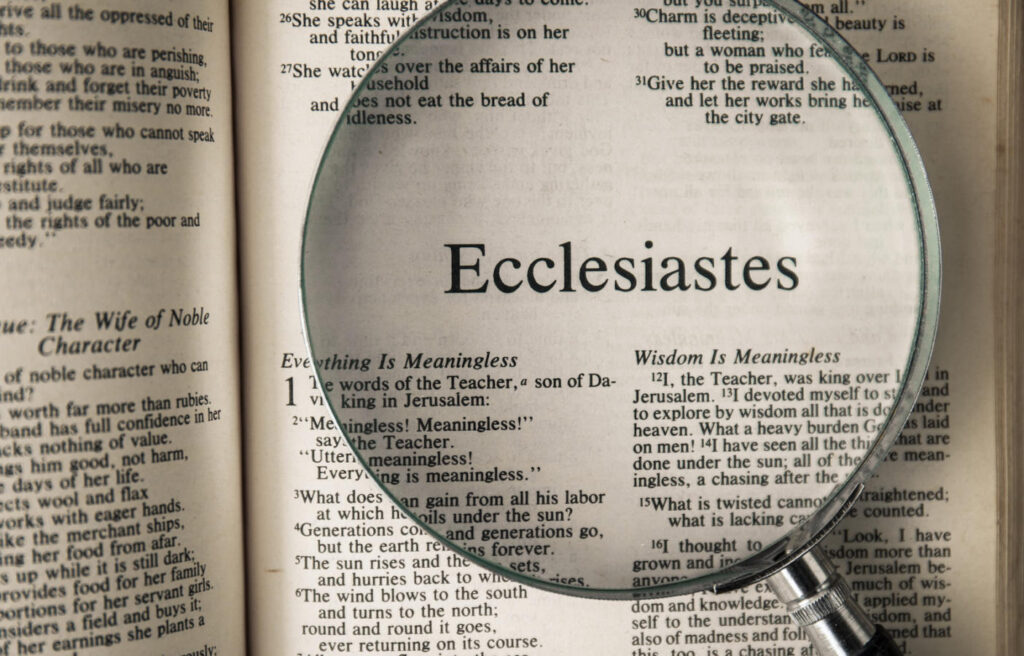
“Meaningless! Meaningless!’ says the Teacher. ‘Utterly meaningless! Everything is meaningless.’”
Yes, I know. That’s actually the second sentence of Ecclesiastes.
But it was clearly meant to be the jarring introduction to one of the Bible’s strangest books.
It packs a wallop for the simple reason that it doesn’t seem to align with “God loves you and has a wonderful plan for your life,” the first “law” of evangelist Bill Bright’s famous Four Spiritual Laws.
As we noted in our extended look at Ecclesiastes a few years ago, this book isn’t like anything else in Scripture. It’s probably the most misunderstood and maligned resident of either Testament.
Some commentators have described its tone as cynical and despairing. Rabbis spent centuries debating its inclusion in the Jewish Scriptures. Christian preachers have cast their votes for its importance primarily by ignoring it. It’s entirely possible to attend church services for 50 years and never hear a single sermon from a text in Ecclesiastes.
At the same time, Ecclesiastes is one of the most joyful books in the Bible. It identifies pleasure as one of God’s greatest gifts. The author unflinchingly declares, as he wraps things up, that nothing is more important than obeying God.
Ecclesiastes clearly deserves to be one of the five “wisdom” books of the Old Testament, which, taken together, constitute a whopping 15% of the Judeo-Christian Scriptures.
The author (traditionally thought to be Solomon) conducts what might be called the Royal Experiment: Is it possible to have everything in the world – fame, power, love, money, wisdom, and influence – only to make the dreadful discovery that everything that’s part of the so-called Good Life adds up to exactly Nothing?
That opening sentence seems to telegraph his despairing answer: Yes.
So we have to ask: If God’s people have good reasons for believing that every moment is shot through with meaning, and that death itself cannot rob us of our life with God and each other, why is there a book in the Bible that begins by declaring that everything is meaningless?
“Meaningless” represents the Hebrew word hebel, which appears 86 times in the Old Testament. Scholars have struggled to agree on a good one-word English translation. If you grew up reading the King James Version, you might remember the opening of Ecclesiastes as “Vanity of vanities, everything is vanity.” Other translators opt for “useless,” “smoke,” “mist,” or “mere breath.”
Everyone agrees that hebel is something that doesn’t last, or that doesn’t produce its intended result. It’s here today, gone tomorrow.
Hebel is something you can’t count on.
And that brings us to the very next verse, where we read the author’s exasperated protest: “What do people gain from all their labors at which they toil under the sun?”
Here the author isn’t making a comment about the physical challenges of plowing, harvesting, and bricklaying under the intense Palestinian sunshine, even though almost every task in the ancient Near East took place outdoors, and none of them were easy.
“Under the sun” is shorthand for this world – the visible world that is all around us, the one that we can access by means of our five senses. The writer of Ecclesiastes makes the case that if we look for the meaning of life in this world only, we will never find it.
If the quest for life’s meaning is like solving a jigsaw puzzle, then some of the pieces seem to be missing. And we don’t have the picture on the box to guide us, even though every religion worth its salt is shouting, “Here it is! This is what you’re looking for.” Ecclesiastes says that all of our eating, drinking, sleeping, working, loving, fighting, and hoping take place under the sun – in this world and this world alone.
And if all our answers for life’s biggest questions come from this world alone, they will turn out to be hebel. They will be meaningless, short-of-the-mark, as insubstantial as an early morning fog.
That may seem like an esoteric philosophical point that doesn’t have a whole lot to do with what you’re going to have for lunch.
But how your life turns out inevitably depends on where you choose to start – the so-called “first principles” that you choose to believe.
The hard-bitten American journalist and satirist H.L. Mencken (1880-1956) mocked people who fell for religious answers. He was fully content with atheism as a bedrock assumption. But his quest for a deeply satisfying this-world-only life came up empty. “The basic fact about human experience is not that it is a tragedy, but that it is a bore. It is not that it is predominantly painful, but that it is lacking in any sense.”
The author of Ecclesiastes would not have been surprised. He himself enthusiastically pursued the search for meaning under the sun, and also came up empty.
The reason Jewish rabbis and Christian preachers ultimately gave their thumbs-up to the inclusion of Ecclesiastes in the canon is the author’s bottom line, especially as spelled out in his last chapter: “Now all has been heard; here is the conclusion of the matter. Fear God and keep his commandments, for this is the duty of all mankind” (12:13).
Or, if you prefer a summary in six words: Outside of God, Everything is Meaningless
And what about us?
We can thank God that the sun will once again appear at tomorrow’s sunrise – and that “beyond the sun” there is indeed true Meaning waiting to be found.