To listen to today’s reflection as a podcast, click here
Each day this month we’re looking closely at one of the 1:1 verses of the Bible – exploring what we can learn from chapter one / verse one of various Old and New Testament books.
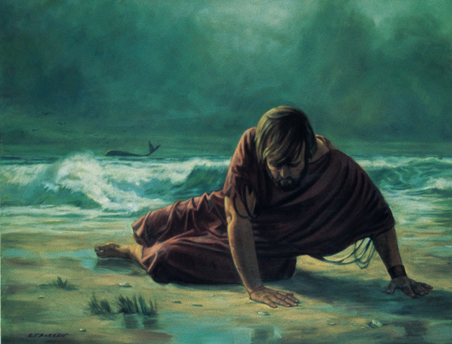
So, how did the prophet Jonah end up on a Mediterranean beach smelling like a tin of sardines?
It all began with a call from God that, in Jonah’s mind, was definitely not his dream job:
“‘Up on your feet and on your way to the big city of Nineveh! Preach to them. They’re in a bad way and I can’t ignore it any longer.’ But Jonah got up and went the other direction to Tarshish, running away from God. He went down to the port of Joppa and found a ship headed for Tarshish. He paid the fare and went on board, joining those going to Tarshish – as far away from God as he could get” (Jonah 1:1-3, The Message).
Nineveh, which was east of Israel, was the capital of Assyria, one of the ancient world’s evil empires. The Ninevites were decidedly lacking in people skills. After they annihilated an enemy city, Assyrian soldiers would typically leave behind a pyramid of human heads as a warning to their neighbors.
Jonah was so excited about the opportunity to preach to this stimulating crowd that he immediately headed in the opposite direction.
I have a friend who used to say that his fantasy, whenever he got the blues, was to buy a Winnebago and head for the beaches of southern California. Why those beaches? They happen to be about as far west as you can go behind the wheel of a Winnebago.
Jonah bought a one-way ticket to the farthest point west he could possibly imagine. At that time it was a place called Tarshish. In his book Under the Unpredictable Plant, Eugene Peterson points out that to this day nobody really knows the exact location of Tarshish. Presumably it was near Spain, perhaps Gibraltar. In Scripture the very name connoted magic, mystery, and escape.
King Solomon imported from Tarshish gold, silver, ivory, monkeys, and peacocks. In the popular imagination it became a synonym for paradise – a kind of prototypical Club Med. Going to Tarshish amounted to dropping off the face of the earth.
Perhaps God has also called you, in one way or another, to go east. But all you want to do right now is head west.
Perhaps you made a promise to be there for a life partner in sickness and in health, in joy and in sorrow, in plenty and in want. You just didn’t realize how hard it would be to love that person when actual sickness, sorrow, and want showed up.
Now you’re standing in line to buy a ticket to Tarshish, where you’ve heard that relationships are problem-free.
Maybe you feel overwhelmed caring for a needy friend or for aging parents. Perhaps you’re stuck in a job that’s breaking your spirit. Or you head home every day to a messed-up house and children who rarely speak words of gratitude.
Wouldn’t it be great to have a fulfilling mid-life crisis in a place like Tarshish?
But as the story of Jonah reveals, sailing west when God calls us to go east means heading into turbulence. As Tim Keller notes in his book The Prodigal Prophet, “The dismaying news is that every act of disobedience to God has a storm attached to it… The Bible does not say that every difficulty is the result of sin – but it does teach that every sin will bring you into difficulty.”
In Jonah’s case, the turbulence was quite literal. A violent storm overtook the boat on which he was making his escape.
So Jonah made a life-altering decision, seemingly on the basis of despair. He bailed on his trip to Tarshish. “Throw me off the ship,” he told the crew. They were terrified to do so. But Jonah assured them that his absence would definitely improve their sailing conditions.
He was right.
The prophet may have assumed that his life was now over. But as Jonah 1:17 tells us, “The Lord provided a huge fish to swallow Jonah.” God provided the fish. It wasn’t a punishment, but a lifeboat. Three days later the fish barfed him up on the shore – one of the really compelling Scripture texts for any kid who’s ever felt bored in Sunday School.
Keller notes that the storms that interrupt our lives (especially when we’re running away) can be very good things: “Storms can wake us up to truths we would otherwise never see. Storms can develop faith, hope, love, patience, humility and self-control in us that nothing else can.”
Best of all, they can stop us in our tracks and prompt us to make an exceedingly difficult choice that will put us back on God’s path:
Stop cheating. Refuse to believe the lies. Face your Nineveh. You’re not a victim. The running stops today.
Those may seem like radical steps. But Jonah showcased one of life’s key lessons:
It’s always safer to be treading water in God’s ocean than to be on a cruise ship heading in the wrong direction.