
To listen to today’s reflection as a podcast, click here
Each day this month we’re looking closely at one of the 1:1 verses of the Bible – exploring what we can learn from chapter one / verse one of various Old and New Testament books.
“In the beginning was the Word, and the Word was with God, and the Word was God.”
If you attend a presentation this week and the speaker begins by saying, with great solemnity, “We hold these truths to be self-evident,” you would have a few questions.
Such as, “Who does this guy think he is?” or “Doesn’t she know those words have already been used to great effect in a different context?” or “Did I accidentally stumble into a recitation of the Declaration of Independence?”
When John launches his Gospel with the words “In the beginning,” his original readers had no choice but to think, “This author apparently thinks he’s writing a new book of Genesis. Talk about pretentious!”
Generations of Bible readers, however, have concluded that John was being anything but pretentious. His explosive beginning is merely the kickoff to an 18-verse Prologue which declares his message and sets the tone for the 21 chapters to follow. More than a few Bible scholars have acknowledged that entering John’s Prologue is like stepping onto holy ground.
It all begins with the word “Word.”
Lest there be any confusion, the mysterious identity of the Word in John 1:1 is cleared up in John 1:14: “And the Word became flesh and dwelled among us.” Jesus is the word for God.
Words have the power to generate images, stir memories, and communicate ideas. Think of the English word “cup.” What came to your mind when you just saw (heard) those three letters in the combination C-U-P?
Perhaps you tightened your grip on the cup of coffee you’re holding right now. Or, as a diehard hockey fan, you immediately felt a surge of joy concerning Lord Stanley’s Cup – the only trophy that members of the championship team actually get to carry home. Perhaps you thought of that cup of broccoli cheddar soup you recently enjoyed at Panera. Or maybe Bible verses came to mind: Jesus pleading with his Father in the Garden of Gethsemane to “take this cup from me,” or David declaring in Psalm 23 that “my cup overflows.”
Because Jesus is the “word” for God, what we’re saying is that when we ponder the life and times of a carpenter’s son in the hamlet of Nazareth twenty centuries ago, we are peering directly into the character and identity of God.
To put it simply, when God wants to tell us about himself, he speaks through his Son.
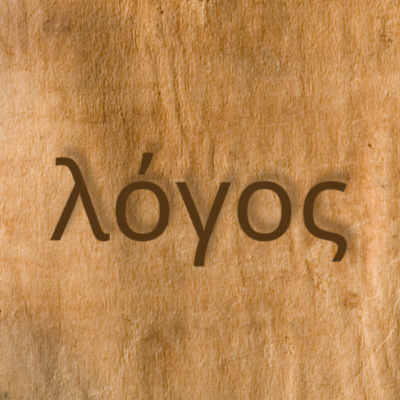
And that’s just the beginning of the significance of the word for “word” (which is logos in Greek).
Logos was widely used in the world of classical antiquity and took on a vast and nuanced range of meanings. It seems that John the Gospel writer was eager to appropriate these meanings and apply them to the subject of his biography.
Peter Kreeft, professor of philosophy at Boston College, identifies just a few of them.
Logos connoted realness, authenticity, truth, intelligibility, meaning, essence, form, structure, purpose, point, order, relationship, unity, principle, and the idea of that which is universal. It also suggests wisdom, understanding, knowledge, sagacity, intelligence, thought, explanation, reason, and logic. Our word “logic,” in fact, is directly derived from logos. Finally, this single word, which is usually translated “word,” can mean language, speech, communication, revelation, expression, manifestation, argument, discourse, testimony, witness, and explanation.
It can safely be said that no other biblical term carries so much weight and meaning.
Jesus is all that and even more. He is what can be known, understood, and communicated about Reality. He is the embodiment of divine Information.
As we noted in a reflection last year, John 1:1 remains alive and well (and of great significance) in the 21st century. Ours is a turbulent era of clashing origin stories. What accounts for the existence of the cosmos? For at least the last 100 years, Western academics have favored the view that the universe can be entirely explained by the behavior of particles at the level of quantum fluctuations.
If the cosmos “popped into existence” out of absolutely nothing, journalist-turned-apologist Lee Strobel notes that we now have to affirm six things:
Nothing produces everything.
Non-life produces life.
Randomness produces fine-tuning.
Chaos produces information.
Unconsciousness produces consciousness.
Non-reason produces reason.
Those are seemingly insurmountable attainments for randomly moving particles – unless a pre-existing something or Someone was there to help direct their interactions.
In chapter one / verse one of his Gospel, John sets forth the theistic alternative. The origin of the universe is personal, logical, conscious, organized, and shot through with divine purpose.
And it’s all about Jesus.
“In the beginning was the Word” and “In the beginning were the particles” are the two great alternatives when it comes to who we are, where we came from, and whether anything has any meaning at all.
What of the other phrases in John 1:1?
“And the Word was with God.” Last summer, in our look at some of the prepositions of the Greek New Testament, we discovered that the word “with” in this verse is not sun, which would mean Jesus is alongside God the Father in a spatial sense. Instead, it is pros, which means that Jesus is “with” the Father in the sense of being on his side, united with him in purpose.
“And the Word was God.” John is not subtle. He has the highest Christology of any of the biblical authors. Jesus is divine. Period.
To be fair, not every Bible translation says that. The New World Translation, published by the Jehovah’s Witnesses, renders the last phrase of John 1:1 as “and the Word was a god.” More than a few homeowners, having welcomed a pair of Witnesses into their living rooms, have engaged in “dueling Bibles” on the subject of Christ’s divinity.
The theology may not be easy, but the grammar is straightforward. According to John, Jesus is not a half-god, semi-god, or almost-God. He is fully divine.
It’s clear that someone could write a whole book just to develop the meaning of John 1:1.
When you think about it, that’s exactly what John himself chose to do.