
To listen to today’s reflection as a podcast, click here
Are you ready for Christmas? During the season of Advent – which annually begins on the fourth Sunday before Christmas and leads up to December 25 – followers of Jesus traditionally look for ways to prepare themselves for the coming of God’s own Son into the world. Throughout December we’ll ponder ways that we can ready ourselves to receive Jesus, once again, into our own hearts.
Before 1937, animated cartoons were mostly kids’ stuff.
“Plots” were little more than a few jokes strung together over three minutes. Characters were roughly drawn and colored without a hint of subtlety.
When Walt Disney began to talk about crafting a full-length animated film, few could even imagine what he had in mind.
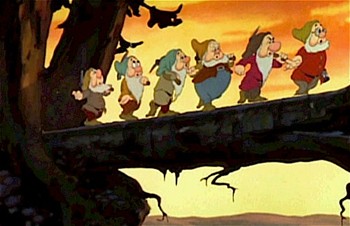
What Disney had in mind was Snow White and the Seven Dwarfs, a work of art that a number of critics continue to believe is the finest movie (of any kind) ever made.
Snow White transformed the reality of animation. Disney insisted that the stars of the movie weren’t silly, exaggerated caricatures trying to get laughs. They were real. They should be portrayed as actual persons.
That meant their eyebrows should crinkle a certain way when they felt wonder or doubt. Their clothes should move naturally when they stood up. Their hands, their cheeks, their hair, and especially their eyes should look authentic.
Without the availability of 21st century CGI technology, all of this had to be done painstakingly by skilled human hands – work that typically took years.
Throughout that time, Walt Disney was everywhere. He visited every department in his studio, continually engaging his nearly 500 co-workers.
Mostly what he did was tell, retell, and tell yet again the story of Snow White and the Seven Dwarfs.
Disney would go from desk to desk and drawing board to drawing board. He would act out every emotion. He would portray every scene. In his monumental volume Walt Disney: the Triumph of the American Imagination, Neal Gabler points out that Disney completely lost himself during these sessions, which often took three hours.
Staff members would be spellbound. Many choked up.
Whenever they heard the leader of their project pour out his heart, their vision was restored. They returned to their highly specific projects – drawing Bashful’s nose, perhaps, or the gnarled branches on certain trees in the woods – with renewed energy.
In other words, whenever they heard the big story, they better understood where their own humble parts of the story fit in.
Gabler asserts this was something Walt Disney could not possibly not do. He had become one with the story. And only he could tell it with such passion and pathos.
There’s a reason that people of faith keep telling the same Christmas Story over and over again.
It helps us find our place in the universe.
It’s not an accident that most of the world’s great made-up stories, including Snow White, Star Wars, Moby Dick, The Brothers Karamazov, and Harry Potter, align with the all-too-real narratives we find in Scripture:
The world used to be a better place. Then dark forces defiled it. Salvation must be plotted. Some characters will choose the light. Others will side with darkness. Only with great courage – and reliance on great powers – can victory be achieved. Along the way, extraordinary sacrifices must be made.
When Snow White sings “someday my prince will come,” she is voicing the world’s most enduring hope: that one of these days, a savior is going to show up and set everything right.
And the world at last will be healed.
There’s a reason we need to hear the Story of God becoming a human being again and again. And yet again.
Every time we face a pile of dirty dishes, or a crucial conversation, or a rampaging toddler, or a relational crossroads, or a workplace decision that feels like one of those make-or-break moments, we need to remember that our lives actually mean something. They are actually going somewhere. And it matters how we respond.
Meteorologists are assuring residents here in the Midwest that we will (once again) see no white snow on December 25.
But at least we can take heart from Snow White.
Whatever we choose to do today, at our own version of a drawing board, will actually make a difference in the Big Picture.