To listen to today’s reflection as a podcast, click here
Life isn’t over when it’s over.
That’s one of the New Testament’s bedrock assertions.
More than a few people, of course, wish they had more than just a few Bible verses to cling to. Is there any tangible evidence, in the here and now, that the world we access with our senses is not all there is to reality, and that death is not the end of life?
Lee Strobel, the atheist journalist-turned Christian apologist, addresses such questions in his new book Seeing the Supernatural. Through a series of interviews with professors, researchers, and theologians, he presents the evidence for angels, demons, and the human soul (all of which are dismissed out of hand by modern materialists), and explores contemporary reports of miracles, near-death experiences, vivid dreams, and deathbed visions.
Concerning that last category, it’s amazing how many families can share remarkable stories with regard to the last words spoken by loved ones.
William Barrett, professor at Ireland’s College of Science, reported the account of a young woman named Doris who, having just given birth, was dying. Barrett’s wife, the attending physician, recalled the details:
Suddenly, she looked eagerly towards one part of the room, a radiant smile illuminating her whole countenance. “Oh, lovely, lovely,” she said. I asked, “What is lovely?” “What I see,” she replied in low, intense tones. “What do you see?” “Lovely, brightness – wonderful beings.” It is difficult to describe the sense of reality conveyed by her intense absorption in the vision.
Then – seeming to focus her attention more intently on one place for the moment – she exclaimed, almost with a kind of joyous cry, “Why, it’s father! Oh, he’s so glad I am coming. He is so glad. It would be perfect if only W [her husband] would come, too.”
Her baby was brought to her to see. She looked at it with interest, then said, “Do you think I ought to stay for baby’s sake?” Then turning toward the vision again, she said, “I can’t – I can’t stay; if you could see what I do, you would know I can’t stay.”
On looking at the same place again, she said with a rather puzzled expression, “He has Vida with him,” turning again to me saying, “Vida is with him.” Then she said, “You do want me, Dad. I am coming.” Then, Doris died.
Who was Vida?
She was Doris’ sister, who had died three weeks earlier – a fact that had been kept from Doris so as not to upset her.
When he learned of this experience, Barrett was propelled into a lifetime of studying the words sometimes spoken by those at the threshold of death. He presented his discoveries in a book called Deathbed Visions.
It turns out that such visions are far more common than one might think.
Strobel reports his conversation with Stephen Miller, professor of religion at Kennesaw State University in Georgia. When Miller looked into deathbed experiences as part of his doctoral dissertation, he had hoped to find at least a handful of reputable inquiries. He was surprised to discover more than 800 scholarly resources. “The frequency of these stories still astounds me,” he says.
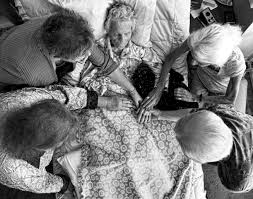
Many of the accounts come from previous generations. That’s because, prior to the advent of modern medicine, most people died in their beds at home with family members gathered around.
Today it’s more common for people to slip away in hospitals or in the gentle embrace of hospice – their pain and discomfort addressed by meds that might limit communication.
As a pastor, however, I have heard some amazing stories – from people I know well – concerning deathbed visions.
One young mom from our church (who was, ironically, an oncology nurse) was coming to the end of her own battle with cancer. In the middle of the night, her husband was sleeping in the chair beside her hospital bed. He was awakened by a gentle breeze. Turning towards his wife, he was surprised to see her staring intently around the darkened room. “Yes,” she said, nodding toward something he could not see. “Yes,” she said again, with happy expectation, then closed her eyes and died.
It’s fair to ask whether such “glimpses of the afterlife” happen only to those who cling to a belief in the next world.
As a young man, Charles Templeton was one of Billy Graham’s closest friends. While Billy became the world’s most famous evangelist, Templeton became known as Canada’s most famous agnostic. Late in life he anguished, with tears, “I miss him… I miss Jesus.”
On his deathbed, Templeton called out to his wife, “Madeleine, do you see them? Do you hear them? The angels! They’re calling my name! I’m going home! …Oh, their eyes, their eyes are so beautiful!” Then he called out, “I’m coming!”
What are we to make of such stories?
Christians – those who have enrolled as apprentices of Someone who came back from the dead – feel assured that dying people don’t just fade into nothingness. They step into a new reality. Followers of Jesus embrace what we might call the afterlife hypothesis.
Materialists prefer the dying brain hypothesis.
Deathbed visions, they insist, can be explained by something other than the supernatural. What people “see” must be the result of dehydration, medication, hallucinations, or perhaps memories churned up at the end of life by grief.
It makes sense that materialists think it’s necessary to settle on a naturalistic explanation.
But the startling nature of these stories, and their constancy through every human culture of every generation, makes them a compelling part of the conversation about whether there is an invisible world.
In particular, the visions spoken by dying children – who sometimes report things they could not possibly have known, such as the existence of siblings who preceded them in death, about whom they had been told nothing – are extraordinary.
What did Miller come to believe through his doctoral research?
“Most convincing to me was the convergence of multiple streams of evidence. I can reflect on thousands of thousands of deathbed experiences collected globally by competent researchers, with case after case testifying to extremely real encounters with God, the afterlife, deceased relatives, and angels… [We] can reasonably project that millions of people will have such experiences.”
Standing outside the fresh grave of his friend Lazarus, Jesus said, “I am the resurrection and the life. The one who believes in me will live, even though they die; and whoever lives by believing in me will never die” (John 11:25-26).
Life, in other words, isn’t over when it’s over.
And death – for those who have abandoned themselves to Jesus – is just the beginning of something none of us will ever be able to put into words