
To listen to today’s reflection as a podcast, click here
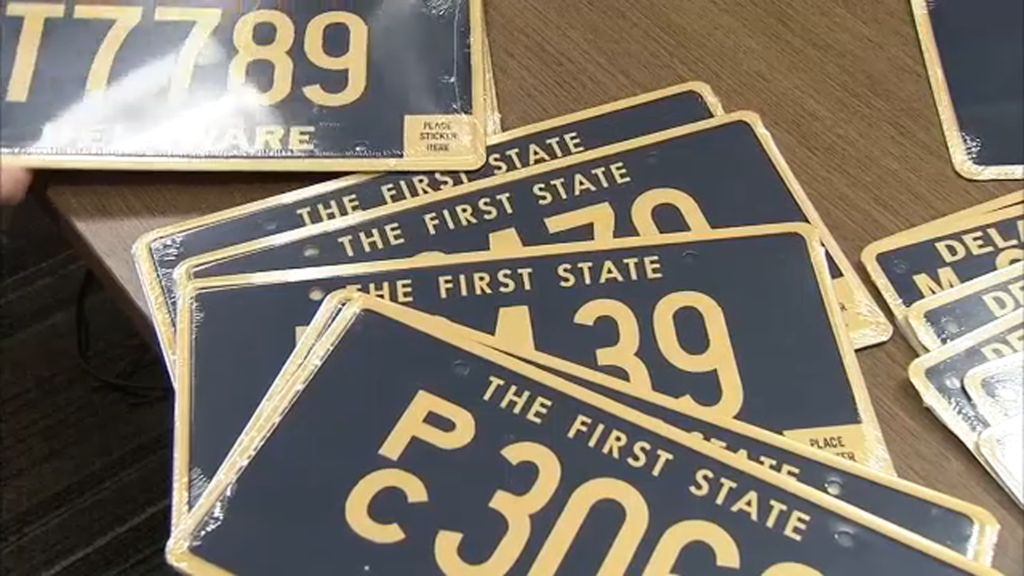
Delaware has perhaps the most boring license plate in the United States.
It’s navy blue with gold numerals. It boasts no images, skylines, natural wonders, silhouettes of famous people, or artistic flourishes. It hasn’t changed since 1942.
It also happens to be the only plate in the country that is entirely flat to the touch – no raised surfaces from metal stamping.
The First State pays homage to the fact that its legislators didn’t hesitate to ratify the new U.S. Constitution in 1787, making Delaware the first of the original 13 colonies to enter the Union. Other than that, the plate offers nothing informational or inspirational.
But whatever Delaware’s license plate lacks in pizazz, it definitely makes up as a potential investment opportunity. Especially if you’re fortunate enough to own the rights to a number with very few digits.
More than a century ago, when cars first arrived in Delaware, the state began issuing plates in numerical order. The rich and powerful were first in line. The number “1” still belongs to the governor, “2” is the lieutenant governor, and “3” belongs to the secretary of state.
The remaining single-digit numbers have gradually become major status symbols. And they can all be bought and sold on the open market.
Do you own the rights to a four-digit Delaware plate? You can almost certainly auction it off for thousands of dollars. Three-digit numbers are worth tens of thousands. And the number “6,” which became available when Charles Murphy died a few years ago? Bidding approached a million dollars.
“There is no better investment in the United States today,” says Butch Emmert, an auctioneer in Rehoboth, Delaware. “I know [a low-digit plate] will outperform the stock market… It’s more important in Delaware to have a low number than to drive a Rolls-Royce.”
Dave Tabler, a Delaware-focused blogger, notes that “these plates become cultural icons that embody family heritage, political influence, and a deep-rooted sense of local identity.”
Human beings are endlessly attracted by the lure of such symbols.
In most cultures, there’s a cult-like fascination with being able to say, “We’re number one.” No one displays a big foam finger at a sporting that event that proclaims, “We’re somewhere in the top 750.”
When people who are unacquainted with the Bible are asked to summarize Jesus of Nazareth’s core teachings, a few predictable responses rise to the top. Jesus came to bring peace. And free us from our sins. And command us to forgive our enemies. And so forth.
What’s often overlooked is how relentlessly Jesus declared that God’s kingdom is ushering in the Great Reversal.
Those who are first in this world are going to be shocked when it turns out their money, power, and status will count for nothing. And those who are currently at the end of the line will be flabbergasted when they learn they have been declared the true winners (see Matthew 20:16).
Author and pastor Tim Keller noted that Jesus didn’t avoid the rich and powerful. The startling thing is that he showed no need at all for their approval.
Those who sit in the courtside seats, who are platinum donors to all the right causes, and who can buy the lowest-digit license plates, may count themselves blessed in the here and now.
But when it comes to receiving God’s gift of grace, they have precisely the same amount of spiritual leverage as a poor person with extended, empty hands.
They have, like everyone else, no leverage at all.
Up is down. Down is up. It’s the way Jesus himself entered the world. It’s also the way he left it.
If you’re a license plate spotter, it’s always a treat to see a Delaware here in the Midwest.
What’s even better is to realize that God’s imprint on your heart, if you have become one of Jesus’ followers, is worth infinitely more.