
To listen to today’s reflection as a podcast, click here
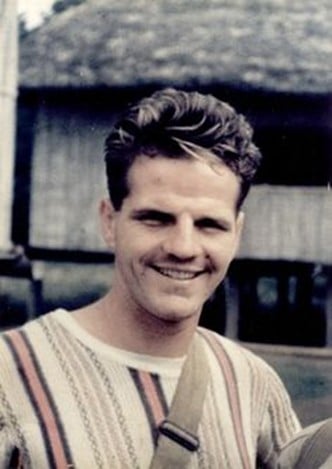
Jim Elliot, seen above, died at age 28 on the banks of the Curaray River in Ecuador, on January 8, 1956.
He left behind his wife Elisabeth and their daughter Valerie, who had not yet reached her first birthday.
Elliot, his friend Nate Saint, and three other missionary companions had spent months trying to win the friendship of the Huaoranis, an “unreached people group” who lived in the Amazon basin. Huaorani culture placed a high value on violence as a way of addressing tribal issues.
The mission workers flew into the jungle in a small plane, landed on a sandbar, and waited with hopefulness for deeper, face-to-face contact with the tribe.
Within 24 hours, all five had been speared to death.
As the startling news spread around the world, there were two primary responses.
The first, predictably, was incredulity. “What a waste,” many said. Wasn’t it obvious to Elliot and his friends that the risks of such ministry far outweighed the rewards?
The second response was more surprising. There is evidence that what happened beside the Curaray River 70 years ago last week drew more women and men into the task of introducing unreached people groups to the love of God than any other single event of the 20th century.
Elisabeth Elliot and young Valerie, along with Rachel Saint, Nate’s widow, went to live amongst the Huaoranis in the fall of 1958.
Through their quiet, incarnational ministry over the next five years, many of the people came to faith, including some of their husbands’ killers.
A number of cultural anthropologists dismissed the whole business as an unwelcome intrusion into traditional Huaorani culture. Other anthropologists and sociologists, however, have noted that the arrival of the Christian message – and the incredible way that two widows modeled it in the midst of the most painful circumstances – were almost certainly why the Huaoranis surrendered violence as a way of life.
Were the risks worth it?
It’s worth noting that the Bible never glorifies risk for its own sake. In the memorable words of author and pastor John Ortberg: “Jesus is not looking for bungee-jumping, hang-gliding, day-trading, tornado-chasing Pinto drivers.”
So, what is Jesus looking for?
Consider his own words in Matthew 16:25: “Whoever wants to save his life will lose it, but whoever loses his life for me will find it.” Notice that both those phrases have something in common:
You lose your life.
Jesus sets before us two choices: We can risk our lives by pursuing him, or we can waste our lives by pursuing safety. According to Jesus, the only people who are ultimately safe are those who pursue him instead of their own security.
Elisabeth Elliot wrote, “Of one thing I am perfectly sure. God’s story never ends in ashes.”
There’s only one way to find out if that is actually true. Take the risk of radical commitment to God and to others:
Don’t miss the great adventure.
As Jim Elliot wrote in his journal a few months before his death, “He is no fool who gives up what he cannot keep in order to gain what he cannot lose.”