
To listen to today’s reflection as a podcast, click here
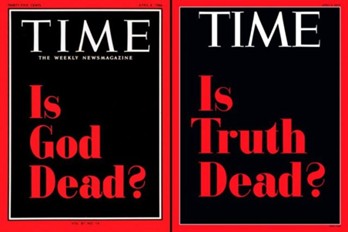
The April 8, 1966, cover of TIME is arguably the most famous in the magazine’s history.
For the first time, the editors didn’t include an image. The black cover featured three huge words in red text: Is God Dead?
That question was connected to the feature article, a survey of certain 1960s theologians who were proposing the elimination of the idea of God from the field of theology. This of course was genuinely ironic, since “theology” literally means “the study of God.”
To say that TIME was swamped with a wave of criticism would be an understatement.
The magazine received more letters to the editor than any story in its history, before or since – many of them expressions of rage.
A great many people never bothered to read the article. They couldn’t get past the cover. To this day, millions of Americans feel certain that TIME once put out an issue in which they publicly declared, in bright red letters, that God is dead.
TIME, of course, was merely presenting the controversial question posed by radical theologians. It’s a sure bet, however, that they knew a tidal wave of emotion and misunderstanding would be coming their way.
Then came April 3, 2017.
Once again the cover featured a three-word question. The dramatic colors and font were deliberate throwbacks to 1966. This time the cover asked, Is Truth Dead? The feature article concerned President Trump’s embrace of a series of apparent falsehoods during the course of his first three months of his first term.
According to the article, the new administration had made startling claims without presenting corroborating evidence, endorsed conspiracy theories, pounded the media for promulgating “fake news,” and even added a new term to the American lexicon: alternative facts.
As I’ve noted before, “Donald Trump” is the subject I most try to avoid when writing reflections.
Even though the president has dominated news cycles as no other chief executive in American history, even the mention of his name triggers deep emotions and potential misunderstandings at both ends of the political spectrum.
Nonetheless, truth is a subject worth addressing. And one can hardly speak of truth in 2026 without noting that what is really true, in the public arena, seems to be up for grabs.
Interestingly, this is an area where Mr. Trump’s fiercest critics and most ardent admirers find themselves in agreement. “Truth,” for the president, seems to be a moving target. Numbers have a habit of changing from speech to speech. Certain announcements fail to align with reality, leaving listeners scratching their heads.
Mr. Trump, for what it’s worth, declared that the 2017 TIME cover was “the worst ever.”
The real issue for followers of Jesus is not who happens to be in the Oval Office. “Is truth dead?” is a question of searing importance – one that inevitably leads us to ask, “Does truth even matter?”
America’s second president, John Adams, observed more than 200 years ago: “Facts are stubborn things; and whatever may be our wishes, our inclinations, or the dictates of our passion, they cannot alter the state of facts and evidence.”
Truth was also front and center 2,000 years ago at a crucial moment in the life of Jesus, when someone else asked about the importance of truth.
The “asker” was Pontius Pilate, a sadistic, weak-willed, middle-level functionary of the Roman Empire who just happened to be governing Judea when Jesus was brought to trial.
From one perspective, Jesus’ confrontation with Pilate looks and sounds like any other kangaroo court that one might find on the pages of history. A corrupt governing authority holds all the cards. He says, “I can make you talk. I can get any information out of you that I want. And if you don’t cooperate, I can make you hurt and take everything away from you, including your life. What do you think of that?”
What’s fascinating is that Jesus appears to care less about Pilate’s threats. In fact, he is apparently counting on Pilate giving the order to execute him. That’s the very means by which his kingdom is going to win.
Jesus is about to take the ultimate symbol of Roman power – the cross, which was widely thought to be the worst thing that could happen to somebody – and turn it into the best thing that has ever happened to the rest of the world.
Jesus doesn’t posture. He doesn’t make threats or say, “By the way, Pontius, are there any messages you’d like me to pass along personally to my Father in heaven when I see him after rising from the dead later this weekend? Won’t you be sorry then!”
Instead, he makes a simple statement. “I have come to testify to the truth.” Pilate famously responds in John 18:37, “What is truth?”
We wish we knew what lay behind those words. Was Pilate merely weary or cynical or wistful or perhaps even curious about what else Jesus might have to say?
The one thing the governor seems to grasp is that he is now stuck in a politically charged situation in which there are no easy exits. Ultimately, he approves Jesus’ crucifixion – probably for no better reason than it allows him to keep his job.
So Jesus dies.
But truth lives on. Truth doesn’t die just because truth-tellers are killed, as the world has learned from countless brave people.
Over the next 24 hours, it won’t matter to most of us what certain politicians say or do. And it won’t matter what our favorite news reporters tell us concerning the way things really are.
But it will matter a great deal whether we choose to be truth-tellers in every conversation. And to keep our promises. And to give up on “impression management” – shading the truth in order to make ourselves look good in the eyes of others.
Truth is very much alive.
Perhaps that’s why Jesus – the one who claimed to be the Way, the Truth, and the Life – still captivates the world.