To listen to today’s reflection as a podcast, click here
All his life, Arland D. Williams, Jr., had been afraid of the water.
As an undergrad cadet at the Citadel, where he was known as Chub, he had had to pass a water-safety and swimming test. Chub was afraid he wouldn’t be able to push through his fears.
He did.
But the biggest test of his life came on January 13, 1982, when the 46-year-old bank examiner boarded Air Florida Flight 90 on a bitterly cold, snowy afternoon in Washington, D.C.
The Boeing 737, its wings shrouded in ice, never really got airborne. It brushed the top of the 14th Street Bridge over the Potomac, killing a half dozen motorists, then smashed nose-first into the ice-capped river. Almost all of its 79 passengers and crew died upon impact.
Horrified witnesses watched as the shattered fuselage vanished from sight. Only the tail remained afloat.
Then, one by one, six survivors appeared.
They all were in shock. They all had swum past the bodies of dead friends, spouses, and seatmates. They all had broken limbs. They all were succumbing to the chill of the water, and could barely hang on to the tail.
Would-be rescuers on the shore tried to figure out how to reach them.
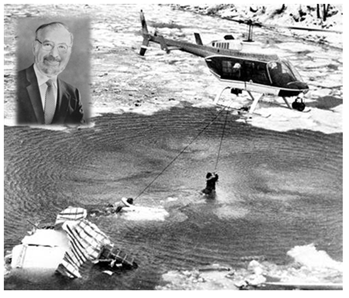
After 20 agonizing minutes, a rescue chopper appeared. As a national TV audience watched, its trained crew dropped a lifeline right into the hands of the man who appeared (as they later described him) to be the most likely to survive.
It was Chub.
He immediately handed the ring to one of the women in the water. The chopper lifted her to safety, then deposited her on the shore.
The chopper made repeated stops just above the aircraft tail, which was rapidly filing with water. Each time, Williams caught the ring. And each time he gave it to someone else.
The other five survivors all made it to safety. The last time the helicopter circled over the jagged opening in the pack ice, this time to retrieve Williams, it was too late. The tail was gone. And so was Chub.
In an eloquent 2007 article on the nature of heroism, Christopher McDougall wrote: “Who was he? But far more perplexing: Why was he?
“Why would anyone put the lives of strangers ahead of his own? He couldn’t even see the faces of the people he was saving, because they were on the opposite side of the wreckage, yet he made a sacrifice for them that their best friends might have refused.”
Frank Webster, who had been one of Chub’s friends at the Citadel, thinks he knows the answer.
“Always take care of your people first,” he said. That was their Citadel training. “That’s an unbreakable code. You go last. Your people go first.” As McDougall put it, “Chub didn’t have to see the survivors across the wreckage from him to know they weren’t strangers. They were family.”
Darwinists – who have concluded that humanity, just to be here, has endured an incredibly long series of “survival of the fittest” crossroads – have always struggled to explain heroic self-sacrifice.
Of what personal value is it to donate a kidney to a complete stranger? Why do Go Fund Me campaigns raise tens of thousands of dollars for families whose houses have burned down, even though the donors will never hear a personal “thank-you”? Why would Williams keep passing the lifeline to the opposite side of the wreckage, surrendering his own life in the process?
If we see things through the lens of Christianity, however, self-sacrifice makes sense.
That’s because we’re called to abandon ourselves to the God who, through Jesus, sacrificed himself for others – and beckons us to do the same.
“This is how we’ve come to understand and experience love: Christ sacrificed his life for us. This is why we ought to live sacrificially for others, and not just be out for ourselves” (I John 3:16).
Every day, we have opportunities to die for someone else.
We give up our own life whenever we advance another person’s agenda at the expense of our own. Whenever we let a teammate take the credit for a shared victory. Whenever we decide to go last, and let other people go first.
You can still drive across what used to be called the 14th Street Bridge over the Potomac River. It’s now known as the Arland D. Williams, Jr., Memorial Bridge.
You may not get a bridge named after you.
But your decision to help someone else make it through the day will, in a small way, change their life – and change the world.