
To listen to today’s reflection as a podcast, click here
Not all feats of daring in the early days of America’s space program happened in outer space.
There was also an extraordinary amount of bravery on the ground, behind closed doors, in NASA’s research centers.
Margot Lee Shetterly’s book Hidden Figures – which became an award-winning 2016 motion picture – documents the stories of some of the hundreds of Black women who served as “human computers” from the 1940s to the 70s.
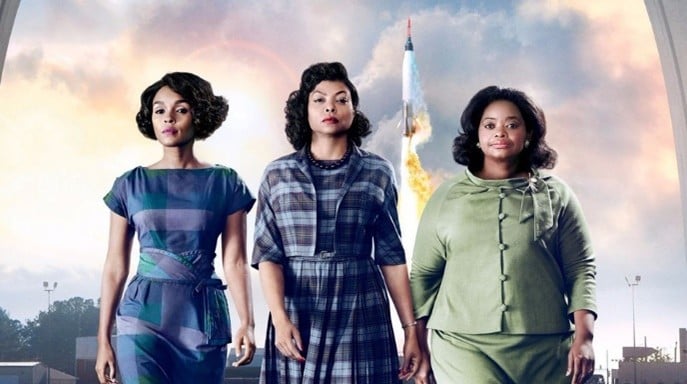
For brilliant mathematicians like Mary Jackson, Katherine Johnson, and Dorothy Vaughn – the three women portrayed, left to right, in the movie poster above – the most challenging part of daily work wasn’t the differential equations.
It was the indignity of the two words printed on the door of “their” bathroom at the far end of the building: Colored Girls.
From the beginning, they were outsiders. They were females in a world overwhelmingly dominated by male engineers.
And they were people of color in Hampton, Virginia (NASA’s original research site) at a place and time when racial segregation was a given. In 1958, the state actually forced the closure of public schools that were attempting integration.
The women gradually began to ignore the expectation that demanded they take bio breaks in separate facilities. And they confiscated the little signs on the cafeteria tables that directed them to sit at the back of the room.
As their work won the respect of some of America’s sharpest minds, the walls of separation began to come down, one brick and one sign at a time.
Between 1959 and 1962, Katherine Johnson almost singlehandedly wrote and solved the equations that governed the orbital patterns of manned spacecraft. Just before astronaut John Glenn blasted off on his historic flight that circled the earth three times in February 1962, NASA’s IBM computer – which was the size of a large room – put her figures to the test.
The machine computer got identical results to the human computer.
Glenn sought one final confirmation before risking his life on the launch pad. He didn’t turn to IBM. “Get the girl to check the numbers,” he said, referring to 43-year-old Katherine. The equations for the flight were printed on a stack of papers as thick as a phonebook. Johnson personally checked every one of them.
The Mercury capsule orbited flawlessly.
Johnson helped do the advanced math that allowed the Apollo 11 lunar lander to depart the moon’s surface with Neil Armstrong and Buzz Aldrin and rendezvous with the orbiting Michael Collins. The calculations took her 14 to 16 hours a day for the better part of six years, from 1963 to 1969.
Let’s just say that Katherine was the mom that everyone else’s kids consulted when they needed help with their math homework.
The achievements of NASA’s Black female mathematicians were played out against the backdrop of America’s civil rights movement.
At what seemed like an excruciatingly slow pace, the nation (and ultimately Southern states like Virginia) began to rethink the inherent injustices of segregation. Marches, protests, prayers, Supreme Court decisions, sermons, elections, and profound personal sacrifices helped turn the tide.
What role in this drama was played by the women in Hampton, Virginia?
I Peter 2:15 tells part of the story: “For it is God’s will that by doing good you should silence the ignorant talk of foolish people.”
Jackson, Vaughn, Johnson, and their colleagues did their work faithfully every day for decades. They accomplished what they had always dreamed – serving their nation by helping win the Space Race. In the presence of others who doubted them, ignored them, or even openly wished they would simply go away, they chose to stay. And to persevere.
Their willingness to remain in the chaos ultimately helped demonstrate that the entire rationale for the bias against them, from the get-go, had never had a basis in reality.
It takes courage to stay on such a path.
But God is the giver of courage to those who are willing to receive it.
And by his grace, the signs that separate us from each other will continue to disappear.