
To listen to today’s reflection as a podcast, click here
The Winter Olympics of Milano-Cortina was supposed to yield the greatest harvest of American gold medals of the past three decades.
Instead, many of America’s made-for-TV superstars have experienced failure on an epic scale.
Lindsey Vonn crashed in the women’s downhill and shattered her left leg. Mikaela Shiffrin, history’s most accomplished skier, has been shut out twice in her efforts to reach the medal stand. Chloe Kim fell in the halfpipe, the event she has long dominated.
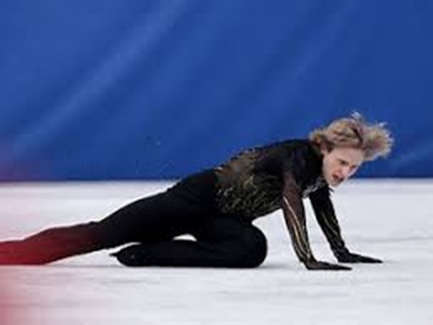
Most astonishing of all, Ilia Malinin – dubbed the Quad God for his mastery of quadruple jumps that most skaters will never even attempt – fell twice, failed to complete basic moves, and finished an incomprehensible eighth. “I blew it,” he said as he departed the ice. Observers described last Friday’s debacle as the most shocking turn of events in Olympic skating history.
One of the reasons we savor Olympic accomplishments is that we can only shake our heads and say, “I could never do that.”
Then, a few minutes later, an elite athlete unravels before the watching world – at which point we shake our heads and say, “On the other hand, I can definitely relate to that.”
A great deal of life is failure.
And how we handle coming up short – sometimes disastrously short – is essential to our growth as human beings.
In his bestseller In Defense of a Liberal Education, Fareed Zakaria notes a worrying trend in how colleges and universities evaluate potential students. He writes, “Admissions offices now prize nothing less than perfection.”
Zakaria asked the leader of the admissions team at an Ivy League school, “Do you take in many kids who have failed in some significant way in high school?” The director candidly admitted that they didn’t. His school only targeted students with the best transcripts and highest SAT scores.
“I pointed out.” Zakaria continues, “that how one responds to and recovers from failure is one of the most important characteristics of an individual, probably one that reveals more about his or her future success.”
The admissions director, a well-educated scholar, acknowledged Zakaria’s point. But if they took in kids who had failed in some major way, “the college would drop in its rankings and in its ‘win-loss’ ratio against other key schools (that is, the percentage of students who, when admitted to two schools, accept one over the other).”
In other words, if you’re looking for an open door to an excellent education, you’d better not fail. Or even hint that your life might have been anything less than a beautiful and flawless journey.
And that is tragic – for the simple reason that failure, perhaps more than anything else, is what makes us.
And then remakes us.
As Yoda reminds us in The Last Jedi, “The greatest teacher, failure is.”
We may be blessed with great DNA, great parents, and great opportunities, but our character really turns on how we respond to life’s inevitable moments of great pain and great disappointments. Those who have faced up to such failures and become wiser and gentler are truly the cream of the crop.
Significantly, the Bible turns out to be a library of failure stories.
Abraham failed to take seriously God’s promise that his descendants would one day become a great nation. Jacob failed to treat his children fairly, thus sowing murderous anger between them. Moses failed in his first attempt to rescue the Hebrews from slavery in Egypt, thereby squandering 40 years of his life. David failed miserably in his marriage(s) and his parenting. Peter failed to stand beside his Master in his darkest hour, declaring three times that he had never even met the man.
Yet Abraham, Jacob, Moses, David, and Peter are among the Bible’s greatest heroes.
“Forgetting what is behind and straining toward what is ahead,” writes the apostle Paul, who survived incredible mistakes early in his life, “I press on toward the goal to win the prize for which God has called me heavenward in Christ Jesus” (Philippians 3:13-14).
God is the one who can transform some of our worst moments into our greatest victories.
Ilia Malinin’s story now includes a brutally rough chapter.
But that doesn’t mean his story has to come to an end.
Our stories aren’t over, either – no matter what we have done or not done, whether this past weekend or many years ago.
If we receive God’s freely offered gifts of grace, forgiveness, and hope, failure doesn’t get to have the last word.