
To listen to today’s reflection as a podcast, click here
Throughout the season of Lent, we’re taking a close look at the Apostles’ Creed – one of the earliest and most concise summaries of what followers of Jesus believe.
If you’re between a rock and a hard place, you’re trapped between two unpleasant alternatives.
You’re going to have to choose. But the risk is that by fleeing from one kind of danger, you’ll run headlong into the other.
The ancient Greeks had a memorable way of depicting this.
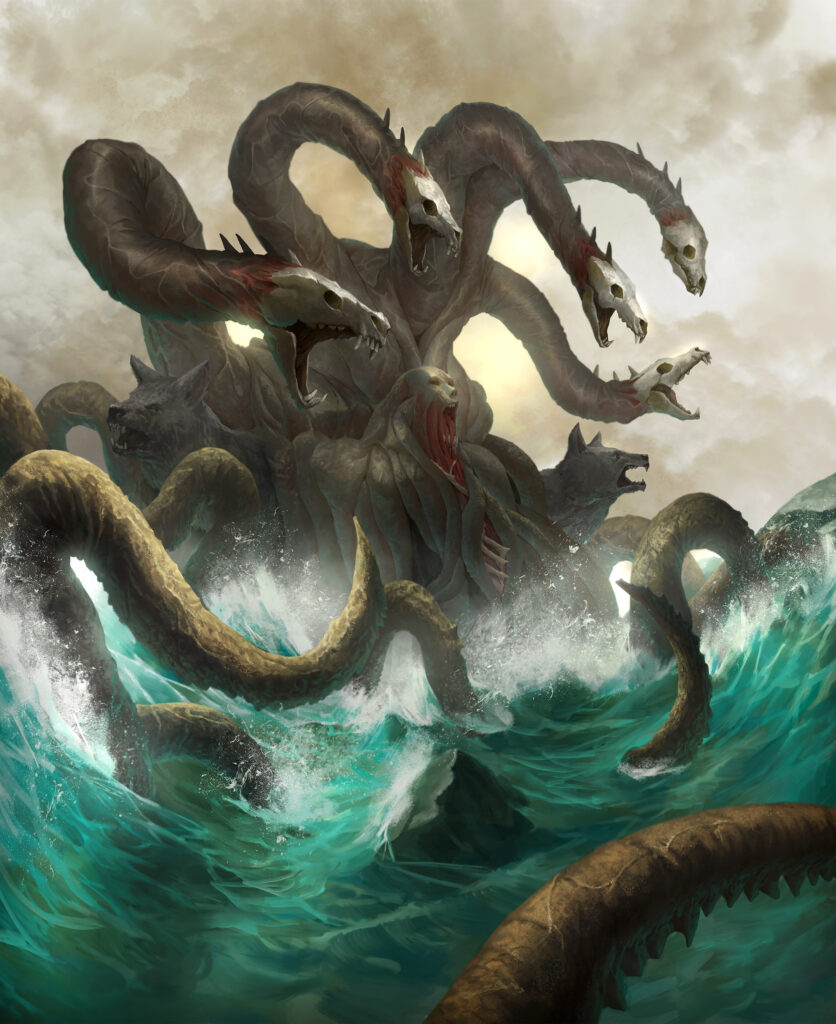
In Homer’s Odyssey, the hero Odysseus and his men have to sail through a narrow channel between Scylla and Charybdis, a tight maritime squeeze that came to be identified with the Strait of Messina.
Generations of students trying to master Greek mythology have been subjected to the trial of learning how to both spell and pronounce Scylla and Charybdis. But that’s nothing compared to the nightmare faced by the sailors in those old stories.
A ship sailing west though the narrow strait would look to the right and see Scylla emerging from a cave.
She was an immense female monstrosity with 12 feet and six heads on serpentine necks. Each head boasted a triple row of razor-sharp teeth, and her midsection was girdled by the heads of barking dogs. Think, “the worst blind date ever,” and you’ve got the picture.
Over on the left was Charybdis, a seemingly less intimidating creature that skulked beneath a fig tree.
But three times a day she drank all the water in the strait, then belched it out into a whirlpool that sucked sailors down into a watery grave.
Ancient wisdom suggested it might be better to sail on Scylla’s side of the gauntlet. She would certainly try to gobble some of your crew, but that was a better option than losing everyone to a bottomless whirlpool.
In the epic, some of Odysseus’ men get their first good look at Scylla and panic. “Go left, go left!”
But those on the whirlpool side of things beg the helmsman, “No, go right, go right!”
Odysseus knows there’s only one way forward. They must look for the Middle Way and keep moving.
When it comes to finding our own way forward as followers of Jesus, it’s not unusual to picture ourselves squeezed between monstrous alternatives. This is especially true when it comes to addressing a question like, “What exactly do I need to know in order to be a true disciple?”
One of the very best answers to that question is the Apostles’ Creed – a short summary of the earliest essential convictions of those enrolled as Jesus’ lifelong learners.
Wrestling with what doctrines are actually essential, however, can feel like choosing between Scylla and Charybdis.
On the one hand – let’s say, the right hand – there are Christian traditions that are deeply committed to the study of Scripture, with an emphasis on discovering and clinging to the correct interpretations of everything we find in the Old and New Testaments. “We’ve already got the Bible, so why do we need a creed?”
On the other hand – let’s call this the left hand – there are Christian traditions that are content with the shortest possible list of affirmations. “God loves you and God loves me, and that’s all we need to know. So why do we need a creed?”
Some churches veer to the right, craving theological certainty. Other churches veer to the left, feeling entirely comfortable with spiritual uncertainty.
Hyper-Certain congregations and Hyper-Accepting congregations have become famous for identifying each other as the real monster.
That’s why, for the better part of 20 centuries, Christians have agreed that we need a Middle Way between those alternatives.
The Apostles’ Creed is faithful to the Bible – but it doesn’t remotely try to say everything the Bible says. The Apostles’ Creed is simple and succinct – but it doesn’t let us get away with thinking that just because God loves us, we don’t need to take our stand regarding anything else.
Why did it seem wise to come up with a concise, middle-of-the-road summary of Christian truth?
Within 100 years of the time of Jesus, a variety of fringe groups were trying to impose their own ideas as to who he was and what he had accomplished.
The Ebionites taught that he had a kind of split personality – a heavenly “Christ” had descended upon the earthy “Jesus” when he was baptized. Gnostics preached that a wicked demigod had created the world, and Jesus came to set us free from our inherently corrupt bodies. The Docetists insisted that Jesus’ own body was nothing but a mirage. Arian theologians taught that since Jesus was just a created being, like everyone else, he couldn’t really save us from our sins. The Marcionites championed the idea that Jesus came to save us from the God of the Old Testament.
If you’re thinking, “Wait a minute, that doesn’t sound right,” that’s exactly what early Christian leaders concluded as well.
It may be that you don’t know Ebionites from Marcionites from mosquito bites. But these are the groups that prompted the creation of the very first creeds.
Faithful teachers needed to know what to teach, and faithful disciples needed to know what to believe.
Orthodox Christians were ultimately able to avoid the extremes – to stay between the rocks and hard places that might otherwise have shipwrecked the faith.
What made the Apostles’ Creed particularly useful in that regard?
We’ll check out that story tomorrow.