To listen to today’s reflection as a podcast, click here
Throughout the season of Lent, we’re taking a close look at the Apostles’ Creed – one of the earliest and most concise summaries of what followers of Jesus believe.
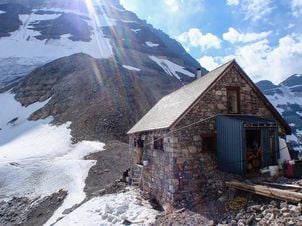
A humble building known as the Abbot Pass Hut was long regarded as one of the Western Hemisphere’s most intriguing structures.
It was constructed in 1922 as a shelter for mountaineers attempting to scale either Mount Victoria or Mount Lefroy, two of the higher peaks in Banff Provincial Park in Alberta, Canada.
Until its rickety timbers were deemed unsafe a few years ago, it served as an overnight waystation for hikers and climbers.
What made it famous was its location – Abbot Pass (9,598 feet above sea level), which sits directly astride North America’s hydrological watershed. That’s the imaginary line popularly known as the Continental Divide.
If a raindrop or snowflake fell on the eastern half of the hut’s roof, it eventually made its way to Hudson Bay and the Atlantic Ocean. Precipitation that fell on the western half of the roof wound up in the Pacific Ocean.
To spend a night in the Abbot Pass Hut was to teeter on the mountainous “rooftop” of the Western world. Depending on which direction you turned when you stepped outside in the morning, you were heading downhill – toward either one or the other of the world’s two greatest bodies of water.
Most people who cross the Continental Divide on paved highways hardly notice it – unless they see an information sign informing them they have just surmounted the watershed.
Things are a bit different on the pages of Scripture.
Just a half dozen chapters into the New Testament, there’s a sudden and dramatic change in how people pray – specifically, in how they picture the God to whom they are directing their heartfelt requests. We might call it the Bible’s Continental Divide.
Before Matthew 6, God is addressed formally, even fearfully. On the pages of the Old Testament, God is only rarely identified as father (check out Isaiah 63:16, Jeremiah 31:9, and Malachi 2:10). More often he is our Maker, Sustainer, Consuming Fire, Shield, Rock, and Strong Tower. He is the Lord Almighty, high and lifted up.
After Matthew 6, however, people begin to address God as “Daddy.” How in the world does this happen?
It happens because of the opening words of the Lord’s Prayer.
It’s worth noting that prayer is the only activity in the four Gospels for which Jesus’ disciples specifically request training.
We never hear them asking, “Lord, teach us how to share our faith, or cast out demons, or run a capital campaign that will really impress the Baptists.” The disciples would have been fully trained in the first century Judaic disciplines of prayer. But in Jesus they observe something different going on. So they ask an expert to mentor them – “Lord, teach us how to pray” – just as we might say, “Alysa Liu, teach us how to do a triple lutz and not fall on the ice,” or, “Warren Buffett, teach us how to turn a few dollars into millions.”
In response, Jesus doesn’t give a lecture. He prays an actual prayer.
Most Bible scholars agree that when Jesus says in Matthew 6:9-13, “This, then, is how you should pray,” he’s not locking us into these specific words. It takes approximately 18 seconds to speak the words of the Lord’s Prayer, and I know of at least one Bible teacher who believes Jesus was telling us we should never pray longer than 18 seconds.
Assuming instead that Matthew 6 provides a general model for sustaining a conversation with God, let’s take a look at those two stunning opening words: Our Father.
It would have been entirely appropriate for Jesus to have said, “My Father.” He is, after all, the only true Son of God. We are God’s children by spiritual adoption. But by using the word “our,” Jesus is inviting us into the family conversation.
Using the word “Father” is like crossing the boundary into an entirely new way of relating to God. There’s no evidence that anyone in Israel’s history had ever had the audacity, in private prayer, to address the Lord in such a familiar way.
Nobody, that is, until Jesus.
But there’s more. Jesus uses the word abba, which is the Aramaic word for “Daddy” or “Poppy.” This is the language of the street, the rhetoric of the nursery – the word a toddler would use when asking for a drink of milk, or when seeking comfort in the middle of a midnight thunderstorm. Children don’t know any better than to say, “Daddy, I need you right now!” That’s how Jesus instructs his disciples to pray.
Which is why the Lord’s Prayer is the Bible’s spiritual watershed.
Before Jesus, God is someone who just might scare us to death. We cannot fathom his holiness and perfection. Isn’t our own unholiness and imperfection an automatic disqualifier for a conversation with the Divine?
After Jesus, however, the door to God’s back porch is open. Against all expectation, we’re being beckoned to cross the threshold and kick off our shoes.
This is where we notice that the Apostles’ Creed preserves the special emphases of both Old and New Testaments. “I believe in God the Father Almighty…”
Australian Bible scholar Michael Bird writes, “To say that God is ‘almighty’ is to say that he possesses all might. His power is not limited by anything beyond his own character and being. God always works to bring about what he intends to do, and not a single molecule in the universe can thwart him or frustrate his purposes.”
He is the one true God, El Shaddai, high and lifted up. But as the Almighty Father he uses his unlimited power to hang onto every word we speak.
It’s a dreadful thing to spend a night wavering between two very different visions of God – to be stuck in a “hut” wondering if God is my enemy or if God is my ally.
The next morning when I wake up, which way should I turn?
Jesus invites us to step onto the path that he himself followed – to believe that, by his grace, we are the treasured children of a Papa who will never let us go.