
To listen to today’s reflection as a podcast, click here
Throughout the season of Lent, we’re taking a close look at the Apostles’ Creed – one of the earliest and most concise summaries of what followers of Jesus believe.
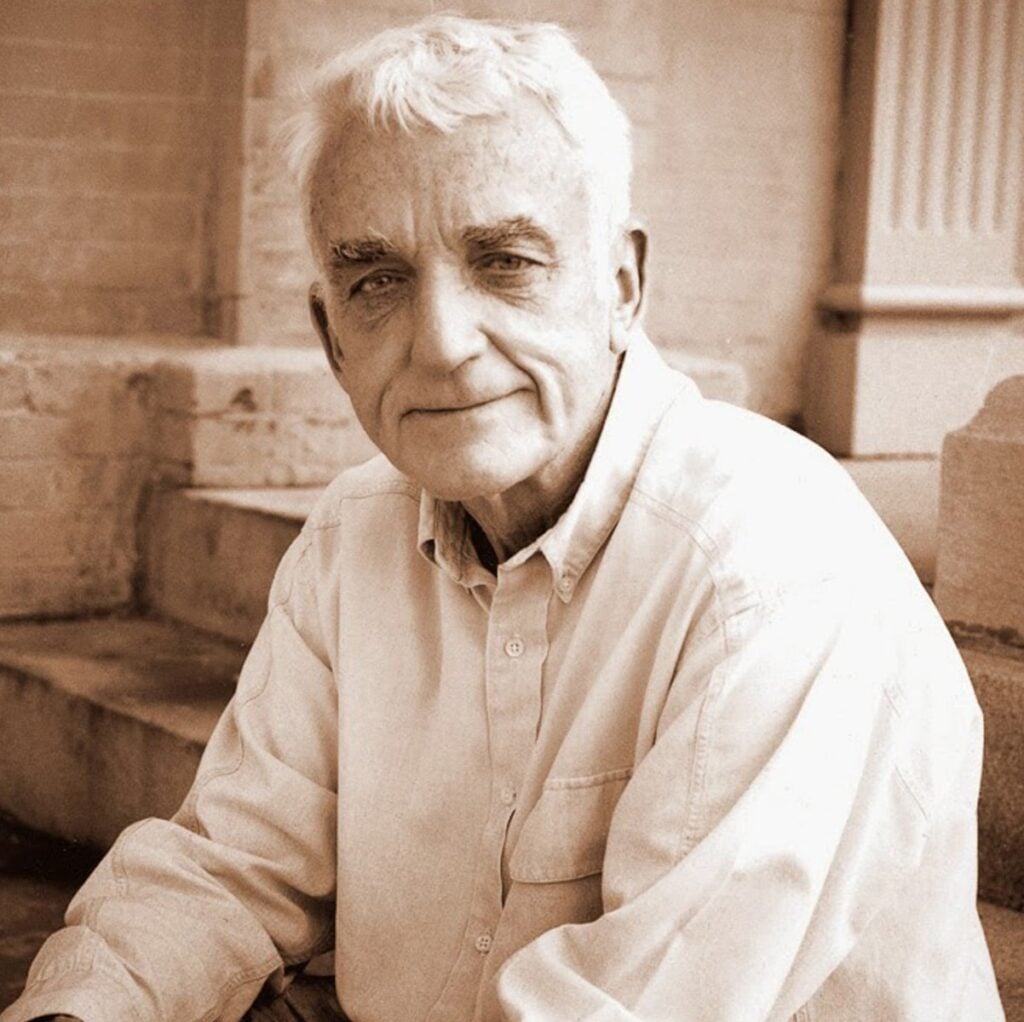
Until his death in 2013, Brennan Manning was one of his generation’s most compelling voices concerning the reality of God’s grace.
Towards the end of his life, he recounted how he got the name “Brennan.”
Growing up in Depression-era Brooklyn, Manning’s best friend was Ray.
They did everything together. They attended the same school. They co-signed a purchase agreement for a car. They double-dated. They enlisted simultaneously in the Marines, endured boot camp side by side, and then went to the frontlines of the Korean War. Together they hunkered down in foxholes.
One night in one of those foxholes, Manning was reminiscing about their childhood days in Brooklyn. Ray was listening and eating a chocolate bar.
Suddenly a live grenade landed at their feet. Ray looked at Manning, smiled, dropped his chocolate bar, and threw himself onto the grenade.
An instant later, Ray was dead. Manning lived on.
More than a decade after that, Manning was ordained a Franciscan priest. He was instructed to take the name of a Catholic saint. For him it was a no-brainer. He chose the Irish saint Brennan, a fitting way of remembering his best friend: Ray Brennan.
One day Manning visited Ray’s mother in Brooklyn. They were sipping tea together when Brennan asked her, “Do you think Ray loved me?”
Mrs. Brennan leapt from the couch. She shook her finger in Manning’s face. “Jesus Christ!” she shouted. “What more could he have done for you?!”
Brennan Manning, stunned by that encounter, never forgot its significance.
He imagined himself standing at the foot of the cross wondering, “Does God really love me?” At that point Jesus’ mother Mary could have pointed to her son and said, “Jesus Christ – what more could he have done for you?”
At the heart of the Christian faith is this extraordinary reality: Jesus of Nazareth threw himself onto the grenade of the world’s sin – including yours and mine – so we could live.
Here we arrive at a flex point in the Apostles’ Creed. “I believe in God the Father Almighty, creator of heaven and Earth. And in Jesus Christ his only Son our Lord.”
The Creed’s opening words concern God the Father. The final lines highlight the work of the Holy Spirit. In between we find the longest section of the Creed, which spotlights Jesus, who is unequivocally the central focus of the New Testament.
And this is where names come into play.
During Bible times, names were considered representations of character, reputation, and identity. “O Lord, our Lord, how majestic is your name in all the earth!” (Psalm 8:1). “Our Father in heaven, hallowed be your name” (Matthew 6:5). We “hallow” God’s name by affirming that he has no rivals in the cosmos.
It’s eye-opening to explore the names associated with Jesus.
Jesus (or Yeshua, a first century rendering of the name Joshua) means “the Lord saves.” Christ (from the Greek word Christos) is actually a title, not a personal name. It translates the Hebrew word mashiach, or messiah, which means “Anointed One” – that is, the true king who has been sent by God to fulfill Israel’s destiny of blessing the whole world.
In the days ahead, we’ll take a closer look at the words “only” and “Son.”
But for now, let’s skip ahead to the Creed’s identification of Jesus as “Lord” – a title that the apostle Paul assigns to Jesus at least 180 times.
This is a very big deal. In the Greek translation of the Old Testament, the word kyrios (“Lord”) applies only to the one true God. Now, in the New Testament, the same word describes Jesus. Does this mean Paul and others were saying that Jesus is the one true God?
It took the best and brightest Christian thinkers more than three centuries to formulate an answer to that question. The result was the doctrine of the Trinity – the recognition that the Creator God is one with regard to essence, but three when it comes to personhood (Father, Son, and Spirit).
Just a few years after his resurrection, Jesus’ first followers – and Paul in particular – were not only using God-language to describe Jesus. They were using Jesus-language to describe God.
This matters more than we can imagine.
It’s theologically correct to say that Jesus = God. But the real revolution happens when we turn that equation around: God = Jesus.
Most of us would admit that it’s hard to picture God. Should we bring to mind a force-field, a king sitting on a throne, a blinding light, or an old man with a flowing beard like Michelangelo’s portrait of the Creator on the ceiling of the Sistine Chapel?
Jesus gives God a face. A human face.
How does God respond to those who are hungry and poor, and to people who are crying out for help? Read the Gospel accounts of how Jesus feeds the crowds and heals the sick. What does God think about religious stuffed shirts who are fixated on rules-keeping? Check out how Jesus confronts the hardheartedness of the Pharisees. What is God’s opinion of those who have totally messed up their lives sexually and relationally? Zero in on the ways that Jesus offers forgiveness instead of condemnation.
When you want to think about God, picture Jesus.
In the words of biblical scholar N.T. Wright, he’s “the one in whom the identity of Israel’s God is revealed, so that one cannot now speak of this God without thinking of Jesus, or of Jesus without thinking of the one God.”
Jesus Christ: What more could he have possibly done?
By calling Jesus “Lord,” the Apostles’ Creed is daringly announcing that he’s done it all.