
To listen to today’s reflection as a podcast, click here
Throughout the season of Lent, we’re taking a close look at the Apostles’ Creed – one of the earliest and most concise summaries of what followers of Jesus believe.
A number of ancient philosophers believed in a Supreme Being.
But for centuries they struggled to agree on exactly what kind of deity they believed in.
How should they account for the character of a God who rules such a spectacularly beautiful world, but which is filled with so much suffering and loss?
The philosophers of the ancient world decided that God, in order to be God, had to be impassive. That means God was endowed with no passion or feelings of any kind.
God could not feel joy, anger, disappointment, or pain. After all, if your prayers could somehow affect God, if your suffering could inspire in God a feeling that wasn’t there before, then you would have a measure of power over God.
And that would make God vulnerable.
If God were vulnerable, he would not be the eternal, unchanging, omnipotent Deity who rules the cosmos. The God who is impassive watches everything from the sidelines, or gazes upon our little problems and crises from the balcony of heaven. Think of Bette Midler’s 1990 hit From a Distance, which won the Grammy for Song of the Year and portrayed God as a blissful spectator to human happenings.
That’s the God of the philosophers. But let’s be honest. Nobody wants or needs a God like that.
When we consider the smorgasbord of today’s global religious options, divine impassivity seems to rule.
Muslims insist that Allah’s perfection is incompatible with transient emotional states. Hindus, Buddhists, and Taoists imagine the Ultimate Being (if they even conceive of one) to be impersonal, and thus incapable of feelings. The Deists of the Enlightenment suggested that an all-powerful Cosmic Force apparently got the universe going – it was a bit like winding up a clock – but then permanently left the scene. We cannot touch the heart of such a God, and he will certainly never touch ours.
The texts of both the Old and New Testament are stunningly different.
God reasons. God feels. God cares.
Two unusual Greek verbs stand out. The first is splagkhnizomai, which is often translated into English as “having compassion.” But it means so much more than that.
Its root is the Greek word for small intestines, or “guts,” which were widely assumed to be the seat of human emotions. It denotes a visceral reaction – something that makes you clutch at your stomach, perhaps with a twinge of outrage.
The word isn’t used very often in the Bible. But wherever it appears, it definitely leaves a mark.
In the parable of the prodigal son, Jesus says that the waiting father (who represents God) has a gut reaction when he sees his lost boy approaching – he runs and throws his arms around him. In another parable, the good Samaritan who comes upon the mugged traveler feels a visceral surge of compassion and stops to help him.
When Jesus sees the restless crowd “like sheep without a shepherd,” his heart goes out to them (Matthew 9:36). He then provides both a literal and spiritual feast of loaves and fishes. His “guts” are moved to compassion when he sees a widow who has lost her only son, hears two blind men crying out for mercy, and is approached by a leper whose disfiguring disease has left him nowhere else to turn.
In each of these dire circumstances, we see God’s Messiah stirred to do something. He is not neutral. He doesn’t remain on the sidelines. This is a God who rolls up his sleeves and goes to work.
The second Greek verb is even more dramatic. It is embrimaomai, which is usually translated “deeply moved.” It appears twice in the John 11 account of Jesus’ visit to the tomb of his friend Lazarus.
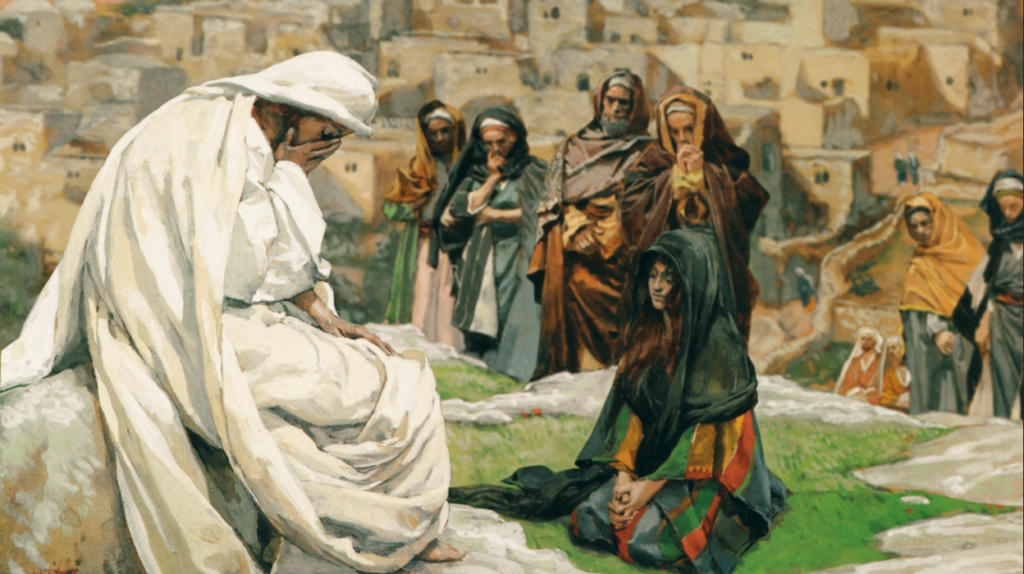
Most of us know “Jesus wept,” one of the shortest verses in the Bible (John 11:35). But as author and theologian Os Guinness points out, sorrowful weeping doesn’t begin to exhaust the description of what Jesus is experiencing in this cemetery.
Embrimaomai is the verb used in John 11:38 to describe his feelings as he approaches the tomb. Its root meaning is to “snort in spirit.” The ancient writer Aeschylus famously used this verb to describe Greek stallions – war horses – just before battle. They pawed the ground, reared on their hind legs, and snorted before they charged towards the enemy.
Jesus likewise displays a surge of anger as he approaches the enemy. What enemy?
He is coming face to face with Death.
Guinness writes, “Entering his Father’s world as the Son of God, he found not order, beauty, harmony, and fulfillment, but fractured disorder, raw ugliness, complete disarray – everywhere the abortion of God’s original plan. Standing at the graveside, he came face to face with a death that symbolized and summarized the accumulation of evil, pain, sorrow, suffering, injustice, cruelty, and despair.”
Crying real tears and feeling heartfelt outrage, Jesus declares that Death’s days are numbered. “I am the Resurrection and the Life.” And then he provides a preview of coming attractions by raising Lazarus from the grave.
The God embodied by Jesus, alone on the world stage, feels the world’s pain. Then he actually does something to heal the sorrow and the loss.
Jesus is conveying to us, “This is what God is like. God is not neutral or impassive. He feels with us. He suffers with those who suffer.”
But there’s more. Much more.
Astonishingly, the God of the Apostles’ Creed has been wounded. We proclaim that Jesus “suffered under Pontius Pilate.” The one who grieves outside the tomb of Lazarus will himself suffer and die just a few days later.
This means that empathy is included in the bandwidth of divine feelings. Jesus doesn’t just see our pain from a distance. He knows and shares our pain from the depth of his own experience.
A God who suffers?
The philosophers of the ancient world mocked the early Christians for worshipping the victim of a public lynching. Talk about backing a loser.
But the God who wells up with tears at funerals is the kind of God we so desperately need.
And the best news of all is that he’s also in the business of raising the dead.