
To listen to today’s reflection as a podcast, click here
Throughout the season of Lent, we’re taking a close look at the Apostles’ Creed – one of the earliest and most concise summaries of what followers of Jesus believe.
Seventy-three years ago today, on March 6, 1953, the front page of The Indianapolis Star announced the death of Soviet premier Josef Stalin.
Stalin is widely regarded as the most heinous dictator in a century that became infamous for genocidal despots.
During his three decades of totalitarian rule, Stalin is thought to have ordered the deaths of at least 65 million people, most of them his own countrymen. In his epic work Stalin: Breaker of Nations, Robert Conquest asserts that Stalin personally approved the execution of 70% of the members of the Communist Party.
A mere suggestion of disloyalty was sufficient to send even a close friend to the firing squad.
Stalin was notoriously insecure. Once, when he entered a concert hall, everyone present sprang to their feet, applauding madly. Now…who would be the first person courageous enough to sit down? After many minutes, an older man finally became tired and retook his seat. The police took note of the man and arrested him the following day.
The long-awaited death of Stalin was big news, indeed. It deserved the primary headline in Indianapolis.
Something much quieter also happened on March 6, 1953. A young Indianapolis couple named Walter and Phyllis Vonnegut became parents of a little girl. The Star noted the next day on a back page that her name was Mary Susan.
I happen to care about March 6, but not because of Josef Stalin.
Stalin is part of history. But Mary Sue Vonnegut is part of my history. Later this year we will celebrate our 51st wedding anniversary.
History shows up, seemingly out of nowhere, in the Apostles’ Creed. Besides Jesus, two other figures appear within the Creed’s recitation of core Christian beliefs. One is Mary, Jesus’ mother. The other is Pontius Pilate. Mary takes center stage at the beginning of Jesus’ life. Pilate arrives on the scene, briefly but dramatically, at the very end.
Think of the high-profile names that might have been included in the Creed but are nowhere to be found: Peter, James, John, Paul, Mary Magdalene, Caiaphas, Herod, or one of the Roman emperors.
The early church opted instead for a mid-level Roman official who, by almost anyone’s assessment, made a serious mess of his job.
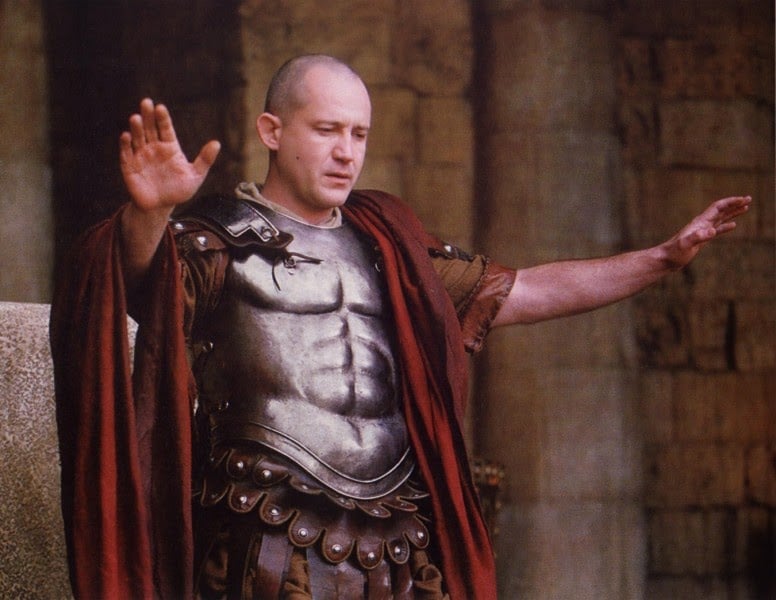
Pontius Pilate has been described as a thug with a toga. He was tabbed by the Emperor Tiberius to serve as procurator of Judea, a role he filled between 26 and 36 A.D. Historians believe that Jesus appeared before him in the spring of A.D. 30.
According to Pilate’s contemporary, the Jewish historian Philo, he was “naturally inflexible, a blend of self-will and relentlessness,” known for “the briberies, the insults, the robberies, the outrages, the wanton injustices, the executions without trial constantly repeated, the ceaseless and supremely grievous cruelty.”
It remains a mystery why the emperor would choose such a candidate for anger management to govern Judea, of all places – a backwater imperial province long known as a simmering pot of revolutionary fervor.
Despite regular warnings not to provoke the Jews, Pilate couldn’t seem to help himself.
He confiscated money from the Temple treasury in order to pursue a pet building project, the construction of an aqueduct. He likewise authorized a cohort of soldiers to enter the Temple mount carrying imperial standards. Since each standard bore the likeness of the emperor, earnest Jews saw this as a brazen attempt to defile God’s holy ground with idols.
In each case, rioting was narrowly averted.
Half a dozen years after Jesus’ crucifixion, Pilate ordered the slaughter of a group of Samaritans on religious pilgrimage. That was a bridge too far, even for an empire that had long before accommodated itself to violence. Pilate was recalled to Rome, never to be heard from again.
It’s worth noting that the four Gospel writers, in their accounts of Jesus’ appearance before Pilate, are somewhat gentler in their assessment of the procurator.
He is presented as curious and confused about Jesus. His wife hastens to warn him that she has had a troubled dream concerning this Galilean prophet.
In the end, however, he defaults to the cynicism that has always been part of his playbook. He works the crowd gathered outside the Praetorium. “Shall I crucify your king?” They respond, “Crucify him! We have no king but Caesar.” To compel a Jewish mob to abandon the kingship of Yahweh in favor of Emperor Tiberius was a political miracle almost too good to be true.
Why, in the end, does Pontius Pilate appear in the Apostles’ Creed?
He is proof that God the Son entered history – real history, stamped with a real name of a real government functionary who appeared in the empire’s official records.
The narrative about Jesus, in other words, is not a myth. It is not a campfire story.
Real history has heroes, villains, and everything in between.
Our call is not merely to be students of things that happened in first century Palestine. It’s to let God become part of our own history – to let him enter our hearts in such a way that we experience his love not only as a story about someone else, but as an account of our own minutes and our own days.
That would definitely be worth a banner headline.