
To listen to today’s reflection as a podcast, click here
Throughout the season of Lent, we’re taking a close look at the Apostles’ Creed – one of the earliest and most concise summaries of what followers of Jesus believe.
The annual commemoration of Jesus’ Ascension is the Rodney Dangerfield of the Christian calendar.
As the bombastic comedian used to say during his stand-up routines, “I’m tellin’ you, I don’t get no respect.”
Jesus’ arrival as a human being (Christmas), his last meal with his disciples (Maundy Thursday), his sacrificial death on the cross (Good Friday), and his empty tomb (Easter) always draw plenty of attention.
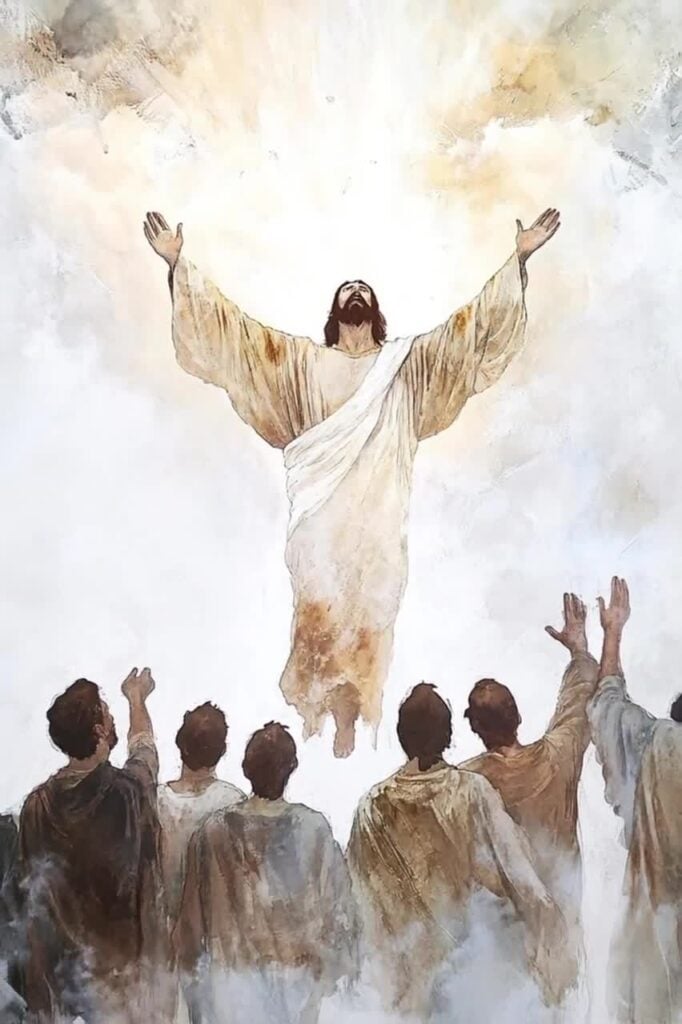
But what are we supposed to do with Jesus suddenly rising into the air and disappearing from sight 40 days after his resurrection, the event that numerous church groups acknowledge every year at the Feast of the Ascension?
His original band of followers wrestled with the same question.
Just six weeks earlier, they felt devastated. Their master had been sentenced to death by a consortium of Jewish religious authorities and Roman political hacks. When Jesus’ body was laid in a limestone tomb and a large rock was rolled in front of it, something else had died, too. Their hope.
Then, incredibly, the worst news they had ever heard gave way to the best news they had ever heard.
Jesus was alive. And he was loose in the world.
When we open the New Testament book of Acts, the disciples are excited. Who can blame them? They ask Jesus, “Lord, are you at this time going to restore the kingdom to Israel?” (Acts 1:6)
Essentially, what they’re saying is, “Lord, is this when we get to relive the glory days of David and Solomon? Is this when everybody takes the express elevator to heaven?” If they were writing God’s story, everything would end right here.
This moment would be called Jesus Ends. Jesus ends pain and death. Jesus ends the occupation of Roman soldiers. Jesus ends the long and winding road of human history.
What a surprise they get instead. This is not Jesus Ends, but Jesus Sends.
Somebody’s going to heaven all right. But it’s not the disciples. It’s Jesus. His followers will stay behind to work on a global job assignment.
Here’s how Luke tells the story in Acts:
“[Jesus] told them, ‘You don’t get to know the time. Timing is the Father’s business. What you’ll get is the Holy Spirit. And when the Holy Spirit comes on you, you will be able to be my witnesses in Jerusalem, all over Judea and Samaria, even to the ends of the world.’
“These were his last words. As they watched, he was taken up and disappeared in a cloud. They stood there, staring into the empty sky. Suddenly two men appeared—in white robes! They said, “You Galileans!—why do you just stand here looking up at an empty sky? This very Jesus who was taken up from among you to heaven will come as certainly—and mysteriously—as he left’” (Acts 1:7-11, The Message).
Here we should pause and note that “heaven,” in Jewish thinking, was not some sort of celestial balcony located just above the stratosphere. Rather, it connoted “the place where God dwells,” whatever and wherever that happened to be. In our own day, a synonym might be “the invisible world.”
Why, then, did Jesus go up?
Many people, when searching for the right way to describe Jesus drifting skyward toward the clouds, might opt for the word “bizarre.”
Australian scholar Michael Bird admits it is “a mixture of visual marvel, strange metaphor, and utter mystery.” Why such a peculiar departure?
Bird writes, “Jesus is taken away in such a manner as to leave clear in the minds of observers that he has gone to be with the Father in heaven.” If Jesus had simply bid farewell to his friends and headed off down the road, they may well have expected to see him around the next corner. The Ascension was an unusually memorable way of communicating, “I am leaving and you are staying.”
More importantly, the Ascension marked the beginning of a new spiritual chapter: the outpouring of the Holy Spirit.
Jesus had spoken about this at the Last Supper: “But very truly I tell you, it is for your good that I am going away. Unless I go away, the Advocate will not come to you; but if I go, I will send him to you” (John 16:7).
Ten days after Jesus ascends into heaven, that promise is fulfilled. The Spirit comes rushing like a mighty wind upon his followers on the day of Pentecost.
Supernaturally empowered, they are released into the world. They are now Jesus’ hands and feet – the ones who, in his name, will heal the sick, comfort the discouraged, feed the hungry, welcome the stranger, and proclaim God’s good news.
To this day, Jesus is still in the sending business.
When he departed this planet, what exactly did Jesus leave behind?
As far as we know, he wrote no books. He left no family line or spiritual dynasty, despite the silly claims of The Da Vinci Code. He left no home or belongings to be safeguarded behind glass display cases in various museums.
The only thing that remains of Jesus, and that’s on display right now, is what he planted within you and me.
What can we hope to accomplish with a resource like that?
If we come to believe that Jesus is still alive and at work in the world, is in charge of everything, and accompanies us by his Spirit wherever we go, there’s honestly no telling what he will be able to do with the rest of our lives.