
To listen to today’s reflection as a podcast, click here
Throughout the season of Lent, we’re taking a close look at the Apostles’ Creed – one of the earliest and most concise summaries of what followers of Jesus believe.
The human body is extraordinary.
That becomes apparent just by considering a handful of numbers.
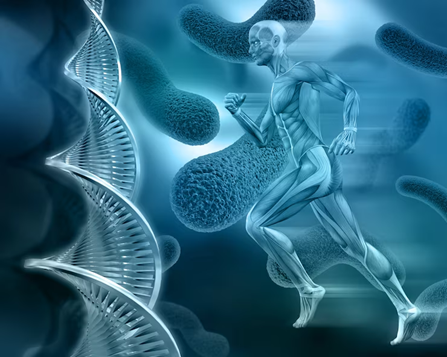
Your body is a teeming metropolis of something like 37 trillion cells, each one of which is regulated by tightly folded strands of DNA that – if stretched out – would exceed the length of a yardstick. If all your cells’ DNA was strung together end-to-end, how far would it go? The answer is 34 billion miles – approximately 17 round trips to Pluto.
Incredibly, your body also happens to be home to more non-human cells than the ones that are strictly “you.” Your personal microbiome exceeds 40 trillion bacteria. While that may sound like the premise of an incredibly creepy horror movie, your digestion, immune systems, and aspects of your mental health would quickly falter apart from your microscopic traveling companions.
Your bones are strong. Really strong. Ounce for ounce, they are five times stronger than steel.
Your brain is a grayish mass about the size of a softball. It boasts more synapses (junctions where neurons communicate with other neurons) than the number of stars in our Milky Way galaxy. That’s pretty remarkable, especially considering the fact your brain is 80% water.
Your body produces 2 million new red blood cells every second.
Finally, human eyes can distinguish at least 1 million different colors. Trying fitting all of those into your Crayola box.
Each of those discoveries has come to light over the past 50 years. People in ancient times had no clue their bodies were so miraculous – literally worthy of wonder.
The consensus of first century paganism, in fact, was that human bodies were basically vile and expendable. If a human being was an ear of corn, the body was the husk that was peeled off and thrown away at death. Bodies were routinely afflicted by blemishes, belches, breakdowns, and a whole host of functions that probably don’t need to be spotlighted in an online devotional.
The only aspect of a person that was worth saving – the “grain,” so to speak – was a non-physical, ghostly “shade.” Your shade would end up in Hades, the realm of the dead, where it was assumed that existence was a never-ending low energy drag.
There weren’t many reasons for pagans to be excited about what awaited them beyond the cemetery.
The first time they heard the words of the Apostles’ Creed – that followers of Jesus believe in “the resurrection of the body” – they must have been more than a little surprised. Who in the world would want to hang on to their body a minute longer than they had to?
It’s worth taking a moment to explore the background of the anti-body sentiment of the ancient Mediterranean world.
Part of that sentiment was influenced by a group of intellectuals who called themselves Gnostics. The name comes from the Greek word gnosis, which means “knowledge.” The Gnostics considered themselves the original Wise Guys, or “people in the know.”
The Gnostics’ signature idea was that spiritual things are good, while material things are evil. Therefore the existence of the universe itself must be considered a terrible mistake.
According to the Gnostics, God never intended to make mountains and waterfalls and anteaters and star clusters and jogging paths through beautiful stretches of woods. A second-rate spiritual being – certainly not the True God – somehow messed everything up by creating a cosmos.
Human beings, unfortunately, became trapped inside physical bodies. As we noted in a reflection last fall, if the Gnostics had been into bumper stickers (or at least chariot stickers), they would no doubt have opted for one of their favorite slogans: Soma Sema.
“Soma” is the Greek word for body. You might remember somatic cells from high school biology. “Sema” means grave. For the Gnostics, Soma Sema meant “your body is a tomb.” It’s a prison. And you’re trapped inside.
Your lifelong job is to break free. True spirituality means abandoning the constraints of your body and everything else here on earth, so you can enter the next world as a pure spirit.
Therefore, according to the Gnostics, nothing here on Earth really matters. Not politics, getting married, feeding hungry people, restoring antiques, building a neighborhood clinic, curing cancer, painting pictures, rallying for justice, or loving your neighbor as yourself. All those things are a colossal waste of time.
,
To which the earliest Christian teachers responded in unison: That’s absolute rubbish.
The Apostles’ Creed, we recall, begins with these words: “I believe in God the Father Almighty, Maker of heaven and earth.” God made the world. Which means God is seriously into stuff – like earlobes and chocolate and goldfinches and enough DNA in everybody’s body to stretch to Pluto and back 17 times. God loves the world so much, in fact, that God the Son lived here as a human being for something like three decades, and still retains a human body – the one in which he sits at the Father’s right hand while ruling the cosmos.
What does the Creed mean by declaring “the resurrection of the body”?
That’s not merely an affirmation that Jesus physically rose from the dead – something stated plainly just a few lines earlier. This time, the word “resurrection” is a prediction concerning us.
Our embodied life isn’t going to end at the moment of death. At some point in God’s future, those who have died “in Christ” will experience physical resurrection. We will get brand new bodies. Transformed bodies. Here’s how the apostle Paul puts it:
“This image of planting a dead seed and raising a live plant is a mere sketch at best, but perhaps it will help in approaching the mystery of the resurrection body—but only if you keep in mind that when we’re raised, we’re raised for good, alive forever! The corpse that’s planted is no beauty, but when it’s raised, it’s glorious. Put in the ground weak, it comes up powerful. The seed sown is natural; the seed grown is supernatural—same seed, same body, but what a difference from when it goes down in physical mortality to when it is raised up in spiritual immortality!” (I Corinthians 15:42-44, The Message).
What does all this mean in the here and now?
It means your body – even your present body, the one that creaks and groans as you get older, but which God gave to you as a gift – is most certainly not a tomb.
Our culture blares all kinds of messages about our bodies, and many of them are right out of the Gnostic playbook: You’re too fat. You’re too thin. You have too many wrinkles. You have too many zits. You ought to feel ashamed of yourself because you don’t have perfect abs.
Have you ever hoped that one day you might see an actual miracle?
Just look in the mirror. Recall that every second you’re standing there looking, your body is producing 2 million new red blood cells.
The author of Psalm 139:14 writes: “I praise you because I am fearfully and wonderfully made.”
The Good News is that a good God has made an awesome world in which creatures like us can experience deep joy.
And our joy will only deepen when we receive the new bodies that he has promised us as part of his new creation.