
To listen to today’s reflection as a podcast, click here
Throughout the season of Lent, we’re taking a close look at the Apostles’ Creed – one of the earliest and most concise summaries of what followers of Jesus believe.
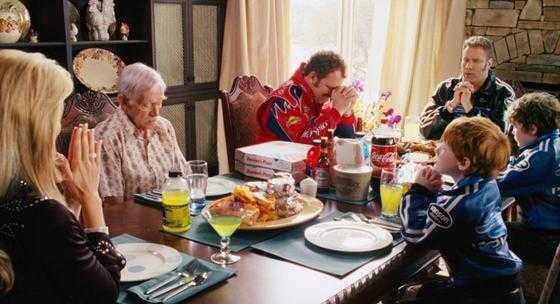
Very few Hollywood films feature a family praying together before dinner.
After listening in on the table grace in Talladega Nights: The Legend of Ricky Bobby, that might be just as well.
Ricky Bobby, played by Will Farrell, folds his hands and prays: “Dear Lord Baby Jesus, I want to thank you for this wonderful meal, my two beautiful sons, Walker and Texas Ranger, and my red-hot smokin’ wife, Carley.”
Ricky goes on: “Dear eight-pound, six-ounce baby infant Jesus … lying there in your little manger, lookin’ at your Baby Einstein developmental videos, learnin’ ‘bout shapes and colors…” Carley cuts in: “Hey, um, Sweetie … Jesus did grow up. You don’t always have to call him a baby.”
Ricky responds: “Look, I like the Christmas Jesus best, and I’m sayin’ grace. When you say grace, you can say it to the Grownup Jesus or Teenage Jesus or Bearded Jesus or whoever you want.”
What follows is a bit of a theological free-for-all. Everybody in the family votes for a favorite Jesus.
“I like to think of Jesus like a Ninja, fightin’ off evil samurai,” says one of the boys. “I like to think of Jesus like a muscular trapeze artist,” says the other. Ricky’s race partner adds: “I like to picture Jesus in a tuxedo T-shirt. ‘Cause it says like, I wanna be formal but I’m here to party, too. I like to party, so I like my Jesus to party.”
As a general rule, it’s wise not to go to Ricky Bobby for theology.
But Ricky’s family is at least willing to do openly what most Americans do more discretely: We choose our own Jesus.
When an anxious Jerusalem crowd stood before Pontius Pilate on a Friday morning twenty centuries ago, those present had to choose their own Jesus as well.
On the surface of things, the choice seemed straightforward. Pilate presented two prisoners: a convicted felon named Barabbas and a teacher from Galilee named Jesus. He declared his intention to set one free. Which one would the crowd prefer?
Matthew described Barabbas as a notorious criminal. The word “notorious” in this context has a connotation of popularity.
He was what you might call a celebrity terrorist – a brave patriot or nationalist revolutionary who had had the guts to do what a lot of other people had only dreamed of doing: He had stood up to the despised Romans. Luke tells us that he had committed murder, presumably of someone sympathetic to the empire.
Here we need to take note of something that doesn’t appear in many modern Bible translations.
In some of the oldest manuscripts of the Gospel of Matthew, we discover that Barabbas has a first name. His first name is Jesus. Jesus (Yeshua, in Hebrew) was a common name in Bible times. It is essentially the English name “Joshua,” and means “the Lord saves.”
Here’s how Matthew reads in the oldest manuscripts: “At that time they had a notorious prisoner named Jesus Barabbas. So when the crowd had gathered, Pilate asked them, ‘Which one do you want me to release to you: Jesus Barabbas, or Jesus who is called Christ?” (Matthew 27:17)
It is a dramatic moment: Which Jesus do you want? This Jesus or that Jesus?
So why doesn’t “Jesus Barabbas” appear in many modern English translations? Most reputable Bible scholars, after all, are convinced of its authenticity.
There is strong evidence that early in Christian history copyists purposely dropped the name “Jesus” before Barabbas out of respect for the “real” Jesus, the one who claimed to be God’s Messiah. The tradition of omission continues with many translators today, since most later copies of Matthew do not, in fact, include Barabbas’ fascinating first name.
The two prisoners stood before the crowd.
It may have seemed as if they were on trial. But in truth, it was now the crowd that was on trial. Which of these two figures held the greater promise for the nation of Israel?
Was it Jesus Barabbas, who would hit the Romans hard, make something important happen, and inspire the masses to revolution? Or was it Jesus of Nazareth, whose primary weapons were trusting God, refusing to worry, and loving one’s enemies?
The crowd chose Jesus Barabbas.
In the words of commentator Dale Bruner: “The wrong Jesus was released, the wrong Jesus was scourged, the wrong Jesus was crucified, but God used all these wrongs to make everything right.”
Every day, like those in the crowd, we must decide which Jesus we want.
Perhaps I want the Jesus who endorses my political views. Or the Jesus who doesn’t crowd me sexually. Or the Jesus who, amazingly, can’t stand the very same people I can’t stand. Or the Jesus who is entirely adjusted to my current behavior.
There’s just one problem with that strategy.
The only Jesus who can save me is the one who is actually real.
And that’s the Jesus who went to the cross on what would become known as Good Friday, willingly sacrificing his life so we might live.
At the beginning of this special weekend, may your heart be renewed by the love and grace of the true King of Kings.