
To listen to today’s reflection as a podcast, click here
As the Cold War began to heat up in the 1950’s, America’s leaders felt led to make a public statement that their chief adversary, the Soviet Union, would have to notice.
If the Soviets believed in state-sponsored atheism, the United States would counter with government-endorsed theism.
The 84th Congress passed a joint resolution that declared “In God We Trust” to be our official national motto. The resolution passed both the House and the Senate unanimously, without a single word of debate.
It’s hard to imagine our present Congress agreeing on what to have for lunch without vigorous debate.
On July 30, 1956, President Dwight Eisenhower signed the resolution into law. On the same day, he authorized a mandate that “In God We Trust” appear on all U.S. coins and currency.
It’s not surprising that a number of Americans are uncomfortable carrying around coins and cash bearing a motto they personally reject. They would gladly see it banished. But in a 2003 poll jointly administered by USA Today, CNN, and Gallup, a remarkable 90% of Americans (that’s more people than say they believe in God) gave it their thumbs up.
Every now and then, the motto gets a little garbled.
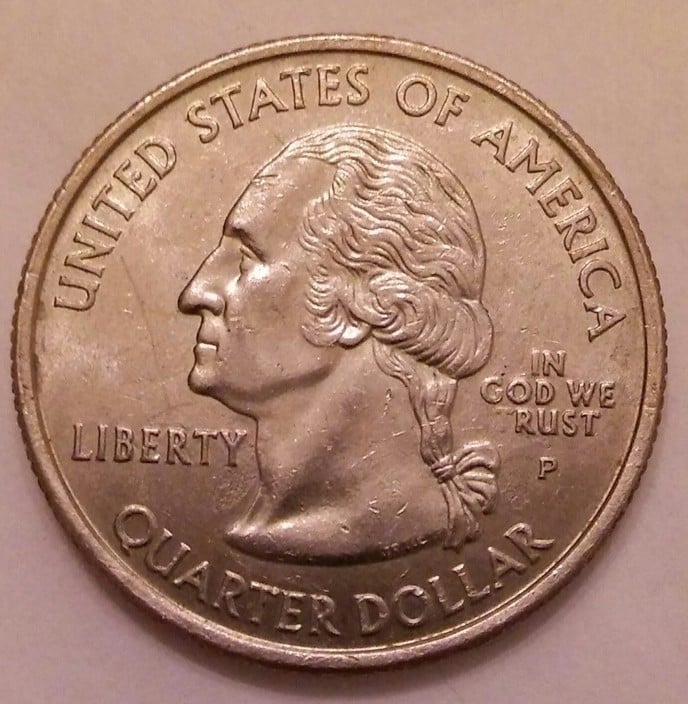
Consider the first run of the “Kansas” quarters in 2005, back when the U.S. mint was creating unique coins for each of the 50 states. A small glob of lubricant escaped from the stamping machine onto the surface of the coin die, plugging up the first letter T in “Trust.”
What do we get as a result? In God We Rust.
If you happen to have a 2005 Kansas quarter, by the way, that looks like the one above, collectors say it’s worth about $10. Which is not a bad exchange for 25 cents.
“In God We Rust” seems to have been the official motto of Jesus’ disciples in the Garden of Gethsemane.
Jesus had retreated to this olive grove with his friends immediately after they shared the Last Supper. He pleaded for their support. Would they be willing to pray for him while he wrestled alone with the task of embracing the monumental burden of pain and humiliation that lay just ahead?
What jumps out in the four historical accounts that we have of this moment – the narratives in Matthew, Mark, Luke, and John – is the utter spiritual ineptitude of Jesus’ apprentices. They all fail him personally.
Jesus returned to his disciples, only to find them sound asleep. “Couldn’t you stick it out with me for a single hour?” he asked. He then added, “Watch and pray so that you will not fall into temptation. The spirit is willing, but the flesh is weak” (Matthew 26:41).
The disciples had essentially stepped into the batter’s box against a major league pitcher, hoping they might be able to swing wildly at a 95-mph fastball and somehow get a hit.
But they hadn’t practiced prayer. They hadn’t practiced waiting. They hadn’t practiced wrestling with God.
They weren’t ready, in other words, for the spiritual big leagues.
Eugene Peterson, in his Bible paraphrase called The Message, offers this memorable rendering of the same verse: “Stay alert; be in prayer so you don’t wander into temptation without even knowing you’re in danger. There is a part of you that is eager, ready for anything in God. But there’s another part that’s as lazy as an old dog sleeping by the fire.”
In God We Rust.
What can we do?
Practice, practice, practice. Knock off the rust. We don’t have to “get anywhere” with God when we pray, because we already are right where we should be.
The best part is that we can practice our practicing any time we want.
Right now, for instance.