
To listen to today’s reflection as a podcast, click here
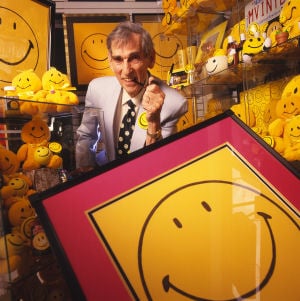
Harvey Ross Ball’s most famous artistic creation took just 10 minutes to complete, and it earned him a mere $45.
But it’s been worth a billion smiles.
In 1963, Ball, a freelance artist guiding his own advertising firm, was approached by the marketing director of State Mutual Life Assurance Company of Worcester, Massachusetts (now known as Hanover Insurance). State Mutual had recently merged with another corporation. The transition had been rough for everyone concerned. Employee morale was in the dumpster.
Could he design “a little smile” to help bring a surge of happiness to the workplace?
Ball decided to go with an actual smile.
He drew an arc on a sunny yellow circle. Concerned that his smile could become a frown if turned upside down, Ball added a pair of narrow oval eyes. In order to add some elements of imperfection, which would evoke a more human feel, he made the eye on the right slightly larger and the mouth slightly off-center.
Done. Just like that, Harvey Ball had created one of the most iconic images of the modern world: the smiley face.
State Mutual ordered 100 yellow buttons and passed them around, hoping that employees would smile more often while providing customer service. It worked. The buttons proved to be such a hit that the next order was for 10,000. Demand continued to accelerate. By 1971, more than 50 million smiley buttons were in circulation.
Today, the smiley face and all the members of his emoji family are global superstars.
Ball became unimaginably wealthy, right? Actually, he chose not to copyright his creation. The humble smiley face belongs to all of us. In 1999 he founded the Harvey Ball World Smile Foundation, a not-for-profit charitable trust that supports children’s causes.
Now, that’s a way to create real smiles.
All of which raises an interesting question: Do fake smiles on billboards, flat screens, and yellow buttons really prompt people to smile in return?
An astonishing amount of research says Yes.
Psychologist Susan Krauss Whitbourne admits that the old saying, “Smile, and the world smiles with you” sounds pretty trite. But it happens to be true. If we place ourselves in the presence of smiling people, or just pictures of those with upturned mouths, our own wellbeing is improved. Smiles are contagious, which means we often smile right back.
Smiles are natural stress relievers, contributing to heart health, reducing blood pressure, and boosting the immune system. Smiling has been likened to getting good sleep.
Studies reveal that even forced smiles stimulate the brain to release dopamine and serotonin, feel-good hormones that help relieve pain and stimulate happiness.
The average adult smiles about 20 times a day. Happy people ratchet that up to around 50 times. Children, on average, smile up to 400 times a day, which is why we so often feel happier in the presence of kids – unless of course they have just finished a large bag of M&Ms and are bouncing off the walls an hour past bedtime.
A famous study tracked the lives of women who had “the best smiles” in their high school yearbook photos. On average, they experienced happier relationships and fewer setbacks. Likewise, a study of major league baseball players revealed that those who smiled broadly on their baseball cards lived something like seven years longer than those who didn’t.
Now I wish I could go back and pose again for my nine-year-old softball team picture.
Does the Bible have anything to say about smiles?
Interestingly, the words “smile” and “smiling” never appear anywhere in Scripture.
But both Old and New Testaments have plenty to say about joy and laughter and celebrating, which we may assume were routinely accompanied by an abundance of smiles.
Here’s how God instructed Aaron the high priest to bless the Israelites: “The Lord bless you and keep you; the Lord make his face shine upon you and be gracious unto you; the Lord turn his face toward you and give you peace” (Numbers 6:24-26).
There was no greater honor in the ancient world than to see the face of the king. And if the king “made his face shine upon you” – or as we might put it, “looked at you with glowing affection” – it’s impossible not to imagine smiles on the faces of both the one who is blessing and the one who is blessed.
St. Mother Teresa declared, “Peace begins with a smile.”
In a world that is desperate for peace of heart and peace between neighbors, the best place to start is to receive the gift of God’s smile.
And then to smile in the presence of all those he will send into our lives this beautiful spring weekend.
😊 😊 😊