
To listen to today’s reflection as a podcast, click here
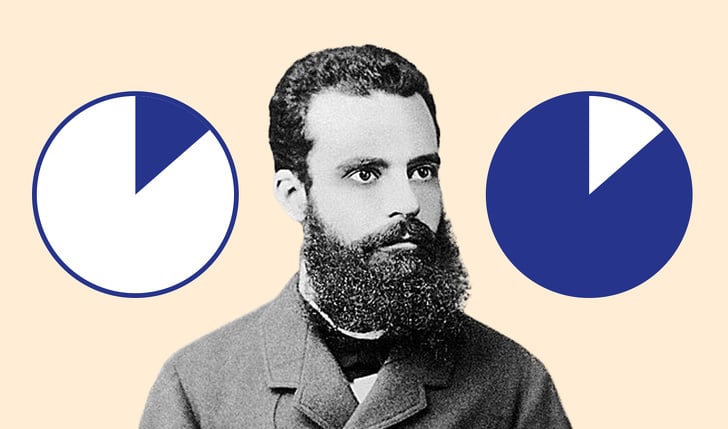
In 1906, the Italian economist Vilfredo Pareto noticed something interesting.
As a rule, 80% of the peas that he harvested from his garden came from just 20% of the pea pods.
Pareto also happened to know that 80% of the land in Italy was owned by only 20% of the population. And a majority of businesses received 80% of their sales from only 20% of their clients.
Thus the world was introduced to the Pareto Principle, or the so-called 80-20 Rule.
In so many words, “80% of the effects are produced by 20% of the causes.” This appears to be true in a surprising number of contexts.
For instance, studies of pro sports teams have shown that one-fifth of the players (the so-called superstars) are responsible for four-fifths of a team’s victories.
According to the United Nations, 82.7% of the world’s wealth is controlled by approximately 20% of the world’s population.
When it comes to human productivity, the Pareto Principle is sometimes known as the Law of the Vital Few. That’s because 20% of the members of a particular group almost always accomplish 80% of the work. The flip side, of course, is that the remaining four-fifths of a typical group assume responsibility for only one fifth of what needs to get done.
Anyone who has ever been part of a not-for-profit board, a Rotary Club, or a youth sports league knows just how true that is.
Likewise, a mere 20% of American citizens generate 80% of what happens in politics, even though 100% of us feel empowered to complain about the results.
We can now confirm what we have long suspected: 80% of the doughnuts at a typical church gathering are eaten by 20% of those present. We have the surveillance videos to prove it.
It’s also easy to confirm that 20% of self-identified followers of Jesus accomplish about 80% of any church’s overall mission work, and 80% of the resources that are required to support that mission spring from the generosity of just 20% of those in the Body of Christ.
The Pareto Principle, in short, is a valid snapshot of the way that life usually works.
That’s another way of saying that 80% of us feel comforted that somebody, somewhere, is going to get that important job done. Somebody else is going to pay for that.
But the 80-20 Rule is not genetically encoded. It is not predestined. It is a sociological tendency that describes typical group behavior.
And things don’t always have to be that way.
Most of us can remember at least one time in our lives when it seemed that everybody pitched in. Remember that winter when Mom got sick, and the entire family had to work together just to keep the house organized and food on the table?
It would seem that the horrors and deprivations of World War II would be among the worst memories for the citizens of London. But countless Brits looked back on those dark days – especially the Blitz, when the city was bombed every night for weeks on end – as the greatest chapter of their lives. That’s because of the camaraderie and collaboration that brought total strangers together in a common cause: to survive the Nazi assault on their very civilization.
Apart from a compelling concern that brings people together, human beings almost always revert to the 80-20 Rule.
But we don’t have to wait for sickness or war to force our hands.
What if we “declared war” on poverty, injustice, spiritual ignorance, and hopelessness on our streets? What if we took seriously the mission that God has already given to us – to raise up ardent followers of the compassionate Way of Jesus, and release them for service in our broken world?
We would quickly discover the most important metric of all:
100% of us have been called and equipped by God to serve others. And we can do that even today.
Followers of Jesus can live out the Law of the Vital Many.
Vilfredo Pareto would surely have been delighted to see such a transforming exception to his rule.