
To listen to today’s reflection as a podcast, click here
If you choose to be good and do good, life will go well for you.
That’s what religion finally boils down to, right?
There are certainly groups out there that would sign off on that credo. But the Jesus movement has never been one of them.
That is powerfully illustrated in a memorable novel by the Scottish writer Robert Louis Stevenson.
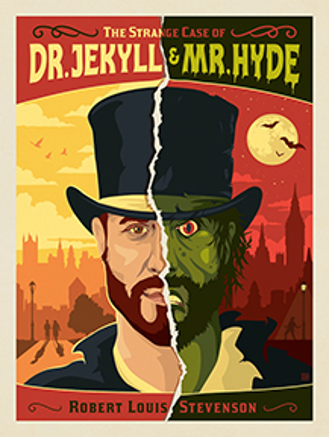
Strange Case of Dr. Jekyll and Mr. Hyde (1886) introduces us to Dr. Henry Jekyll, an erudite, upstanding gentleman who wants to be good and do good. But his efforts to be a wholly good person are constantly defeated by dark impulses that seem to lurk inside his heart.
It’s almost as if he is two people. One is righteous; the other is depraved. The doctor is frustrated because his evil twin seems to be holding him back.
Therefore he cooks up a potion that will solve the problem. He will separate his good self from his shadow side.
Whenever he downs this chemical concoction, Jekyll is free to walk about town during the day doing wonderful things. At night, however, his body is taken over by Edward Hyde, the personification of his worst impulses.
Jekyll quickly gets a rude surprise.
His dark side is far worse than he thought. Edward Hyde turns out to be a monster. He rages and murders without a shred of remorse. Literary critics have pointed out that Stevenson did not choose the name “Hyde” arbitrarily. We all have a concealed self that we hide from the world and even from ourselves.
What “potion” does it take to bring out your dark side?
Perhaps it’s that creep who cuts you off in traffic. Or the workplace manager who dismisses your best efforts in front of the whole team. Or that tsunami of temptation that your better self has learned to run away from. Suddenly we become monsters.
Jekyll, assessing the horror of his situation, resolves never to drink the potion again. He will make up for Hyde’s crimes by becoming as good as good can be.
This brings great relief. One day, while sitting in a London park, he congratulates himself for becoming such a moral hero through his own efforts:
“I smiled, comparing myself with other men, comparing my active goodwill with the lazy cruelty of their neglect… at the very moment of that vain-glorious thought, a qualm came over me, a horrid nausea and the most dreadful shuddering… I looked down… I was once more Edward Hyde.”
This is a terrifying development.
Even though he hasn’t taken the potion, he has become the monster. Jekyll can no longer control the co-existence of his two selves. Overwhelmed by fear and despair, he takes his own life.
Author and pastor Timothy Keller observes in his book The Reason for God, “Jekyll becomes Hyde, not in spite of his goodness, but because of his goodness.”
There are two ways to ruin your life.
One is to become a self-centered monster who smashes every rule in sight. The other is to become a self-righteous prig who is consumed with pride by trying to obey every rule in sight.
Only Jesus can save us from both pathways.
A program of self-salvation – “I promise to be as good as good can be, starting now” – can never save us from our dark selves. It will only cause us to hide (Hyde) our darkness from the world. Within our hearts it will produce a poisonous crop of bigotry and conceit.
Is Satan hoping we will become monsters? Keller doesn’t think so: “The devil, if anything, prefers Pharisees – men and women who try to save themselves. They are more unhappy than either mature Christians or irreligious people, and they do a lot more spiritual damage.”
So why did Jesus allow himself to end up on the cross?
He died to render null and void every program of self-salvation.
My inner world is so bent that Jesus had to die for me, but I am so treasured by God that Jesus was glad to die for me.
Life, in the end, is not about being good and doing good.
It’s about choosing to throw in our lot with an exceptionally good Savior.