
To listen to today’s reflection as a podcast, click here
In his book The Greatest War Stories Never Told, Rick Beyer describes the fateful charge of Pickett’s Brigade on July 3, the final day of the Battle of Gettysburg:
With tens of thousands watching in awe, these brave men set off beneath the fierce afternoon sun.
A mile of farm fields separated them from the Union soldiers up on Cemetery Ridge, but come what may, they were intent on coming to grips with their enemy.Proudly they marched, battle flags waving, a spectacle more dramatic than anyone there had ever seen. As they drew close, the rebel yell broke from their throats.
The Yankees, crouched behind a stone wall, could wait no longer. Hearts about to burst with emotion, they flung themselves forward to meet the enemy.
And then everyone hugged and cried.
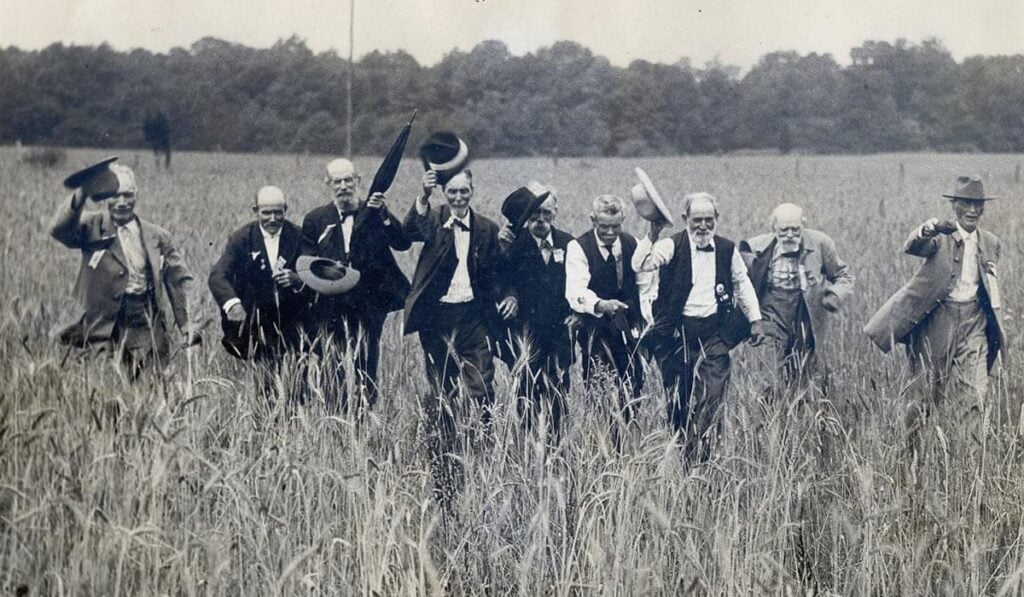
This was not the Civil War. This was July 3, 1913 – the 50th anniversary of Pickett’s Charge. The Confederate survivors of that horrific day, many wearing their old uniforms (as can be seen in the photo above), retraced their steps across the fields with canes and crutches. Their Union counterparts and more than 100,000 spectators looked on.
Philip Meyers, who witnessed the event, wrote, “As the rebel yell broke out after a half century of silence…a moan, a gigantic sigh, a gasp of unbelief rose from the onlookers.”
Men who had made war now chose to embrace peace.
On this particular July 3 – having arrived at the eve of our nation’s 250th birthday in a cultural fog of anger, mistrust, and personal conflict – our call is surely to do the same.
Our current struggle is not that we’re mired in disagreements.
Disagreements will always be with us. As author and apologist Vince Vitale points out, the real problem is that we have lost the ability to disagree well.
All too often, disagreements lead to devaluing other human beings. If you and I have different convictions about consequential issues, my mind will quickly try to come up with reasons why you don’t see the world the way I do (which I’m pretty sure is the right way).
Apparently, you’re deeply confused. Or you’ve bought into the agenda of some radical podcaster on the Left or the Right. Or you are irrationally angry. Or you don’t appreciate the nuances of my own story and why I feel the way I do, which is no doubt why you keep wounding me.
Or maybe you just like wounding me. Because you’re unhinged. Or because you should be on meds. Which explains why you go to the wrong place of worship, vote for the wrong candidates, and watch the wrong newscasts. In short, your views are messed-up because it’s pretty obvious you’re a seriously messed-up person.
Enough, already.
Can’t we find a healthier way forward?
The answer is not to eliminate disagreement. The last thing we need is a world in which disagreements can no longer be voiced. Cherishing different opinions about Stuff That Matters is one of the best things about being part of a vibrant community.
Instead of less disagreement, the need of the hour is more love – a love big enough that I can disagree with someone without devaluing them.
Where can such love be found?
The next time you are in active disagreement with someone, silently bring to mind the fact that this person is God’s unique creation. Just like you. And this is a person for whom Jesus gladly died on the cross. Just like you. The one thing that unites us with every other person on the planet is that God is utterly committed to us with a love that never quits – even when our words, actions, and cherished convictions must surely break his heart.
Jesus calls us to love others the way his Father in heaven loves them.
In the days ahead, whether you’re in a family room, a board room, or a chat room, you’ll be in position to ask one of two questions – either, “How can I get this other person to see that I am right?” or “How can I communicate God’s love and respect for this other person, even though we disagree?”
The most profound way to “conquer” someone else is with love – a love that is patient, that listens carefully, and that is open to the possibility that we ourselves still have a whole lot to learn.
As the apostle Paul put it 20 centuries ago:
“We’re Christ’s representatives. God uses us to persuade men and women to drop their differences and enter into God’s work of making things right between them. We’re speaking for Christ himself now: Become friends with God; he’s already a friend with you” (2 Corinthians 5:19-20).
The need of the hour is to agree to disagree agreeably.
And, if possible, to meet one day on what used to be a field of combat and to share some hugs and tears.
May God bless you this Fourth of July holiday weekend with his grace, peace, and love.