
To listen to today’s reflection as a podcast, click here
Each day this month we’re looking closely at one of the 1:1 verses of the Bible – exploring what we can learn from chapter one / verse one of various Old and New Testament books.
“Paul, an apostle—sent not from men nor by a man, but by Jesus Christ and God the Father, who raised him from the dead…”
It happened just 24 years ago, but Americans are still trying to wrap their heads around 9/11.
How is it possible that such a small group was able to generate so much destruction and loss?
A great many Americans (53%, according to a recent survey) think there simply has to be more to the story than we are being told. Were U.S. agents somehow behind the terror attacks – so they could provide the Bush administration a pretext for invading the Middle East?
According to Christopher Bader, a sociologist at Chapman University in California, a great many of your fellow citizens are comfortable with a degree of paranoia. Conspiracy theories abound. The moon landings may have been faked. Are government officials covering up an alien autopsy in Roswell, New Mexico? JFK was surely assassinated not by a lone gunman, but by Cubans or mafiosos or Russian operatives. Right?
“We found clear evidence that the United States is a strongly conspiratorial society,” says Bader.
Here’s a telltale sign: More than a third of those he surveyed believe the government is concealing information about “the North Dakota crash.” There’s no such thing as the North Dakota crash. Bader and his associates made it up.
Science writer Michael Shermer, editor-in-chief of Skeptic magazine – and quite possibly the world’s leading expert on conspiracy theories – points out that just because something is identified as a conspiracy doesn’t mean it isn’t real.
We know that the Johnson administration, for instance, conspired to cover up the nature and extent of the Vietnam War. The Nixon administration plotted to hide the details of the Watergate break-in. And there are good reasons to believe that a small group of highly committed individuals did indeed conspire (and succeeded) in launching the 9/11 terror attacks.
Conspiracy theories, on the other hand, are unproven assertions that claim to know the “real story” behind significant events.
Conspiracies and conspiracy theories are part and parcel of Bible history, too.
A consortium of powerful individuals, including members of the Jewish religious establishment and Roman occupiers, conspired to kill Jesus. When claims circulated that his tomb was empty, they decided to float a conspiracy theory that his body had been stolen by his disciples. In 1965, British scholar Hugh Schonfield published ThePassover Plot, a conjecture that Jesus (with Judas’ assistance) schemed to fake his own death on the cross by drinking a slurry of drugs.
Then and now, a great many people will settle for a conspiracy theory instead of doing the hard work of discerning reality. Why?
Conspiracy theories are exciting. They give us a feeling of control. At least we know a bit of what’s really going on. And they tend to absolve us of responsibility. Strange forces and mysterious figures are running the world’s show, and there’s almost nothing we can do about it.
The Jesus Story that emerges on the pages of the Bible is different.
It invites verification. “These [details of Jesus’ life] were written so that you may know that he is the Messiah” (John 20:31). Paul lists the names of people who met the resurrected Jesus, as if to say, “Check out their stories for yourself” (I Corinthians 15:3-8). It claims to be public news, not esoteric information for a handful of insiders: “These things were not done in a corner” (Acts 26:26).
Look again at Galatians 1:1: “Paul, an apostle—sent not from men nor by a man, but by Jesus Christ and God the Father, who raised him from the dead…”
At first glance, that seems fairly innocuous. But when we take into account the widely accepted timeframe for Paul’s letter, that final phrase becomes pretty special.
Bible scholars of all theological stripes agree that Galatians was possibly the first New Testament book to have seen the light of day. Evidence suggests that Paul composed this correspondence in A.D. 49 or 50. That’s only 20 years after Jesus’ final Weekend in Jerusalem.
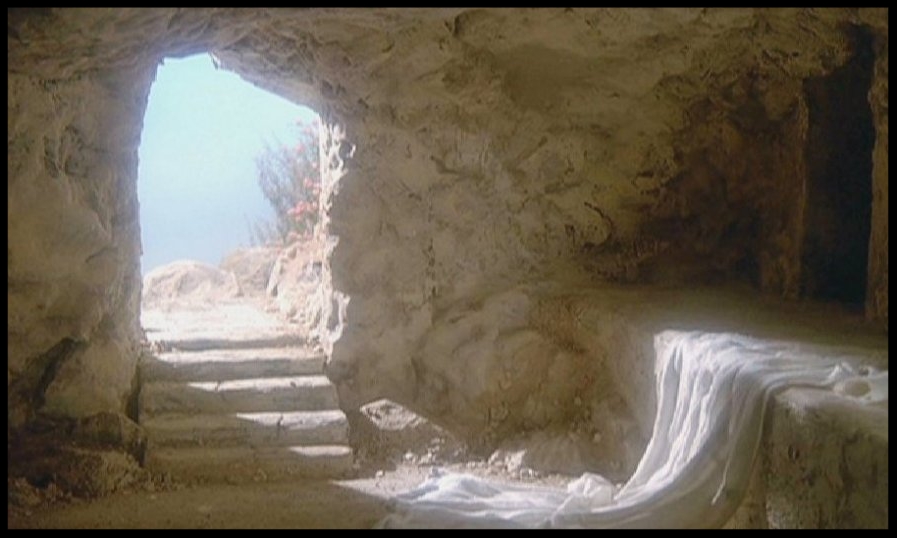
It’s not uncommon to hear religious skeptics assert that Jesus’ resurrection was a late “add-on” to the Christian message. One hundred, maybe 200 years after his death, so the theory goes, a few church bureaucrats began to float the notion that Jesus was somehow still alive and well. He rose from the dead. Yeah, that’s it. Let’s say an angel rolled away the stone from his tomb.
Galatians, however, was written within two decades of Jesus’ time on Earth. And Paul was saying at this very early time that God the Father had “raised him from the dead.”
The story was already out.
Paul composed his letter to the Romans some five to seven years later. British scholar N.T. Wright observes, “Paul’s letter to the Romans is suffused with resurrection. Squeeze this letter at any point, and resurrection spills out; hold it up to the light, and you can see Easter sparkling all the way through.”
By the mid to late 50s in the first century, the claim concerning the empty tomb was racing around the Mediterranean as fast as a new TikTok dance craze.
The resurrection wasn’t presented as the latest nutty idea from Judea, that nation of nutty people who for some reason believed in only one God. Its advocates agreed with Jesus, who had said: “Ask and it will be given to you; seek and you will find; knock and the door will be opened to you. For everyone who asks receives; the one who seeks finds; and to the one who knocks, the door will be opened” (Matthew 7:7-8).
In other words, don’t settle for urban legends, rumors, and conspiracy theories. Do your homework. Go find the truth.
The Jesus Story makes demands. It not only claims to make sense of the world but insists that we do something about it.
The world is a mess. So are we.
God is a God of action who has rolled up his sleeves and is asking us to join him in the ongoing work of rescue, healing, and redemption.
Paul insists, from Sentence One of his earliest book, that we won’t be attempting such a thing by ourselves.
The risen Christ will be with us every step of the way.