To listen to today’s reflection as a podcast, click here
Are you ready for Christmas? During the season of Advent – which annually begins on the fourth Sunday before Christmas and leads up to December 25 – followers of Jesus traditionally look for ways to prepare themselves for the coming of God’s own Son into the world. Throughout December we’ll ponder ways that we can ready ourselves to receive Jesus, once again, into our own hearts.
It’s so easy to rush quickly over the words of Scripture – especially when it comes to verses we think we know forwards and backwards.
In our haste, however, we sometimes miss the story behind the story.
Consider Matthew 1:18: “This is how the birth of Jesus the Messiah came about: His mother Mary was pledged to be married to Joseph, but before they came together, she was found to be pregnant through the Holy Spirit.”
There’s a lot to unpack in those words. Let’s take a closer look at “pledged to be married.”
During the first century, when a young Jewish man wanted to propose marriage to a young Jewish woman, he would gather their families and their friends. Everybody in the village would know what was about to happen. People would be humming that commercial jingle, “Every kiss begins with Kay.”
What followed would be a solemn but joyful ceremony. Engagement was a serious business, so serious that it took a civic and religious ceremony to kick things off.
Trembling, the young man would take a cup of wine and publicly offer it to his potential bride – a young woman probably in her early teens.
Here’s where it would get interesting.
Even if the parents had already arranged this wedding years before – as was often the case – and even if the girl had already told all of her friends that she thought this boy was a man of integrity who would make a fine husband and an excellent provider, she could still refuse to drink the wine.
Everyone is watching. What will she do?
If she says yes by taking the cup and drinking it, the engagement is on. In approximately one year, they will be married.
Within a few days, a search will begin within the courts of the Jerusalem temple – an exploration of family genealogical records. It wouldn’t be unusual for two young people from the same village to be distantly related to each other, but no one would want them to have too close a kinship tie. That was one of the reasons for the year-long engagement period. The search had to be extensive. Likewise, this time was an opportunity to confirm that the bride was morally pure.
The groom, overwhelmed with relief that his bride-to-be has welcomed the cup, gives a little speech. Everyone applauds and the young man heads home to take his next big step toward matrimony.
He begins a construction project.
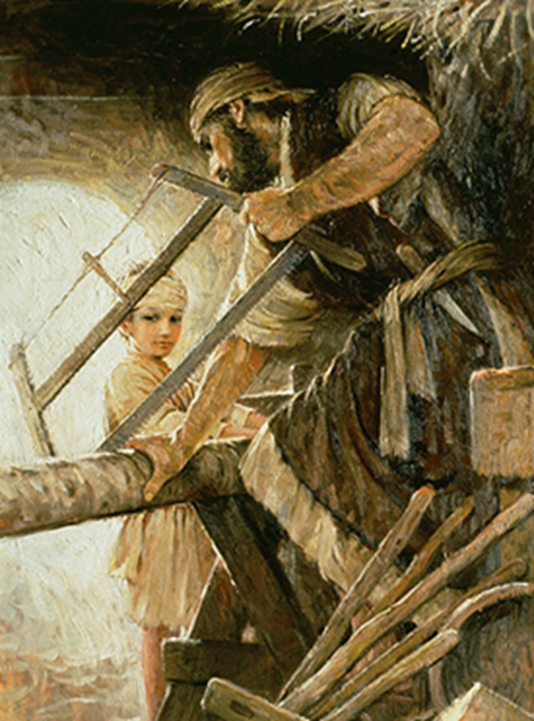
It is now his job to build a room onto his father’s house. This will be the place where he and his new wife will live together and start building their family.
Why doesn’t he build a house of their own? No one had yet dreamed up Starter Homes of Galilee. As long as a Jewish father was alive, his sons and daughters-in-law belonged to the same household. Therefore, a young man who intended to get married needed to pay close attention in his high school “mechanical arts” class.
He had to build, from scratch, a new addition to his father’s house. If the father had many sons, and if he lived a long time, his home would continually be sprouting new rooms.
When the work was finished, and the father had given his thumbs-up concerning the quality of his son’s efforts, the final preparations for the wedding could begin. The groom would go to his bride and take her to the place he had prepared.
That was the cultural reality that provided the backdrop for some of Jesus’ most famous words at the Last Supper.
While Jesus was sharing the Passover meal with his disciples, he spoke plainly. He told them he would be with them only a little while longer. He was leaving – and for now, at least, it would be impossible for them to join him.
Peter was floored. “Lord, where are you going? And why can’t I come with you right now?” Then he promised that he was ready to die for Jesus that very night. Instead, his courage and faith would implode. Three times he would tell strangers that he didn’t even know who Jesus was.
Jesus did not hesitate to answer Peter’s questions:
“My father’s house has many rooms; if it were not so, I would have told you. I am going there to prepare a place for you. And if I go and prepare a place for you, I will come back and take you to be with me, that you also may be where I am” (John 14:2-3).
We often hear those words today – at funerals. But to first century ears, what does Jesus sound like?
He sounds a lot like a young man who is proposing marriage.
He is going away to prepare another room in his Father’s house. And when all of the preparations are completed, he will come back.
In the Old Testament book of Exodus, at the foot of Mt. Sinai, God made four promises to his people: I will take you out of the situation that you are in. I will rescue you. I will redeem you. I will take you to be with me. It’s worth noting that in a traditional Jewish wedding, the groom makes those same four promises to his bride.
They echo the words that Joseph presumably spoke to Mary so many years earlier – and that Jesus, the son whom they would raise, would one day speak to his disciples as they wrestled with fear and disillusionment.
So where does that leave us this Christmas?
Jesus is making a proposal to you – one that you have no doubt heard before. He is declaring his love for you. He is yearning for you to enter a relationship with him.
He has no interest in your becoming a cringing subject.
Your friends and family may not be holding their collective breath, and you may not be handed a glass of wine.
But he is definitely waiting – with hope that goes all the way back to the foundation of the world – that you will say, “Yes