
To listen to today’s reflection as a podcast, click here
Fans of the Indianapolis “500” have fond memories of the 1969 Memorial Day race.
It was the one and only time that Mario Andretti – who at age 81 remains a public ambassador for the sport – was able to take the checkered flag.
But there’s another Speedway legend from 1969. His name is Jigger Sirois.
His story is very different.
Jigger’s full name – Leon Duray Sirois – is a tribute to Leon Duray, a racing luminary from early in the 20th century. His nickname honors Jigger Johnson, one of the Speedway’s riding mechanics – those characters from the early days who sat alongside drivers in wide open cockpits during the race. Typically, neither drivers nor mechanics wore seatbelts.
Jigger’s on-track career began in the late 1950’s. He excelled at racing high-powered midgets on small ovals and dirt tracks and would go on to be inducted into the National Midget Racing Hall of Fame. By the late 1960’s he was ready to tackle the “500.”
During that era of competition, the Speedway featured four full days of qualifying. No matter how many cars got on the track on the first day, and no matter how many cars didn’t get on the track, the fastest would claim the coveted pole position – the chance to start the race from the inside of the front row.
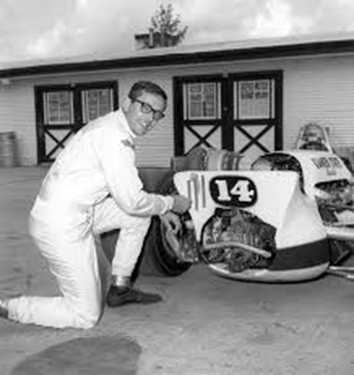
On May 17, 1969, it rained almost all day. The skies cleared briefly about 4:00 pm. By luck of the draw, the first car in line to make a qualification attempt was No. 14, driven by the rookie Sirois.
In the image above he is removing the “rookie stripes” from the back of his car, the sign that race officials considered him skilled enough (and other drivers considered him safe enough) to take a shot at becoming one of the 33 starters.
It was Sirois’ dream to race at Indianapolis – the track where his father had been a mechanic for two “500” winners. Since rain was once again closing in on the Speedway, all he had to do was complete four laps and the pole position would be his.
Jigger was coming around the fourth turn on his last lap when he saw it. His crew was waving a yellow flag.
That meant he was “waving off” that qualifying attempt. Crew members were afraid that even if Sirois was fastest on day one, there might be 33 faster qualifiers by the end of the month, and he would be bumped from the field.
The raindrops began to fall. No one else made a qualifying attempt that day. As it turned out, Sirois’ four-lap average speed would indeed have been good enough to make the race. If Jigger had just taken the checkered flag – if his crew hadn’t waved that flag out of a sense of caution – he would have won the pole position.
Sadly, when he finally had a chance to qualify the following weekend, his engine blew. He never did make an Indy “500” field. Sirois retired from racing six years later, having never turned a competitive lap at the greatest racetrack in the world.
One might even say that his struggles have been memorialized. Every May, the most hard-luck driver at Indy receives a dubious recognition. It’s called the Jigger Award – granted to the driver most undone by circumstances beyond his or her control.
But there’s much more to the story of Jigger Sirois.
At the age of three he had witnessed a killer tornado churning near his home in Shelby, Indiana. He was traumatized by the sight. From that day he had struggled to speak without a stutter.
His racing days behind him, Sirois was introduced to therapies that helped him recover his speech. Thus began his second career: helping stuttering children find their voices.
Jigger points out that there are four stages in the stutterer’s life. First, you’re embarrassed. Then you feel ashamed. Then you feel inferior. Finally, worst of all, you develop a fear of talking. He committed himself to helping kids overcome the fear that left so many of them in silence.
Last month, Jigger celebrated his 91st birthday. He remains one of the nation’s most articulate advocates for speech therapy for children.
Seven years ago, as the Speedway approached the 50th anniversary of his near miss at qualifications history, I wrote a Morning Reflection about the events of that rain-soaked day – and his amazing second calling in life.
Electrons are powerful things. By the end of that day, the reflection had traveled around the country, from inbox to inbox, ultimately ending up in Williamsburg, Virginia, where Jigger lives with his wife Juanita. A few days later he sent me a deeply touching word of thanks – a handwritten note which I still have in my desk – expressing gratitude for revealing that his life story has been a deeply fulfilling one after all.
It may be that you once had a dream. You’re pretty sure that something or somebody else, maybe a storm cloud or a waving yellow flag, took it away from you.
But nobody can take away the deeper dream that God has always prepared for you – the one in which, because of your circumstances, you are uniquely qualified to serve.
This Memorial Day weekend, give someone else the gift of hope.
Through one means or another, help someone else find their voice.