To listen to today’s reflection as a podcast, click here
Throughout the season of Lent, we’re taking a close look at the Apostles’ Creed – one of the earliest and most concise summaries of what followers of Jesus believe.
“There’s a new king, and it’s you.”
That’s the slogan of Burger King’s brand-new marketing campaign which debuted last weekend.
The fast-food giant, having grown weary of being stuck in McDonald’s shadow, launched a series of ads admitting their food and their service have fallen short of expectations. Consequently, they have reinvested in their restaurants and endeavored to improve their famous Whopper recipe.
Most notably, they dumped their mascot.
That would be the Creepy King with the smiling, plastic face – an image that tends to conjure up comparisons to Stephen King’s killer clown Pennywise. In an interview last weekend, even Joel Yashinsky, Burger King’s chief marketing officer, used the word “creepy” to describe the now-dethroned king.
The new commercial shows him departing BK’s office complex clutching his personal possessions in a cardboard box.
He’s been fired. Which means, according to the Burger Powers That Be, there’s a new king. And it’s you.
According to the Powers That Be that actually manage the universe, however, there really is a King who has authority over everything.
And it’s definitely not you.
In Ephesians 1:20-21, the apostle Paul writes: “[God] raised Christ from the dead and seated him at his right hand in the heavenly realms, far above all rule and authority, power and dominion, and every name that is invoked, not only in the present age but also in the one to come.”
That statement dovetails with the Apostles’ Creed’s declaration that Jesus is currently “seated at the right hand of God the Father Almighty.” What does that mean?
Ancient people had a strong bias toward right-sidedness – evident in the Latin words for right (dexter, as in “dexterity”) and left (sinister, as in, “never trust a left-handed person”). The right hand was the symbol of hospitality (“extend the right hand of fellowship”) and strength (God upholds his people with “his righteous right hand,” as in Isaiah 41:10).
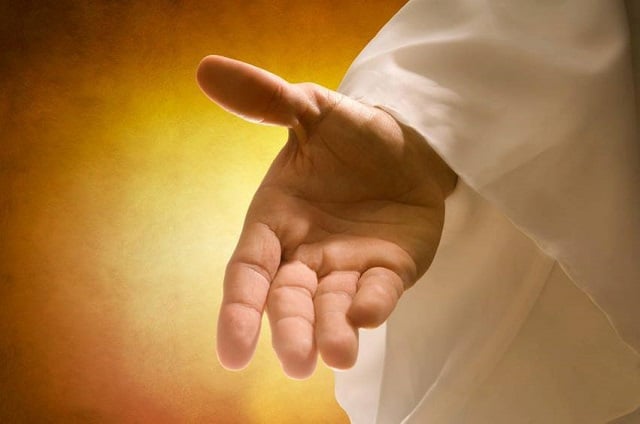
With regard to authority, the right side was the side of honor – an idea that has survived in expressions like, “He’s my right-hand man.”
After his life, death, burial, and resurrection, Jesus ascended into heaven (that is, the realm where God dwells) where he accepted the symbolic place of highest honor.
Then he sat down.
This is not a random detail. The theological term for this event is the “session” of Christ.
Today the word “session” sounds a bit antiquated and is generally used to describe the assembly of those in a courthouse (“this court is now in session”), the legislature (“the next session of Congress”), and the pastors and elders of a Presbyterian church (where “session meetings” refer to two or three-hour increments of your life that you ultimately realize you will never be able to get back).
The fact that Jesus sat down is wonderful news for us.
The New Testament book of Hebrews identifies Jesus as our heavenly high priest. In the Jewish tabernacle (and then temple), there were no chairs. That’s because, symbolically, a priest’s work was never done. There was always another prayer to be prayed and another sacrifice to be offered. A priest had to remain on his feet.
But according to Hebrews 10:11-12, after Jesus offered himself as the ultimate sacrifice for sin, nothing else had to be done to bridge the gap between God and humanity. “It is finished,” he said on the cross.
Therefore, after ascending into heaven, he sat down.
In just a handful of words, Paul is declaring that there is no one else like Jesus – because no one else can possibly do for us what Jesus has already accomplished.
The fact that Jesus is seated at the right hand of God may seem at first like a novel and interesting idea. But in much the same way as buying a new car opens our eyes to seeing that make and model everywhere we look, the session of Christ suddenly begins to turn up all over the New Testament.
For instance, what Old Testament text is quoted in the New Testament more often than any other?
Followers of Jesus adore Psalm 23. But the 23rd Psalm isn’t quoted even a single time by the New Testament’s authors.
The actual “winner” is Psalm 110, which is quoted 20 times in the Gospels and epistles. Here’s one example:
“While the Pharisees were gathered together, Jesus asked them, ‘What do you think about the Messiah? Whose son is he?’ ‘The son of David,’ they replied. He said to them, ‘How is it then that David, speaking by the Spirit, calls him “Lord”? For he says, “‘The Lord said to my Lord: “Sit at my right hand until I put your enemies under your feet.”’ If then David calls him ‘Lord,’ how can he be his son?” (Matthew 22:41-45).
Jesus quotes Psalm 110, which declares that God’s Son, the Messiah, will take the place of highest authority next to Yahweh.
This is a good moment to pause and note that Jesus is still a human being in every sense. He ascended into heaven with a human body (although it is clearly a body that was somehow transformed by the resurrection).
Jesus didn’t shed the physical aspect of his humanity when he entered the throne room of God.
The true King of the cosmos, reigning over everything God created, is one of us.
Paul goes on to tell us in Colossians 3:1, “Since then, you have been raised with Christ, set your hearts on things above, where Christ is, seated at the right hand of God.” The fact that Jesus is seated at God’s right hand should stir in us a deep desire to live lives worthy of being his followers.
And elsewhere Paul says, “Who, then, is the one who condemns? No one. Christ who died – more than that, who was raised to life – is at the right of hand of God and is also interceding for us” (Romans 8:34).
In his book What Christians Should Believe – his commentary on the Apostles’ Creed – New Testament scholar Michael Bird notes the popularity of the four letters WWJD.
They invite us to stop and ask ourselves, “What Would Jesus Do?” if he were in our shoes at any given moment.
Bird wonders if it might be just as wise to stop on a regular basis and ponder four other letters: WIJD.
“What is Jesus Doing?”
Right now, Jesus is doing amazing things. He is ruling over the universe. He is superintending human history. He is interceding for us, continually bringing our prayer requests before the Father.
In short, he is being the true King.
Which means the last thing we would want to try to do today is to “have it our way.”
Let’s have it His way instead.