
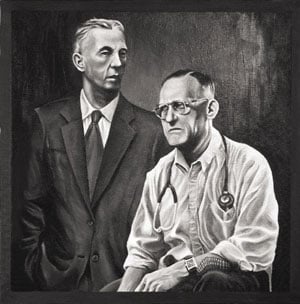
To listen to today’s reflection as a podcast, click here
His real name was William Griffith Wilson.
But for most of his life he was known as Bill W or just Bill.
On May 12, 1935, he journeyed from his New York home to Akron, Ohio, intent on closing a business deal.
There was a lot at stake.
Wilson was an alcoholic who had been drinking excessively since joining the military in 1916, shortly before America’s entry into World War I. After imbibing his first few drinks he thought, “I’ve found the elixir of life.” Here at last was the cure for his social awkwardness.
Following the war, he went to law school. He failed to graduate, however, because he was too drunk to pick up his diploma. He became a stock speculator and traveled the country. Bill was a sufficiently gifted businessman, but his drinking routinely sabotaged any real chance for success. He spiraled into depression – which only increased his dependence on the bottle.
Now, standing in the lobby of Akron’s Mayflower Hotel, he was at a crossroads.
Something incredible had happened the previous November. Lying in bed, despairing over the condition of his life, he had cried out, “I’ll do anything! Anything at all! If there be a God, let him show himself!” As Wilson later told the story, he was flooded with a feeling of ecstasy. He suddenly felt serenity.
It was as if God had extended the offer of grace – and he simply said Yes.
On December 11, he had taken his last drink. Or so he thought.
The Ohio business deal flopped. A familiar feeling of dread began to engulf him. He was a failure, and everyone surely knew it. His mother had deserted him 30 years earlier. He felt crushed by loneliness.
At the far end of the lobby, he saw the bar and heard the familiar sounds of laughter and tinkling glasses. “I’m going to get drunk,” he thought. He immediately knew that throwing away six months of sobriety might mean the end of his life.
That’s when another thought entered his mind. It wasn’t “I need a drink,” but “I need another alcoholic.”
Wilson needed to find someone else – not just a fellow drinker who could empathize with his addiction, but someone who, like him, desperately needed help. Bill sensed that if he poured himself into helping another struggler, it might help break the spell of his self-centered misery.
He stepped into the lobby’s phone booth and found a directory of local churches (yes, there really used to be such publications). He called nine congregations, asking if someone might be able to put him in touch with an alcoholic. It was an odd request. He heard “sorry” nine times.
By the time he dialed the tenth time, Bill was getting anxious. The thought occurred to him that if just had a drink, it would help him make these calls.
After identifying himself as “a rum hound from New York,” the woman on the other end of the line put him in touch with Dr. Robert Smith, the husband of one of her close friends. He was also a proctologist and a raging drunk – and it was widely known that his drinking habits had not exactly improved his effectiveness as a surgeon.
Smith was a Christian. He had begged for God’s help. But after more than a dozen stays at various sanatoria, sobriety eluded him. Bob read a lot of Scripture, but he discovered that most of his good ideas came to him while he was drunk – after which he couldn’t remember a thing.
But when Bill W got in touch that day with Dr. Bob, something important happened. A crucial understanding dawned on both of them.
As Smith later put it, “The spiritual approach was as useless as any other if you soaked it up like a sponge and kept it to yourself.”
In other words, in order to keep something, you have to give it away. The key to sobriety is not just getting there (as important as that is) but maintaining it through a never-ending commitment to share such grace with others.
In Jesus’ memorable words, “Whoever tries to keep his life will lose it, but whoever loses his life for my sake will preserve it” (Matthew 16:25).
Within a few weeks Bob and Bill had established what they later called “a nameless squad of drunks” – a unique support system in which alcoholics help other alcoholics stay sober.
The group became known as Alcoholics Anonymous, and William Griffith Wilson became Bill W. He refused to use his full name for the rest of his life. He died in 1971 after 36 years of sobriety and wouldn’t even let TIME put his picture on their cover, honoring AA’s ideal of anonymity.
The magazine later identified him as one of the 100 most important figures of the 20th century. The self-described hopeless drunk was now acclaimed as “The Healer.” British philosopher Aldous Huxley called him the greatest social architect of our time.
Today there are more than 120,000 AA groups worldwide, through which millions of alcoholics have experienced help and hope. Myriad other “twelve-step” communities have sprung up to support men and women addicted to drugs, sex, food, gambling, shopping, workaholism, and a host of other self-destructive behaviors.
At the heart of every one of those movements is a simple premise:
We sin alone, but we heal together.
The purpose of life is not to get. It’s to give. God’s best gifts come to us because they are on their way to someone else.
It’s worth noting that AA identifies its birthday not as December 11, 1934 – when Bill W stopped drinking – but as June 10, 1935.
That’s when Dr. Bob took his last drink and began to embody the principle that if we commit ourselves to help each other, something wonderful happens:
All of us, by God’s grace, can get well.