
To listen to today’s reflection as a podcast, click here
Rod Serling, Hollywood’s “angry young man” during the 1950s, had a dream.
He would write and produce cutting-edge TV dramas that explored the social issues he cared about passionately.
Those included racism, war, censorship, fear, injustice, nuclear paranoia, and the emerging power of television to influence culture.
But all he heard from network executives and sponsors was the sound of slamming doors. Their job, after all, was to attract crowds of loyal viewers to whom they could peddle soup, cigarettes, soap, and new cars. Censors were thus hyper-sensitive to scripts or plotlines that exhibited even a whiff of socially controversial themes.
Seemingly blocked at every turn, and overwhelmed by frustration, Serling almost walked away from Hollywood.
Then he tried a different approach. He accepted an invitation from CBS to create his own show – a first-of-its-kind science fiction series.
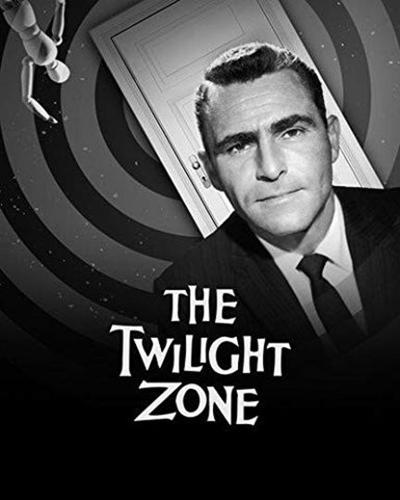
The Twilight Zone debuted in October 1959. Almost seven decades later, it remains one of TV’s truly transformative dramas.
If you’re feeling a sudden desire to hear that signature music and experience the surrealist images that introduced each show, here they are.
The Twilight Zone featured Serling, almost always holding a lighted cigarette, offering interpretive comments at the beginning and ending of each episode.
Viewers could expect an underlying sense of dread; warps in the space-time continuum; extraterrestrial visitors to Earth; surprise twist endings; and one of the earliest TV appearances by a young actor named William Shatner (talk about scary).
And what were the themes explored during those half-hour mini dramas on Friday evenings?
They included racism, war, censorship, fear, injustice, and nuclear paranoia.
Serling, in other words, ended up making precisely the kinds of statements he had hoped to make all along. The same executives and sponsors who had been his opponents – “TV viewers don’t want to hear what you have to say about equal rights for women!” – did everything they could to keep The Twilight Zone on the air. “People sure love how you depict space aliens!”
Despite the initial anxieties of most studio chiefs, The Twilight Zone used compelling stories about fantasy creatures, flying saucers, and Einsteinian physics to help people think more deeply about the meaning of their lives.
And Serling ended up reaching far more people with his cutting-edge messages than he ever dreamed.
As he observed years later, “A Martian can say things a Republican or a Democrat could never say on TV.”
In one of her poems, Emily Dickinson urges us to “tell all the truth but tell it slant.” It’s best, that is, to convey important truths indirectly or gradually – perhaps bit by bit or from an unexpected angle – rather than clobbering people over the head with too many startling facts.
That’s how Jesus chose to connect with his listeners.
Primarily, he told deceptively simple stories.
Matthew 13:34 makes this remarkable statement: “He did not say anything to them without using a parable.” We know that when speaking to specific groups (like his inner circle of disciples), Jesus did not always tell stories. But parables were his chief means of declaring to a general audience, “This is what it means to have a Father in heaven.”
Why tell stories?
Parables are sneaky. Some even seem childish. But they are full of surprises and unexpected twists. Jesus is able to communicate hard-to-swallow spiritual truths in delightful, memorable ways.
That would include ways that may make us yearn to know God better.
In that sense, his parables are subversive. Just when we think we’ve figured out everything about Us vs. Them, and feel absolutely certain that Jesus loves Us and will be sending Them straight into a smoldering abyss in the next world, he comes up with a story that forces us to see things in a different light.
Maybe we’ve been a bit off the mark. OK, maybe we’ve been way off the mark. That’s the power of parables.
The astounding thing about these stories is that they don’t seem to age. Parables invite us to listen to God in new ways. Perhaps you first heard about the Good Samaritan back in third grade Sunday School. And after just one reading of the Gospels, you could rattle off the essential message of the parable of the Four Soils.
But the meanings of these stories aren’t static. They become deeper, richer, and increasingly surprising as we grow older. The more we experience life, the more we will find ourselves thinking, “I never saw that before.”
Author and pastor Brian McLaren observes, “Human kingdoms advance by force and violence with falling bombs and flying bullets, but God’s kingdom advances by stories, fictions, tales that are easily ignored and easily misunderstood. Perhaps that’s the only way it can be.”
“You unlock this door with the key of imagination,” said Rod Serling every week. “Beyond it is another dimension.”
That was the only way into the Twilight Zone.
The amazing thing is that Jesus makes it quite clear that’s the only way into the kingdom of God, as well.