
To listen to today’s reflection as a podcast, click here
The signature story of Israel’s history is the Exodus.
It’s the account of the arduous trek of hundreds of thousands of freed Hebrew slaves across the brutal wilderness of the Sinai Peninsula.
The Promised Land of Palestine lies ahead. Egypt is in the rearview mirror. The people are buoyed by overwhelming hope and gratitude.
Right?
In truth, the Hebrews are a classic case study in whining. They grumble about the scarcity of water. They wail about the “giants” in Canaan who make them feel like grasshoppers. As we noted earlier this spring, “God got his people out of Egypt, but then he had to get Egypt out of his people.” Their victim mentality proves difficult to uproot.
We read in Numbers 21:4-5 that “the people grew impatient on the way; they spoke against God and against Moses, and said, ‘Why have you brought us up out of Egypt to die in the wilderness? There is no bread! There is no water! And we detest this miserable food!’”
God, of course, has been feeding them faithfully.
The “miserable food” they’re talking about is his daily gift of manna. As author and pastor John Ortberg reminds us, manna hardly seems to qualify as “miserable.”
“Manna was by all accounts an amazing product. It tasted like wafers made with honey. It was apparently a very versatile food. The Israelites were told to bake what they wanted to bake, boil what they wanted to boil, lay aside that which they wanted to eat raw.
“It sounds a little like Bubba in the movie Forrest Gump describing the infinite variety of ways in which you could fix shrimp. ‘Baked manna, boiled or barbecued manna, manna-on-a-stick, manna burgers, manna-salad, manna-cotti, manna-banana cream pie…’”
All washed down with a glass of manna-schewitz, no doubt.
God’s ability to endure his people’s deeply ingrained ingratitude finally reaches a breaking point.
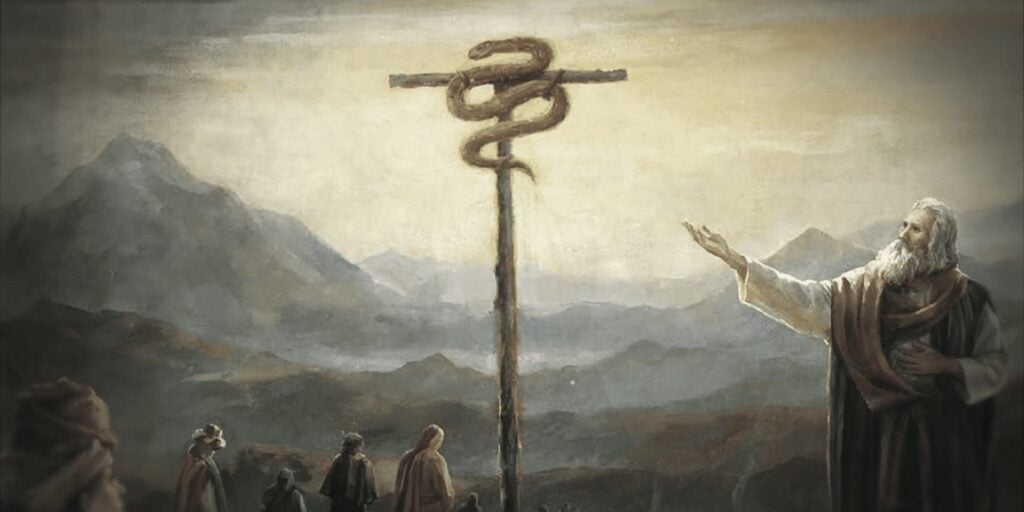
Reading on in Numbers 21, “Then the Lord sent venomous snakes among them; they bit the people and many Israelites died. The people came to Moses and said, ‘We sinned when we spoke against the Lord and against you. Pray that the Lord will take the snakes away from us.’ So Moses prayed for the people.
“The Lord said to Moses, ‘Make a snake and put it up on a pole; anyone who is bitten can look at it and live.’ So Moses made a bronze snake and put it up on a pole. Then when anyone was bitten by a snake and looked at the bronze snake, they lived” (Numbers 21:6-9).
This is a strange story. There’s nothing quite like it anywhere else in the Bible.
There’s no suggestion here that Moses’ “fake snake” has any power in and of itself. What heals the snakebite victims is a simple act of faith – choosing to cast a glance at the snake-shaped piece of bronze affixed to the top of a pole.
And just like that, the story ends. Snakes never get another mention in the biblical account of the wilderness wanderings.
But the rest of the Bible isn’t finished with the bronze snake just yet.
Immediately before John 3:16, one of Scripture’s most celebrated statements (“For God so loved the world that he gave his only Son…”), Jesus declares, “Just as Moses lifted up the serpent in the wilderness, so the Son of Man must be lifted up, that everyone who believes in Him may have eternal life” (John 3:14-15).
Jesus, incredibly, likens himself to Moses’s serpentine bronze-work.
If whining, ungrateful, messed-up people could, in a moment of total panic, look up at something at the end of a pole and receive healing, then whining, ungrateful, messed-up sinners like us can, in a moment of total spiritual desperation, fix our gaze at the cross and receive saving grace from the One who was nailed there for the explicit purpose of forgiving our sins.
That’s a startling and powerful connection.
Interestingly, the bronze snake gets one more mention on the pages of Scripture.
It happens in chapter 18 of the Old Testament book of 2 Kings. King Hezekiah, one of ancient Israel’s few God-honoring royal figures, orders a national spiritual housecleaning. “He removed the high places, smashed the sacred stones and cut down the Asherah poles” (2 Kings 18:4).
Then comes this amazing statement: “He broke into pieces the bronze snake Moses had made, for up to that time the Israelites had been burning incense to it. It was called Nehushtan.”
The bronze snake has not vanished. It hasn’t been on display in a Museum of Hebrew Antiquities in Jerusalem, nor is it collecting dust somewhere in a storage locker some 500 years after the Exodus.
It has become an idol. A vile thing. A rival to Yahweh himself. It even has a name: Nehushtan. The Hebrew etymology suggests that means “Bronze Thing.” Or perhaps “Bronzey.”
We may think it incredible that God’s people could be so thick-headed as to transform one of God’s own graciously provided means of help and healing into an idol.
But we do the same sort of thing all the time.
The Spirit inspires a great idea. Our church or small group or Christian gathering creates something special with music or a meal or a mission trip. Hearts are lifted up. Lives are changed. “Let’s do this again next year!”
And so it goes. Year after year after year. Until it becomes unthinkable – even against the will of God, we suspect – that we would ever dare to skip the musical production or rummage sale or overseas trip that God has used to make such a difference in the world.
But what once seemed like a great idea has now become empty and lifeless.
Our hearts are no longer in it for the simple reason that the Spirit is no longer in it.
Old methods, old songs, and old perspectives (not always, but all too often) become objects of worship. What God once used to bring hope and redemption is now our very own Nehushtan – a favorite program before which we feel obligated to bow down.
The same thing can happen with certain family rituals. The best way to open Christmas presents, for instance, or the one true way to load the dishwasher can sometimes be granted an untouchable sacredness.
Many traditions are sweet.
But as the old saying puts it, “When you visit the altars of the past, bring back the fire and not the ashes.”
Our call is to dare to imagine that God’s Spirit has something new to teach us, and that the challenges and opportunities of the present moment require new ways to receive God’s blessings.
We can do it. We can embrace things that are new.
Otherwise, we just might end up snakebit.