
To listen to today’s reflection as a podcast, click here
It’s a very big deal if you manage to appear in the Star Wars cinematic universe.
Even if you’re on the screen for a grand total of two seconds.
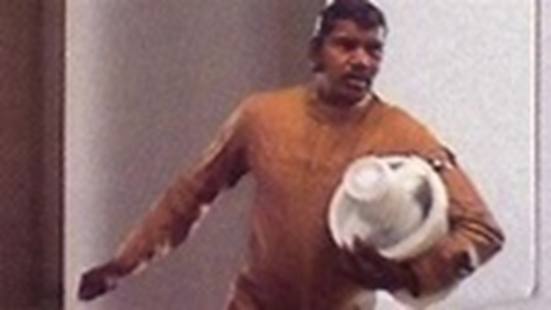
In The Empire Strikes Back, after a dramatic announcement that Imperial storm troopers have taken over the Cloud City of Bespin, people begin to scatter. An unnamed, uncredited extra wearing an orange jumpsuit streaks across the screen.
He appears to be carrying an ice cream maker.
Who is this guy, and what in the world is under his left arm?
Those are the kinds of questions that keep Star Wars devotees awake at night. Not long after Empire’s 1980 release, “Ice Cream Guy” became something of a cult figure. Years later, an especially dedicated fan named Scott Pearson created a fan-fiction backstory that exploded into an internet movement. Tens of thousands of people who loved the films petitioned the keepers of the Star Wars narrative to bestow an actual identity on the legendary extra.
It finally happened.
Ice Cream Guy has officially been named Willrow Hood. In alignment with Pearson’s fictional account, Hood is a Tibanna gas miner at Cloud City. He works with a company that does business with the Rebellion. Thus he serves the “good guys” like Luke Skywalker who are committed to the Empire’s downfall.
And what is he cradling under his left arm? That’s a computer memory core he is transporting for safekeeping.
Willrow Hood ultimately received his own entry in The Complete Star Wars Encyclopedia, the essential Who’s Who for fanatics. But he really hit the big time about 20 years ago, when Hasbro released the Willrow Hood action figure.
That’s right. You can own your very own plastic figurine of a guy who carried an ice cream maker in the background of a movie for two seconds.
And you’re wondering if the fires of heroism in our culture have almost gone out.
Do some people take Star Wars a little too seriously?
Let’s put it this way: It’s astonishing how many fans of the pop culture phenomenon, when asked on a form if they would be willing to declare a religious affiliation, write “Jedi.”
May 4 is the unofficial national holiday for devotees of the space opera that director George Lucas launched with the original Star Wars movie in 1977. “May the Fourth be with you,” it must be admitted, is undoubtedly the best pun on the calendar every year – considerably better than tomorrow’s “Revenge of the Fifth.”
If those words didn’t immediately make you think of the Sith, the cult of the Dark Side in the StarWars mythology, it means you probably have a lot of screen time ahead of you in order to get caught up.
Lucas never concealed the fact that his grand epic was more than just entertainment.
He delved deeply into various global religious traditions in order to help his viewers embrace new ways of envisioning the cosmos. He told an interviewer, “I wanted to make it so that young people would begin to ask questions about the mystery.”
The mystery of life, that is. And the mysteries of meaning, purpose, Good, and Evil.
Lucas borrowed generously from Buddhism. One writer has even described Star Wars as “Zen with lightsabers.” He embraced the notion of the “yin and the yang,” as well as Taoism’s never-ending quest for balance as we seek to follow the Tao, or Way, through this world. The nine feature films and numerous back-story movies and TV episodes that comprise the Star Wars saga include echoes of Zoroastrianism (Dark vs. Light) as well as Brahman Hinduism.
Then there are the Messianic associations with Anakin Skywalker, who is mysteriously born of a virgin and declared to be the Chosen One – the long-prophesied figure who will bring balance and peace to the galaxy. Unlike Jesus, however, Anakin yields to the Dark Side and becomes Darth Vader – definitely not a positive development, seeing as he was recently voted the most notorious movie villain of all time.
And what of Lucas himself? He was once described as a “Buddhist-Methodist.” In 1999 he told Time magazine, “Let’s say I’m spiritual.”
The central metaphysical component of Star Wars is the Force. As the Jedi master Obi-Wan Kenobi puts it, in what amounts to Galactic Theology 101: “The Force is what gives a Jedi his power. It’s an energy field created by all living things. It surrounds us and penetrates us. It binds the galaxy together.”
The Force is utilized by the Jedi to bring about redemption and hope. But it’s also manipulated by the Sith to generate chaos and destruction.
Which brings us back to those words you may hear a few times today: “May the Force be with you.” As the science fiction columnist Emmet Asher-Perrin inquires, “The next time you say, ‘may the Force be with you’ to a friend, you might want to ask – what exactly are you wishing for them?”
Is proximity to the Force a good thing or a bad thing? Is it both? Or maybe neither? And in what sense can the Force be “with” us?
Star Wars declines to provide clear answers.
Expectations are decidedly clearer when it comes to that phrase frequently uttered by followers of Jesus: “The Lord be with you.”
This is not a way of saying, “Well, you know, sometimes God is with you to do you good, and sometimes he’s not, so I hope this turns out to be one of the good times.” The Lord be with you is a stirring call for us to remember that we are in fact never alone. As far as God’s children are concerned, his presence is always a good thing.
When exactly is God with you?
God is with you when you stare at the ceiling in the middle of the night and wonder if your life is turning out the way it should. God is with you as you wait to hear from the doctor in the ER. God is with you as you try to figure out how you can possibly afford to fill your gas tank this month. God is with you as you weep over the addiction you cannot beat. God is with you as you wonder if you can ever be reconciled to one of your kids. God is with you as you grieve the painful divisions in our culture. God is with you in the meeting you dread because you know your job might be on the line.
Bible scholars have long noted that there is a “with” at both the beginning and the end of the gospel of Matthew.
Jesus comes into the world as Immanuel, “God with Us” (Matthew 1:23). And he departs the company of his disciples with the words, “And surely I am withyou always, to the very end of the age” (Matthew 28:20).
He is the With-Us God. Which makes him a Force like no other.
You may never get to run across a movie screen. You might not even like ice cream.
But you can be with Him, just as He is with you – not a long, long time ago in a galaxy far, far away, but right here and right now.