
To listen to today’s reflection as a podcast, click here
On March 30, 1981, just 69 days into his presidency, Ronald Reagan and members of his entourage were attacked by a lone gunman outside a Washington D.C. hotel.
A bullet shattered one of Reagan’s ribs, punctured a lung, and lodged perilously close to his heart.
By the time he had been driven to George Washington University Hospital, the president’s blood pressure was so low that doctors later acknowledged that most 70-year-olds in his condition would not have survived.
For the president, it turned out to be a day of memorable quotes.
“Honey, I forgot to duck,” he said to Nancy when the anxious First Lady arrived at the hospital. In the operating room he pulled back his oxygen mask and said to his surgical team, “I hope you are all Republicans.” Dr. Joseph Giordano, the lead surgeon, happened to be a committed liberal Democrat. After laughing aloud with the rest of the team, he assured his patient, “Today, Mr. President, we are all Republicans.” It was a kinder, gentler time.
It also turned out to be quite a day for the Secretary of State.
General Alexander Haig had recently assumed that key Cabinet position. Both praised and feared for his take-no-prisoners style, the former Supreme Allied Commander in Europe had startled even his closest friends by suggesting that the U.S. fire a “nuclear warning shot” to deter the Soviet Union.
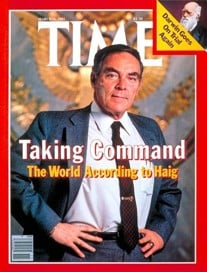
Just two weeks before the president was shot, he appeared, hands on hips, on the cover of Time magazine. “Taking Command,” read the caption.
His image was never quite the same after March 30.
Leaders of the Soviet Union, hearing the news that Reagan had been shot, immediately moved their nuclear submarines closer to the American coast. Vice President George H.W. Bush, the future president, was on a jet returning from Texas. Who was making strategic decisions? Who had access to The Football, the briefcase with America’s nuclear launch codes?
Haig stepped before a roomful of reporters and announced, “As of now, I am in control here.” Several reporters in the room actually laughed.
If he meant the presidential line of succession, he was clearly wrong. Both the Speaker of the House and the president pro temp of the Senate came before the Secretary of State.
If he meant he was in control of the White House – well, those watching got the distinct feeling that Haig at that moment was too rattled even to command a troop of Brownies. Haig looked pale. Fretful. Anything but in control. That moment of anxious, grab-the-bull-by-the-horns “leadership” actually raised the country’s level of nervousness.
And it doomed Haig’s dreams of winning any future national elections.
On the day that Jesus died, Pontius Pilate had his Alexander Haig moment.
Pilate commanded Jesus to speak. But Jesus remained silent. “Don’t you realize I have power either to free you or to crucify you?” he asked the prisoner (John 19:10). “Can’t you get it through your head that I’m in control here, and that you’ve got nothing?”
The Gospel accounts make it clear that Jesus wasn’t fazed by Pilate’s threats. In fact, he was almost certainly counting on Pilate to give the orders to execute him. Jesus knew that he was about to take the ultimate symbol of Roman power – the cross – and turn it into the very means of accomplishing his own mission.
Pilate couldn’t fathom Jesus’ claim to be a king, for the simple reason that he was measuring Jesus with the wrong yardstick.
In the governor’s mind, a real king would have a kingdom. And an army. And a palace. And bodyguards. How could this man who had no power and no authority claim to be royalty?
“My kingdom is not of this world,” Jesus had explained. But Pilate didn’t get it.
It is one history’s great ironies that the peace that comes through the kingdom of God was not achieved through violence against the king’s enemies. Rather, it came about through violence to the King himself. Jesus was trying to explain to Pilate – and is still trying to explain to us today – that in order for God’s reign to succeed, first it had to fail.
Good Friday had to come before Easter.
This summer, you might be counting on the fact that you’re going to be in control. You have places to go, and your list of things to do, and you’ve planned all the details, and you’re not going to let circumstances overwhelm you. You’ve got this.
Except, you really don’t.
You’re not in control. You’re not even in control of whether you’ll still be breathing by the time you make it to the end of this sentence. Our illusion of “taking command,” standing with our hands on our hips before the watching world, is just that: an illusion.
But there’s good news. Somebody is in control. Somebody who can be trusted with all the details of our lives.
And if our out-of-control lives seem to have taken us for the moment to a dead end, there’s even better news:
That Somebody is in the business of raising the dead.