
To listen to today’s reflection as a podcast, click here
Norwegian explorer Thor Heyerdahl was gripped by a compelling idea.
Was it possible that the indigenous people of South America, centuries before Columbus, had actually sailed across thousands of miles of open water and helped populate the Polynesian islands of the South Pacific?
Heyerdahl and five companions decided to see if such a thing were even possible.
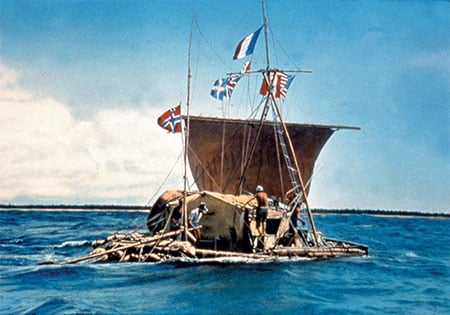
In 1947, they built a crude raft out of balsa logs, hemp, and materials they presumed would have been available to the primitive communities living on the western coast of South America. They named the raft Kon-Tiki after an ancient Incan god.
On a late April day they departed Peru and headed west, powered by nothing but the trade winds and the Humboldt Current.
It’s worth noting that Heyerdahl was terrified of water. He had almost drowned twice during childhood.
Now he and his crew were heading into one of the great “empty spaces” on the surface of the Earth – a vast stretch of water with few islands – in a raft that might not even hold together.
The men quickly discovered that Kon-Tiki was exceedingly maneuverable. But it proved impossible to slow the boat down. If anything disappeared over the side, it was best simply to let it go.
That policy seemed wise enough until about 60 days into the trip, when they were thousands of miles from land. Herman Watzinger suddenly lost his footing and fell overboard.
Kon-Tiki, at the moment, was being driven by a strong wind in heavy seas. Watzinger swam as hard as he could to keep up with the raft, but he rapidly became exhausted and fell behind. Soon he disappeared behind the rising and falling waves.
What could they do? Knute Haugland quickly made up his mind.
He fastened a rope around his waist and dived into the water. Haugland went back for his friend. He found Watzinger, threw his arms around him, and waited for the others to reel them both back in.
After a journey of 101 days and 4,300 miles, Kon-Tiki crunched into a Polynesian coral reef. All six men who began the voyage were there at the end because Knute Haugland believed he had been called to pursue the one who was lost.
In Luke 15, Jesus tells a story with a similar theme.
A shepherd caring for 100 sheep discovers that one of them is missing. In the barren wilderness of the Middle East, being lost and alone is a death sentence. Jesus affirms that his Father is thrilled that 99 sheep are safe at home. But God is also relentlessly passionate about pursuing the one who is lost.
Followers of Jesus, unfortunately, don’t always share that outward-focused perspective.
Christians are famous for creating holy huddles, turning inward toward those they already know and trust. All too many churches present themselves as fortresses – safe places for convinced people. Sheep-hunts feel like risky business.
But that is far from the spirit of Jesus’ parable, where a shepherd sets out at great personal risk to find the one who will never make it home unless pursued.
All around us there are people like Herman Watzinger, trying to stay afloat as best they can. But they’re falling behind and drifting out of sight. They cannot reach us. We will have to go get them – with actions such as words of encouragement, interceding prayers, financial support, legal intercession, or perhaps something as simple as an assurance of friendship when everyone else has turned away.
Who is that person in your life right now?
If you feel spiritually safe and sound today, give thanks to God.
And then, by God’s grace and power, offer a lifeline to someone else.