
To listen to today’s reflection as a podcast, click here
The first fight of the Founding Fathers was about faith.
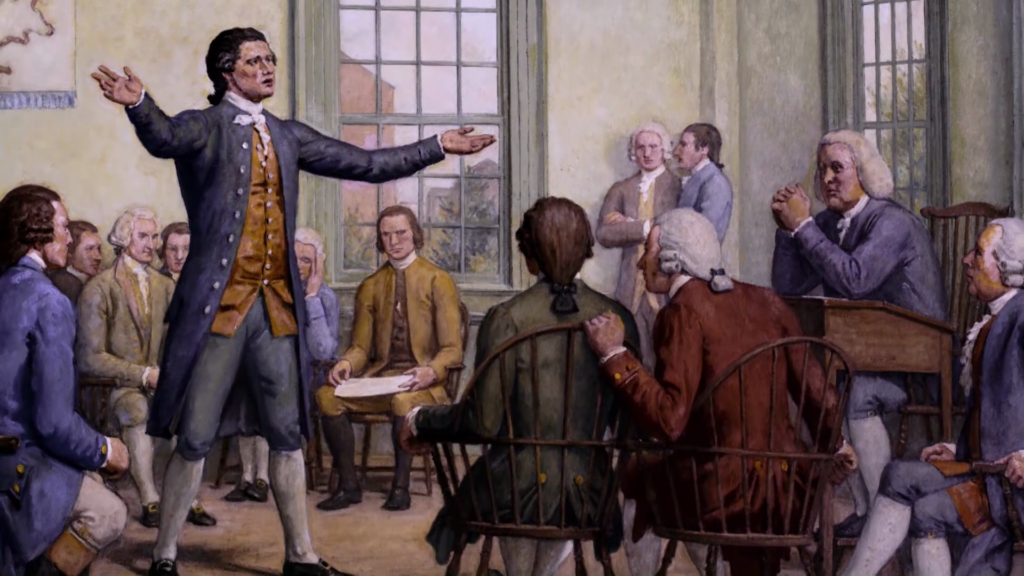
The inaugural session of the Continental Congress – the group that would ultimately call for the drafting of the Declaration of Independence – convened in Carpenter’s Hall, Philadelphia, on September 6, 1774.
Thomas Cushing, a lawyer from Boston, moved that the delegates begin with a prayer. That seemed entirely reasonable. But both John Jay of New York and John Rutledge of South Carolina objected.
The men chosen to steer the direction of our not-quite-yet-nation at that perilous hour couldn’t even agree on talking to God.
What’s interesting is that neither Jay nor Rutledge were skeptics. Both were active church leaders. John Jay, in particular, was an enthusiastic follower of Jesus. John Adams later wrote to his wife Abigail, “Because we were so divided in religious sentiments, we could not join in the same act of worship.”
John Meacham asserts in his book American Gospel, “Whatever Jay’s and Rutledge’s motives, their objection, if successful, had the power to set a secular tone in ceremonial life at the very outset of the American political experience.”
Whatever happened next was going to matter.
As it turned out, Samuel Adams (a man with a lively faith, but whose chief legacy these days seems to be the 20 Samuel Adams varieties of beer) said that he would gladly hear an honest person read prayers to the assembly. He had heard positive things about a particular Episcopal clergyman in Philadelphia.
Would that pastor be willing to open the session the following morning? The motion was seconded and approved.
The atmosphere was heavy with the fear of the outbreak of war. The American colonies were finding themselves increasingly at odds with Great Britain.
It turned out that the reading assigned by the Episcopal Church for September 7 that year was Psalm 35. It included these words: “Plead my cause, O Lord, with them that strive with me. Fight against them that fight against me. Take hold of shield and buckler, and stand for mine help.”
John Adams, who was no believer, later wrote that he was stunned and moved. “I never saw a greater effect upon an audience. It seemed as if heaven had ordained that psalm to be read on that morning.”
The American experiment began with a reading of Scripture. As James Madison was later to say, faith shaped our nation. But it did not strangle it.
Conservative Christians insist that the Revolutionary era was fundamentally a religious event. Secularists look back on our nation’s founding as the ultimate act of establishing a society where free opinion is valued more highly than religious sentiment.
Both are right. But neither is completely right.
God was not absent from the Revolutionary era. But neither was America established as a nation where a particular set of spiritual views were required, by law, to be elevated above all others.
In his book American Creation, historian Joseph J. Ellis points out that there were two “founding moments” during the Revolutionary era. The first was 1776, which declared American independence. The second was 1787-88, which declared American nationhood.
“The Declaration of Independence is the seminal document in the first instance, the Constitution in the second. The former is a radical document that locates sovereignty in the individual and depicts government as an alien force, making rebellion against it a natural act. The latter is a conservative document that locates sovereignty in that collective called ‘the people,’ makes government an essential protector of liberty rather than its enemy, and values social balance over personal liberation.”
Ellis then notes something that makes our country’s earliest years astonishing.
It’s rare for a group of revolutionaries (who are chiefly motivated to tear something down) to come together and successfully build something up.
But that’s exactly what luminaries like Washington, Jefferson, Adams, Madison, Franklin, and Hamilton accomplished.
What they avoided at every turn was identifying a set of religious beliefs or political ideologies and then declaring, “This is the final word, so don’t ask questions – just believe.”
Instead, the Founders established a way for the new nation to have an ongoing conversation, grounded in the Declaration and Constitution, in which hard questions and diverse opinions would be welcome. So far, that national conversation has gone on for 250 years.
There are days in which the existence of America seems almost miraculous. There are also days in which our fondest dreams of national goodness and integrity seem on the verge of being thwarted.
But consider this:
What the Founders accomplished was the creation of a political and social framework in which a retired Presbyterian pastor can send five emails a week to a mixed crowd of Lutherans, Methodists, Baptists, Pentecostals, Catholics, Orthodox, atheists, agnostics, and even a few New England Patriots fans…and no one raises an eyebrow.
Now, that falls into the category of miracle.