To listen to today’s reflection as a podcast, click here
In 1885, Tsar Alexander III placed an order for an Easter gift for his wife.
It wasn’t just any Easter gift.
The leader of Russia’s royal family asked the master jeweler Peter Carl Faberge to create something special. Something fit for an empress.
The result was a white enamel Easter egg, about the size of an ordinary hen’s egg. When gently opened, a surprise awaited. A golden hen with ruby eyes, wearing a tiny replica of the Romanov crown, sat on a golden yolk.
The Tsarina was beside herself with joy. Alexander wasted no time in commissioning Faberge to create a new egg the following spring and every Easter after that. Thus began a tradition that continued until 1917, when the Russian Revolution brought the Romanov dynasty to a cataclysmic end.
In all, the craftsmen of the House of Faberge created 52 imperial eggs. Each one – elaborately decorated and richly bejeweled – exceeded the beauty of its predecessor. No expense was spared. The eggs featured hidden compartments, mechanical birds, and surprising trinkets – unmatched examples of artistry and complexity.
The eggs quickly became icons of luxury – representations of the wealth, power, and opulence of Russian royalty.
As symbols of former grandeur, it was clear they could have no place in the revolutionary world of the Bolsheviks. In a matter of months, the eggs were scattered, looted, or lost. Some were stored away in Russia. Some ended up in museums. Still others were snatched up by private collectors. Josef Stalin sold at least one to help finance a Communist initiative.
When the dust finally settled, 46 of the 52 Faberge eggs were accounted for. What had happened to the other six?
Here we arrive at one of the greatest treasure hunts in modern history.
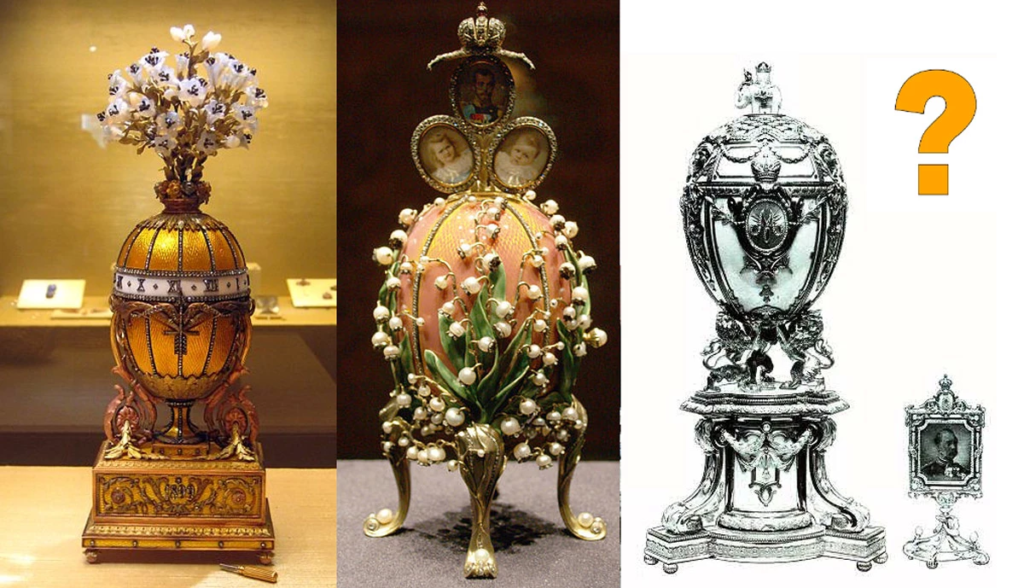
Art historians and collectors continue to search for the 1886 egg, the so-called Hen with Sapphire Pendant (the second Faberge creation); the 1888 Cherub with Chariot; the 1889 Necessaire (which includes a tiny storage space for toiletries bedecked with emeralds, rubies, and sapphires); the 1897 Mauve Egg; the 1903 Royal Danish Egg (shown at right in the photo above); and the 1909 Alexander III Commemorative Egg.
Do they still exist? A number of historians and collectors live in the hope that they are out there somewhere.
Those hopes were bolstered by the surprise discovery in 2014 of the 1887 imperial egg. An American metal dealer browsing at a Midwest antique mart bought it for a comparative pittance, intending to melt it down for scrap. Further examination revealed it to be one of Faberge’s irreplaceable masterpieces. It was valued at $33 million.
Financial incentives aside, artists the world over believe that it’s worth searching for the six missing eggs. They are a treasure like no other. They are worth recovering.
Treasure-hunting – the relentless search for that which is lost – is a subject that recurs in the teaching ministry of Jesus.
Two weeks ago we briefly touched on his parable of the Lost Sheep: “Suppose one of you has a hundred sheep and loses one of them. Does he not leave the ninety-nine in the open country and go after the lost sheep until he finds it?” (Luke 15:4).
Interestingly, those in his original audience may well have been thinking, “Actually, no, I wouldn’t go looking for just one sheep.”
Kenneth Bailey, a missionary who spent almost all his life in the Middle East delving into the richness of Bible backgrounds, suggests that his listeners probably expected Jesus to ask a different question – perhaps this one: “Which of you, owning a hundred sheep, if a report came to you that one was lost, would not send a servant to the shepherd responsible and threaten him with a heavy fine if he didn’t find the sheep?”
In other words, if something is lost, somebody else is going to have to pay. But Jesus says, “No, think again. You are responsible. You own a hundred sheep, and you lose one of them.”
Looking for a lost sheep in Palestine was (and still is) no walk in the park.
The land is extremely dry. Bailey remarks that more than once he witnessed a Holy Land tourist leave his bus, wander off the path with a camera and a bottle of water, only to be brought back two hours later on a stretcher.
Most shepherds who are alone in such conditions will think to themselves: “I hope I find the sheep…and I pray that it’s already dead.” That way the shepherd can bring back an ear or a foot and say, “Here it is. I found it. Job over. We don’t have to do anything else.”
But that’s not what happens in Jesus’ parable: “And when he finds it [very much alive], he joyfully puts it on his shoulders and goes home.”
I grew up in a church where there was a beautiful painting of Jesus with a sheep draped around his neck. It never occurred to me to wonder what that must feel like. Imagine walking on a wilderness path with an awkward, heavy animal – its four feet bound together – wrapped like a pretzel around your shoulders.
When it comes to “missing” human beings, people who are “out there somewhere,” we are not to be spectators.
Restoring the stranger whose security is at risk, or the man who is disillusioned by organized religion, or the woman who’s been rejected by friends and family, or the teenager ready to give up on life, will almost always require significant commitment. There may be a high price to pay. But the shepherd who has on his or her heart what the Good Shepherd has on his heart is willing to search, find, and restore.
The parable ends with this interesting twist: The shepherd “calls his friends and neighbors and says, ‘Rejoice with me.’”
Imagine telephoning the people on your street and announcing, “You’ll never believe it, but I finally found my hedge clippers. They were right behind my snow shovel the whole time! How about coming over for some burgers this evening to celebrate?”
In ancient Palestine it was not uncommon for at least 10 to 20 families to jointly own a flock of sheep. So if one sheep became lost, it was everyone’s loss. And if that sheep were found, it became everybody’s reason to rejoice.
Jesus is saying that God’s heart always goes out to the one who is most in need of help, most in trouble, or most neglected. And we should feel a stab of happiness when something wonderful happens to someone else – even if we don’t get any special credit or attention.
Why is Jesus so preoccupied with all of this?
A Faberge egg may be a treasure worth finding.
But there is no treasure like every human being you will see today – including the one in the mirror.
And no task is so eternally significant as joining the Good Shepherd in restoring his children who are out there somewhere.