
To listen to today’s reflection as a podcast, click here
“Will you go to prom with me?”
For a young man, pausing awkwardly by his potential date’s locker between classes, that has always been one of life’s most anxiety-inducing questions.
These days, prom requests have become increasingly playful, creative, and even desperate, as documented by scores of postings on social media. Audacity and live streaming definitely score extra points.
But when it comes to over-the-top cries for a special someone’s attention, no one is likely to top the French composer Hector Berlioz.
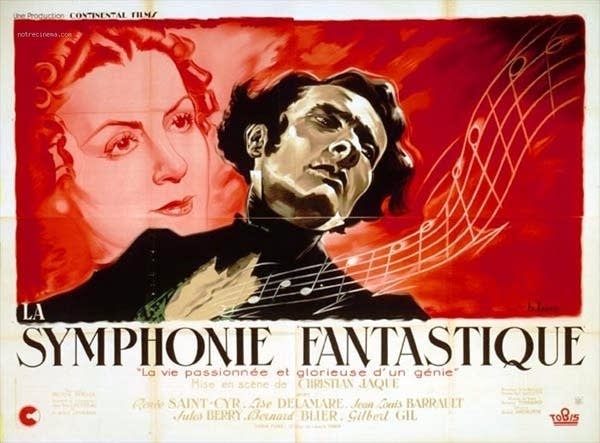
In 1830, Berlioz wrote an entire symphony to express his feelings of unrequited love for his dream girlfriend, the English stage actress Harriet Smithson.
It just so happens that Symphonie Fantastique became the first great musical composition of the Romantic Era. It remains one of the world’s most popular orchestral works – and can only be described as a very strange musical trip.
The story behind it is stranger still.
When Smithson traveled to Paris in 1827 to perform the role of Ophelia in Shakespeare’s play, Berlioz saw her for the first time. He was completely smitten. She became his fantasy lover.
He desperately tried to meet her. She didn’t even know he existed.
He showered her with letters. But Smithson didn’t understand French, so she never read them. While she remained in Paris, he rented an apartment that allowed him to spy on her comings and goings, even though they had never had a conversation. Dude, you really ought to consider finding another girlfriend.
If only he could have her, his beloved Henriette. This was interesting, since her name was actually Harriet. But in Berlioz’s mind she would always be Henriette. By preferring a fantasy name to her real name, he had clearly moved into seriously obsessional territory.
When Symphonie Fantastique was performed, Berlioz insisted that everyone in the audience receive a special program. It told the story behind the music.
He himself was the hero of the piece. He yearns for the love of his life, but she ignores him. At one point (according to the program), he takes opium to cope with his grief. While under the influence, he tragically kills his beloved. Berlioz composed a dramatic scene in which he is dragged to the guillotine. The blade descends. You can “hear” his head bouncing twice on the platform in what can only be described as a memorable orchestral moment.
His death is then celebrated by a macabre witches’ dance. In 1830, no one had ever heard music like this. Audiences who were used to Mozart and Beethoven didn’t even know how to react.
Here’s the famous witches interlude as directed by Leonard Bernstein, who openly suggested the Frenchman had actually taken opium in order to compose it: Berlioz: “Symphonie Fantastique” – 5th Mvt. – Leonard Bernstein. At the 3 minute 15 second mark, one hears for the first time the morbid theme that is routinely played, interestingly enough, by American college pep bands when the opposing team is facing trouble. It has also become the musical template for more than a few of the horror movies you’ve seen.
And what did Harriet Smithson think of all this?
She didn’t get around to hearing the symphony for at least two years. When she finally did, and when she discovered that the whole thing had been designed as a cry of obsessive love for her, she consented to meet Berlioz. They fell in love and got married.
And they lived happily ever after, right?
Actually, they quickly discovered they couldn’t stand each other. It wasn’t long before Berlioz abandoned her. He tried for the rest of his life – without success – to find the happiness he had always longed for.
Psychologists call it “apocalyptic romance.” If I can’t have you, the world will come to an end.
Every now and then, we actually get to experience what has always seemed unattainable: the perfect partner, the dream job with the corner office, the fantasy vacation, the title or award or public honor that will finally allow us to declare that we have made it.
But’s it’s never enough. No human being, and no mere something, can ever bear the weight of our overwhelming need to feel deeply loved and truly significant.
Only God can do that.
Duke University theologian Stanley Hauerwas writes, “The assumption is that there is someone just right for us to marry and that if we look closely enough we will find the right person. This…fails to appreciate the fact that we always marry the wrong person. We never know whom we marry; we just think we do.
“Or even if we first marry the right person, just give it a while and he or she will change… The primary problem is learning how to love and care for the stranger to whom you find yourself married.”
We always marry the wrong person.
But we can still learn to love and cherish that person, as long as we realize they were never intended to be the ultimate source of our happiness. If God’s love is at the center of our life, we can finally let our partner off the hook. He or she doesn’t have to fulfill all of our dreams.
That’s a lot to take in, especially in a culture obsessed with apocalyptic romance.
But, fortunately, it’s a lesson we can learn at any age or stage of life – long after our standing-beside-the-locker days are mercifully behind us.