
To listen to today’s reflection as a podcast, click here
Throughout the season of Lent, we’re taking a close look at the Apostles’ Creed – one of the earliest and most concise summaries of what followers of Jesus believe.
Kids ask great questions.
A young student named Emma asked her social studies teacher, Mr. Johnson, “How do you think Noah stored enough food to feed all those animals on the ark?”
Mr. Johnson sighed and said, “This isn’t Sunday School, Emma. We’re not here to talk about questions like that. Besides, most people agree that if there ever was somebody like Noah, he didn’t actually build a giant boat and fill it with animals to escape a flood.”
“Well,” said Emma timidly, “I guess I can ask him myself when I get to heaven.” “Really?” said Mr. Johnson, rolling his eyes. “So, what if Noah ended up in hell?”
Emma answered, “Then you can ask him.”
So, what’s a question that you always had when you were a kid, but never got around to asking?
How about one of these:
If God created the universe, what came before God? And how exactly is it possible that God has always existed? And what would motivate God to create something in the first place? Did he feel lonely and unfulfilled and in desperate need of companionship? Was God so neurotic that he had to create a race of beings who would bow down before him every day just so he could hear somebody tell him he was great?
The Bible makes it clear that God didn’t invent human beings because he was lonely or depressed or needed someone to boost his divine self-esteem.
Instead, humans entered the picture so we could be invited into something that has always existed – the ceaseless reality of love, joy, and communication that is central to God’s own identity.
From before the beginning of time, God has known what can only be described as a never-ending, joy-filled, self-giving experience of love. What we’re talking about is the essence of the Trinity. God exists as a society – as Father, Son, and Holy Spirit.
The most obvious feature of the Apostles’ Creed is its Trinitarian structure. The Father, Son, and Spirit each headline one of its three main sections.
Here we should pause to acknowledge that not everyone in the Jesus Movement over the years has been a fan of the Trinity. It’s true that there are no biblical “prooftexts” – verses that declare, in no uncertain terms, that God is three-in-one.
But it’s also true that during the three centuries that followed the time of Jesus, the Church’s sharpest minds were steered relentlessly toward the classic formulation of the Trinity that was ultimately expressed in the Nicene Creed (A.D. 325).
Since that time, Christianity’s three major ecclesiastical groups – Catholics, Protestants, and Orthodox – have each regarded the Trinity as a core doctrine.
By affirming Jesus as God’s Son – and not just a prophet, inspired teacher, or moral example – the Apostles’ Creed is clearly aligned with the notion that Jesus is divine.
So how could God become a human being, but still be God? That’s a question that routinely occurs to both kids and adults.
What Scripture affirms is that God the Son became a real human being at a real place at a real time in a real family. The most celebrated biblical description of this is found in John 1:14: “The Word became flesh and made his dwelling among us. We have seen his glory, the glory of the one and only Son, who came from the Father, full of grace and truth.”
The English words “made his dwelling” are a translation of the single Greek word eskenosen, which literally means “pitched tent.” In the person of Jesus, God came into our encampment. He pitched his tent right next to ours. He sat around the same campfire (so to speak), breathed the same air, and shared the same daily chatter about the weather, the flocks, and which family down the way just welcomed a new baby.
In other words, he became one of us.
Jesus’ extraordinary and evident humanity is clearly one of the reasons that so many of his followers have struggled to affirm his divinity.
But isn’t the whole idea of Trinity a blatant contradiction? How can God be both three and one?
Theologians have been careful to point out that God is singular in one category (essence – there is only one God) but plural in another category (personhood – God is tri-personal by nature). Such a description is neither a contradiction nor a violation of the principles of logic.
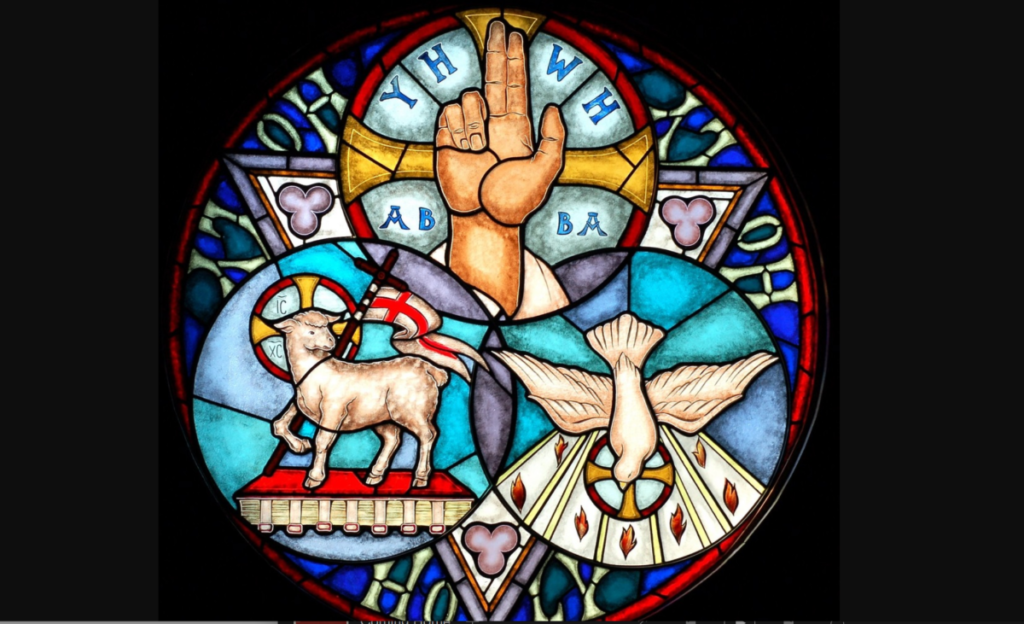
Nevertheless, it is certainly a paradox (something that at first glance seems to be contradictory) and a mystery (a profound truth that we can’t comprehend on this side of heaven). No picture (like the stained-glass window above) will ever lead us to say, “Oh, so that’s what God looks like.”
According to the church’s best thinking after centuries of ruminating on Scripture, what we can affirm is that God’s Son and God’s Spirit are both fully divine. They are not “different ways of thinking about God” or each one-third of the godhead.
We pray to the Father, through the Son, by the Spirit – and in every regard find ourselves in the presence of God.
So, what might it be like to be amongst the three persons of the Trinity?
Early in church history, theologians coined the word perichoresis. To modern ears, that might sound a bit like a serious skin disease. Perichoresis turns out to be a mashup of the Greek words peri (“around”) and choreo (“to come or go”). It suggests something that is going around and around and around. The word “choreography” springs from the same family of words.
When you think of the Trinity, think of an eternal, joyful dance of God, with Father, Son, and Spirit forever taking delight in each other.
And every one of us has been offered a ticket to the ball.
Perichoresis has proven to be a way to help us describe, at least in part, what we know to be indescribable – the internal dynamic of God’s own self.
The late philosopher Dallas Willard said it well: “God’s aim in human history is the creation of an inclusive community of loving persons, with himself included as its primary sustainer and most glorious inhabitant.”
No artist could ever depict such a reality. Nor can we always answer every child’s sincere questions about God.
But we can still be inspired by the thought of an exuberant divine dance as the representation of deep, lasting joy.
A joy that – by God’s grace – we, as his adopted children, will one day share.