
To listen to today’s reflection as a podcast, click here
Throughout the season of Lent, we’re taking a close look at the Apostles’ Creed – one of the earliest and most concise summaries of what followers of Jesus believe.
“Weekend Update” is a comedic take on national news headlines in every edition of Saturday Night Live.
The British equivalent was Not the Nine O’Clock News, a sketch comedy show that ran years ago in the same time segment as – you guessed it, Britain’s ultra-serious Nine O’Clock News.
One evening the cast presented a satirical Church of England worship service. The congregation was asked to stand and read from “the new revised version of the new revised version of the Book of Common Prayer.”
Together they recited aloud, concerning Jesus in the Apostles’ Creed, “who was conceived by the Holy Ghost, born of the Virgin Mary. No, don’t laugh. It could happen. After all, they can do it in a test tube these days.”
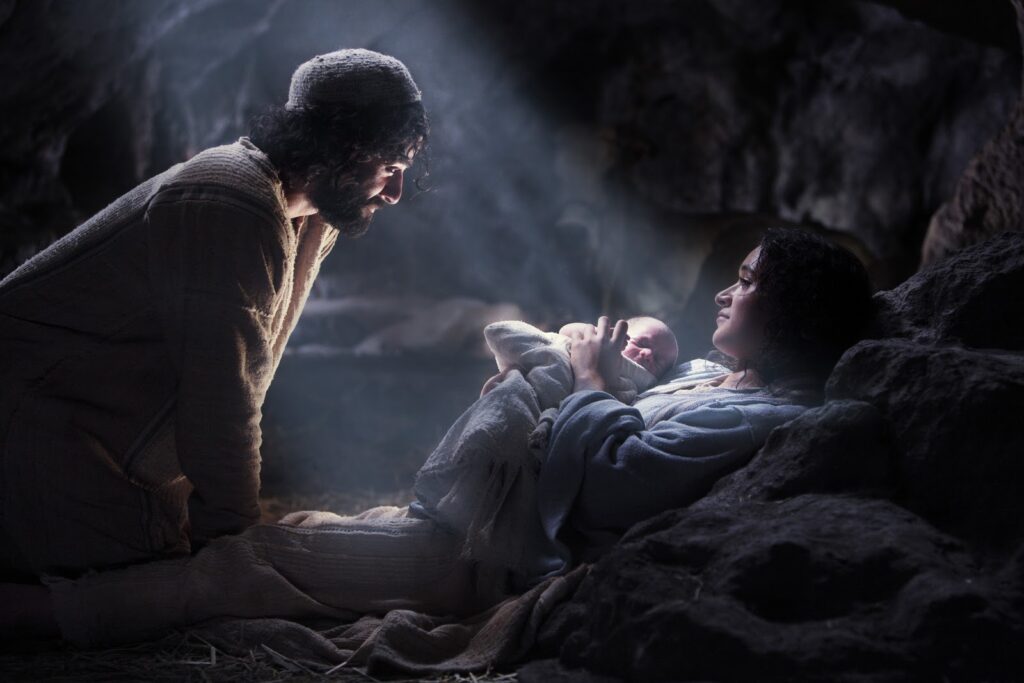
The Virgin Birth tends to make people laugh. Or roll their eyes. Or wince. Even for a number of Christ-followers, the notion that Mary brought Jesus into the world before she ever experienced sexual intimacy is something of a headscratcher.
Yet there it is – right in the middle of Christianity’s most widely circulated statement of faith.
The Apostles’ Creed bristles with theological declarations. No surprise there. But it’s more than a little surprising that the Creed also includes the names of two real-life human beings.
The first is Mary, the central figure at the beginning of Jesus’ life. The second is Pontius Pilate, who played a brief but crucial role during his last 24 hours.
New Testament scholar Michael Bird notes that the phrases “born of the Virgin Mary” and “suffered under Pontius Pilate” are separated by nothing more than a comma. The Creed skips over Jesus’ entire three-year ministry – his heartfelt teachings, his expressions of compassion, his extraordinary miracles, his confrontations with theological opponents, and his mentoring of a dozen apprentices.
All of that Gospel wealth is compressed into a single comma.
A few days from now, we’ll explore why the authors of the Creed thought it vital to mention the name of a corrupt Roman procurator. In the meantime, let’s address a few of the questions that are frequently raised with regard to Mary and the Virgin Birth.
Isn’t it likely that the earliest Christians merely borrowed pagan ideas to make Jesus look special?
As we noted yesterday, it’s true that certain ancient figures – such as the “dying and rising” gods of the so-called mystery religions of Osiris, Mithras, and Cybele – were thought to have supernatural origins and powers.
But no one ever tried to make a case that such deities had ever stood on a certain plot of ground during a certain year in the presence of actual witnesses. They were myths, not figures of history. Everyone knew that.
Jesus was different. He lived in a country that actually existed and walked on paths where actual people could actually walk. The apostle Paul insisted that at least 500 people – many of whom were still alive in A.D. 50 – had at one point been in the presence of the risen Jesus, and were presumably available for interviews (see I Corinthians 15:3-8).
But isn’t a virgin birth simply hard to believe?
This seems like an odd question, even though it’s frequently asked.
If God is really there – a God who is capable of opening the eyes of the blind, healing cancer, parting the waters of the Red Sea, and creating an entire cosmos – why should it seem particularly challenging to assemble the genetic material to produce a human fetus?
Isn’t it somehow beneath the Living God to mess around with the mechanics of human reproduction?
To be honest, this was one of the objections of many early skeptics and heretics.
Valentinus declared that Jesus passed right through Mary’s body like water through a pipe, without being contaminated in any way by human physiological yuckiness. Marcion couldn’t even imagine God’s Son coming into the world like everyone else. He preferred the idea that Jesus just showed up one day, fully grown.
Here we need to say, with sensitivity and not a little joy, that God is apparently delighted by human yuckiness.
He invented our bodies. Jesus chose to share every bit of our humanity. And that includes the sights, smells, and sensations that we don’t always talk about in polite company.
Do I have to believe in the Virgin Birth to be a “real” Christian?
Many contemporary Bible teachers would say this is not a make-or-break issue. Over the centuries, Jesus’ virginal conception has seemed to be of secondary importance.
After all, it doesn’t rate a single mention in the writings of Peter and Paul. Nor does it appear in two of the four Gospels, Mark and John.
But it does lead off the Gospels of Matthew and Luke. And the earliest Christians thought it to be of such significance that they included it in the Apostles’ Creed.
We can truthfully say that the Christmas story doesn’t make much sense unless we embrace the biblical idea that Jesus’ birth wasn’t merely an out-of-wedlock “accident,” but God’s gracious way to ensure that Immanuel, “God With Us,” would come into our hurting world and experience the actual ups and downs of being a real human being.
So, if the Virgin Birth actually matters, why does it matter?
God made a promise to Abraham in Genesis 12:1-3. He would richly bless Abraham, whose descendants would richly bless the world.
But the people of Israel failed, again and again, to faithfully represent God’s good news to the rest of the world. That world-transforming mission would fall to the Messiah, who would have to be an Israelite. Jesus needed the DNA of the family of David, which came via Mary, as well as the divine nature of God Almighty, which came via the Holy Spirit.
The Virgin Birth thus provided the essential dual nature of Jesus the Messiah.
The Apostles’ Creed regards Mary as someone special. How special is she?
Different believers have come to different conclusions.
Catholics have elevated Mary to places where Scripture clearly does not go. That includes the doctrine of the Immaculate Conception – declared by papal bull in 1854 – which asserts that Mary herself was born without sin. Catholic theologians have reasoned that Jesus’ mother needed to be sinless in order to give birth to a sinless Savior. Nothing in the Bible leads us to think this must be so.
In some cultures – in Latin America, for instance – Mary is regarded almost as a co-redeemer with her son. Jesus may be the designated mediator between God and humanity, but Mary is our mediator with Jesus. Again, there is nothing in the New Testament to suggest such an extraordinary role.
Protestants, in their eagerness to distance themselves from the perceived excesses of “’Mariology,” have typically gone in the opposite direction. They value Mary too little, failing to honor a young woman who was asked to surrender, for God’s sake, all the plans she had for her own life.
And who bravely said yes.
So, where’s a good place to land?
Here’s how Michael Bird sums up the importance of this doctrine: “The virgin conception is not a Christianized version of pagan mythology, nor an odd tale of God’s onetime enterprise at running a Galilean fertility clinic for teenage girls.”
Instead, it’s all about “Israel’s hopes coming true, about God’s Son made flesh, about the Spirit’s power in Jesus’ life, about a new world dawning, and about God’s victory over Satan through the offspring of Eve.”
Or, to put it more simply, ours is a Christmas faith every day of the year.
All because God’s Spirit overshadowed an incredibly courageous teenage girl.