
To listen to today’s reflection as a podcast, click here
In Vienna, Austria, in the middle of the 19th century, going to a hospital to have a baby could be likened to a roll of the dice.
Sometimes, new mothers did not return home.
The mortality figures were staggering. Almost 20% of the expectant moms in Vienna General Hospital’s First Obstetrical Clinic succumbed to so-called “childbirth” or “puerperal fever” – a dreadful illness of unknown origin.
Physicians entertained a variety of explanations. Advocates of miasma theory believed that bad air was the culprit. The name “malaria” (literally, “bad air”) is the linguistic legacy of such thinking. Some doctors recommended that hospital windows remain open, even in the dead of winter. Others insisted they be closed, even on sweltering summer days.
Still others declared that childbirth fever was associated with the inherent frailties or moral weaknesses of particular moms.
There was one thing the doctors knew for sure: They weren’t responsible for all those deaths.
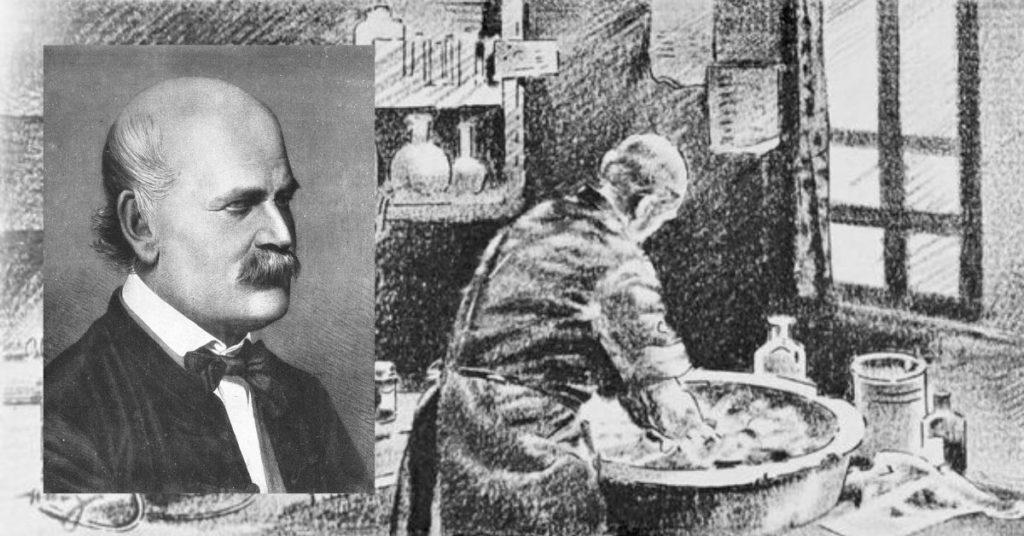
A Hungarian physician named Ignaz Semmelweis came to a different conclusion. Semmelweis (1818-1865), upon arriving in Vienna, noticed the startling difference in infection rates between the hospital’s First Clinic (which was staffed by doctors and medical students who were also conducting autopsies during their daily rounds) and the Second Clinic (staffed by midwives and students who were not).
Mothers-to-be noticed the same numbers.
Desperate women got down on their knees and begged not to be admitted to the First Clinic. Their fears were hardly laid to rest when priests routinely spoke last rites over mothers in labor. Semmelweis heard accounts of women deliberately giving birth in the streets, then carrying their newborns into the Second Clinic to receive care. He noticed that those who delivered their babies on the sidewalks of Vienna almost never got puerperal fever.
What if the doctors in the First Clinic were carrying some sort of mysterious “cadaverous particles” from their autopsies into the labor rooms? Would it make sense for physicians to wash their hands?
In 1847 he proposed that physicians cleanse their hands in a chlorinated lime solution between patient visits – especially if they had been in the presence of corpses. When Semmelweis mandated hand-washing as a standard practice in the First Clinic, something wonderful happened: The maternal mortality rate plunged from 18% to less than 2%.
Immediately, doctors everywhere rejoiced. A deep mystery had been solved, and countless precious lives would now be saved.
That’s not exactly what happened.
Doctors everywhere denounced Ignaz Semmelweis as a kook and a fraud.
What proof did he have of these “cadaverous particles”? Semmelweis himself knew he had no scientific explanation for the strategy of hand-washing. Twenty years would go by before Louis Pasteur and Joseph Lister would articulate the germ theory of disease.
All Semmelweis had was an incredible (and incontrovertible) set of real-life results.
His colleagues, however, refused to believe. They offered alternative explanations. Hand-washing was too ridiculous, too simplistic, and too divergent from prevailing medical wisdom.
But most of all, it was too offensive to the doctors themselves.
There was general agreement that physicians were gentlemen. And a gentleman’s hands could never transmit disease. That notion was impossible to fathom.
Semmelweis’ insights were rejected. He did not respond well. Because he vociferously pushed back against the medical establishment, he was labeled a troublemaker and driven from Vienna. In 1865 he suffered a nervous breakdown, was committed to a Budapest asylum by friends and colleagues, and died shortly thereafter.
The Hungarian did not live to see his total vindication.
He certainly did not suspect that one day psychologists would speak of the “Semmelweis Reflex” – a form of confirmation bias that prompts even some of the world’s most intelligent people to reject new ideas out of hand just because they don’t align with “what everyone knows to be true.”
Confirmation bias is the tendency to favor ideas that we have already accepted.
We find it easy to agree with those who express the political, religious, and ethical convictions we already have. Our TVs go right to our favorite news channels. “He’s a brilliant author!” we will say about the writer who represents the views of our camp. But we quickly dismiss those who present opposing arguments. “What a dumb book!” we conclude.
As sociologist Elliott Aronson notes, “Once we are invested in a belief and have justified its wisdom, changing our minds is literally hard work.” Our brains just don’t want to do it. Studies have shown that a majority of people would rather experience uncomfortable dental work than even listen to opinions they don’t agree with.
This is a major problem.
Especially when we consider that the essence of spiritual growth is change.
What were the first words of Jesus’ public ministry? “Repent and believe the Good News” (Mark 1:15). The concept of “repentance” has fallen on hard times. In our culture it chiefly registers as a negative: You’d better stop doing that. But the Greek word that it translates, metanoia, literally means “change-mind.”
Jesus is saying, “Take a different view of things. Come to a different conclusion about reality. Open your mind to the incredible opportunities of living under God’s leadership instead of muddling through life on your own.”
Confirmation bias is what keeps so many of us from even considering that invitation.
All religions are equal: equally useless. Besides, my life hasn’t run off the rails. Who wants to end up like those nuts on TV? I just don’t want to be deluded.
Without some kind of help, most of us will never be able to think our way to a change of mind.
But help is available. In Romans 12:2, the apostle Paul talks about the power of the Holy Spirit to accomplish the “renewing of our minds” – the gradual reorientation of our perspectives and mindset.
How does such a transformation begin? We ask for the Spirit’s help, perhaps by offering this 15-word prayer:
“Lord, open my eyes to who you are, and I’ll open my heart to you.”
Is this going to turn out to be just another spiritual dead-end?
Relying on his grace and power, ask God to help you wash your hands of that very idea.