
To listen to today’s reflection as a podcast, click here
If you’re into conspiracy theories, the late great Georgia Guidestones might be your cup of tea.
They were huge. Their origin was mysterious. And their meaning definitely generated plenty of heated conversation.
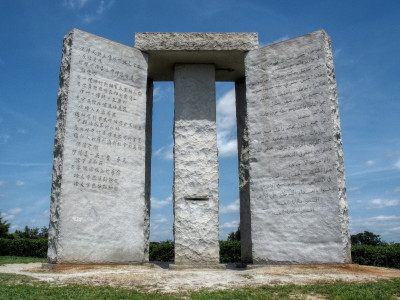
The Guidestones, sometimes referred to as “America’s Stonehenge,” were located about 90 miles east of Atlanta near the town of Elberton.
Four gargantuan granite slabs, each about 19 feet tall, surrounded a center slab and capstone.
Ten guidelines or principles were chiseled onto the eight primary surfaces in eight different languages (English, Spanish, Russian, Chinese, Arabic, Hebrew, Hindi, and Swahili):
- Maintain humanity under 500,000,000 in perpetual balance with nature.
- Guide reproduction wisely — improving fitness and diversity.
- Unite humanity with a living new language.
- Rule passion — faith — tradition — and all things with tempered reason.
- Protect people and nations with fair laws and just courts.
- Let all nations rule internally resolving external disputes in a world court.
- Avoid petty laws and useless officials.
- Balance personal rights with social duties.
- Prize truth — beauty — love — seeking harmony with the infinite.
- Be not a cancer on the earth — Leave room for nature — Leave room for nature.
What was going on here?
For decades, no one knew who designed the monument, came up with the list, or paid for its installation.
A man who introduced himself as Robert C. Christian (widely regarded as a pseudonym) had commissioned a local stone company to prepare the slabs. He explained that the structure would function as a primitive clock, calendar, and compass.
And then, more ominously, he indicated that the slabs should be able to withstand “catastrophic events.”
Authorities, when asked, were able to confirm that the Guidestones were dedicated on March 22, 1980, before a group of several hundred people. But the organizers of that event chose to remain silent and anonymous.
Opinions abounded, of course.
Since the monument went up during the Cold War, many wonder if principle #1 – sustaining global population at a half billion people (compared to today’s 8.2 billion) – suggested that the sponsors were foreseeing an apocalyptic World War III. Did the Guidestones present a “rebuilding” plan for humanity?
Others called the guidelines the Ten Commandments of the Antichrist. Conspiracy theorist and YouTube personality Mark Dice suggested they were of a “deep Satanic origin.”
Dice, of course, also believed that Katy Perry’s Super Bowl halftime show in 2015 was Satanic. That was the game where Tom Brady and the New England Patriots won on a goal-line interception with less than a minute to go. So, maybe Dice had a point after all.
In 2008, the stones were defaced with aerosol paint and graffiti: “Death to the New World Order.”
In response, a man identifying himself as R.C. Christian released this statement: “I am the originator of the Georgia Guidestones and the sole author of its inscriptions. I have had the assistance of a number of other American citizens in bringing the monument into being. We have no mysterious purposes or ulterior motives. We seek common sense pathways to a peaceful world, without bias for particular creeds or philosophies.”
It was a calm and gracious appeal. But conspiracy theorists continued to assert that the slabs posed some kind of existential threat.
The controversy came to an explosive end on July 6, 2022, when someone planted and detonated a bomb at the site, significantly damaging the stones.
The mayor of Elberton declared that the Guidestones should be rebuilt. The Elbert County Board of Commissioners, however, disagreed. A month after the bombing they voted to donate the rubble to the Elberton Granite Association. It seems likely that America has seen the last of one of its most mystifying public monuments.
Because geology can be so durable, a number of significant works of art and important messages have been fashioned in stone.
The Parthenon of ancient Greece exemplifies reason and order. The Taj Mahal is a memorial of marital love and fidelity. The Great Pyramids and Sphinx of ancient Egypt, as well as Britain’s Stonehenge, represent mysteries that have still not been entirely decoded. Mount Rushmore presents four faces of transforming leadership.
Historically, some of humanity’s most revered laws have been chiseled onto stone.
Think of Babylon’s Code of Hammurabi (about 1754 B.C.) and the Ten Commandments of the Israelites (about 1250 B.C.).
Followers of Jesus are committed to a radically different idea.
God’s directives to humanity don’t appear on granite slabs. Instead, they should be on public display in us:
The apostle Paul told the young (and unruly) Christians in ancient Corinth, “You yourselves are our letter, written on our hearts, known and read by everyone. You show that you are a letter from Christ, the result of our ministry, written not with ink but with the Spirit of the living God, not on tablets of stone but on tablets of human hearts” (2 Corinthians 3:2-3).
God’s story is primarily accessible on the pages of God’s Word.
But the imprint of that same story – including its warnings, commands, promises, and assurances – should also be something people can “read” in our conversations, our character, and our choices day after day.
The more we allow God’s Spirit to “chisel” our hearts, the less we will feel the need to go on pilgrimage to the world’s stone monuments.
And the more the world will see, just by looking at us, what God can accomplish in a surrendered human life.