
To listen to today’s reflection as a podcast, click here
Each day this month of August we’ll be looking at one of the extraordinary metaphors that the Bible uses to illustrate the nature of our relationship with God.
One of my happy memories as a pre-teen was spending Saturday afternoons at the Uptown Theater in Indianapolis.
My ritual included purchasing a Bit O’ Honey or a Slow Poke sucker at the concession stand, taking in the three or four cartoons before the main feature, then sitting back to enjoy the Monster Movie of the Week.
These were usually low-budget productions graced by less-than-stellar actors and cheesy special effects. Flying saucers, giant spiders, and mummies who simply would not stay dead and buried captivated us for the next 90 minutes.
In 1963 we were treated to The Crawling Hand – the strange tale of an astronaut who comes under the influence of an extraterrestrial malevolent force. When he crash-lands back on earth, the only thing that survives is one of his hands. It promptly takes on a life of its own and begins to stalk the citizens of a small town.
Spoiler alert: The town is saved from this menace by a hungry cat, which runs off with the hand at the end. It’s a deeply satisfying cinematic moment for cat lovers.
There’s something incurably creepy about human body parts that shuffle off on their own – disembodied arms, eyes, heads, and so forth. Those make great props for a horror movie, but “doing your own thing” is definitely not the biblical vision for serving God.
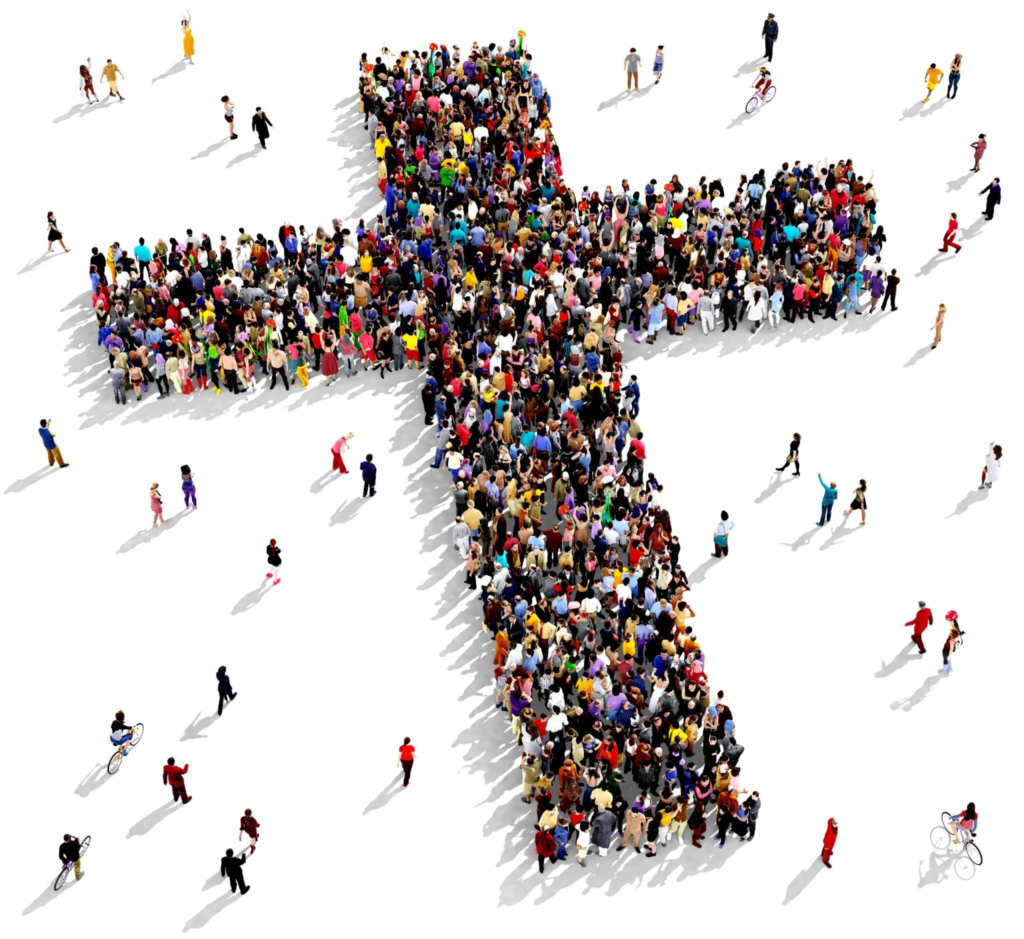
Instead, the New Testament presents – more than 30 times – the metaphor of the Body of Christ.
The Christian faith rises or falls on a single historical claim: that Jesus of Nazareth was not in his tomb on the first Easter morning because God had raised him from the dead. Where is Jesus right now? He is “seated at the right hand of God the Father,” as the Apostles’ Creed asserts. Jesus rules the cosmos. He rules it invisibly. But that doesn’t mean he is no longer actively present in this world.
Jesus, by the Holy Spirit, lives within his followers. He acts, speaks, and reaches out to a broken world through us.
One of the intriguing evidences that the resurrection really took place is that Jesus’ tomb never became, like so many other burial plots of famous religious figures, a place where pilgrims came to lay flowers and offer prayers. The earliest disciples quite literally lost track of the location of Jesus’ tomb – for the simple reason that they knew Jesus wasn’t there. Because of the resurrection, the “action,” so to speak, has forever shifted to any place where someone chooses to call on Jesus’ name.
Have you ever wondered how neat it might have been to be one of Jesus’ contemporaries?
But you are in fact a contemporary of Jesus. He is alive amongst his followers right now.
As Paul puts it in Ephesians 1:22-23, “And God placed all things under his feet and appointed him to be head over everything for the church, which is his body, the fullness of him who fills everything in every way.” The Body of Christ and the church (here we’re talking about those who are genuinely committed to Jesus) are one and the same.
This is unsettling news for the myriad self-described American Christians who consider local churches something akin to kryptonite. Instead of joining what will surely turn out to be a dysfunctional spiritual family, why not pursue instead a pathway of do-it-yourself discipleship?
Paul’s answer is that sharing life with other Christ-followers is not an elective in the Christian curriculum, nor a side dish we can pass up at God’s buffet table. The church is an organization only secondarily. Primarily the Body is an organism – a living association of women and men who are becoming more and more like Jesus, with Christ himself as the head. We are his arms, legs, hands, feet, sinews, and muscles.
If Jesus is going to accomplish anything in this world, he’s made it clear he wants to make it happen through his church. Therefore, we must walk, serve, and love together – not as disembodied organs or limbs crawling off to do our own thing. Whenever Christians do that, all the world sees is a spiritual horror movie.
What’s it like to be in the Body of Christ?
There’s something about all of us that is the same. But there’s also something about each of us that is different.
Paul makes this signature statement in I Corinthians 12:4-6: “There are different kinds of gifts, but the same Spirit distributes them. There are different kinds of service, but the same Lord. There are different kinds of working, but in all of them and in everyone it is the same God at work.”
Notice where the sameness is found. It relates to the source of human giftedness. We receive what we need in life from the same God (the Father), the same Lord (the Son), and the same Spirit.
Our personal experience, meanwhile, is differentness – different gifts, different kinds of service, different kinds of working. People are not interchangeable. We didn’t all roll off the same assembly line.
Every Christian carries the DNA of discipleship. But just as different cells in different parts of the human body express different aspects of the same genetic code, members of Christ’s Body will tend to excel in significantly different areas.
Let’s imagine, for example, that as part of trusting Christ we’re all called to live out the letters “SE.” How might that be expressed in ministry?
For those in the choir, SE might mean “sing exuberantly.” People on a mission venture will “serve enthusiastically.” Members of the pastoral staff are called to “study eagerly.” Volunteers with Habitat for Humanity “sheetrock energetically.” Those on the Finance Team excel at “shrinking expenses.” And out of love for God, members of the Sunday morning Hospitality Team will “serve eclairs” – something that helps the rest of us grow in our love for God, too.
If all this sounds like a vast over-simplification, it is. No one knows how or why the Holy Spirit leads different members of God’s team to function in such different ways.
Nevertheless, we know it’s true. To paraphrase Paul, “If all of us exceled at exactly the same thing, you’d never look at a group of Christians and say, ‘Now, that’s a body.’”
So where does that leave each of us?
If you’ve given yourself to Christ, then you represent him here on earth. And what you contribute matters. As the old saying goes, when you get to heaven God isn’t going to ask you why you weren’t more like Martin Luther or Francis of Assisi or Billy Graham or Mother Teresa. He’ll ask you why you weren’t more like you.
So, don’t be a Slow Poke.
As an indispensable member of the Body of Christ, resolve to discern the uniqueness of your calling and pursue it with all your heart.