
To listen to today’s reflection as a podcast, click here
Are you ready for Christmas? During the season of Advent – which annually begins on the fourth Sunday before Christmas and leads up to December 25 – followers of Jesus traditionally look for ways to prepare themselves for the coming of God’s own Son into the world. Throughout December we’ll ponder ways that we can ready ourselves to receive Jesus, once again, into our own hearts.
Doctors have not always been seen as heroes.
For generations they were considered little more than butchers.
In the pre-anesthetic era, surgeons were haunted by the screams of their patients. It took overwhelming courage for the average person to submit to an invasive procedure. Childbirth could be agonizing. Battlefield hospitals seemed like previews of hell.
A Scotsman named James Young Simpson, having witnessed a surgery in the 1820s, almost gave up his dream of becoming a doctor.
Millions of people are grateful he didn’t. That’s because Simpson became committed to finding an anesthetic that really worked.
Simpson, who had been the living embodiment of a precocious child, entered college at age 14. He graduated with honors and became the most celebrated obstetrician in Scotland. His deepest hope was to find a way to alleviate the discomforts and dangers experienced by women in childbirth.
During the 1840s Simpson learned that American surgeons had experienced some success with ether. But ether worked too slowly to be of much value during labor, and it left mothers feeling sick to their stomachs.
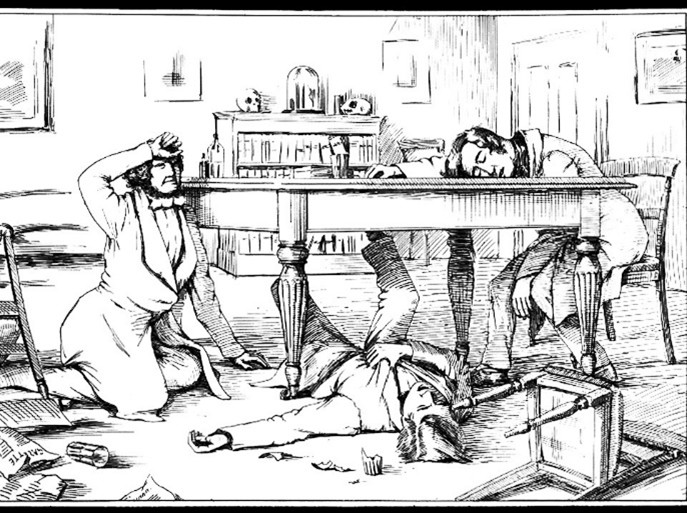
Simpson was fortunate to work with a pair of assistants who weren’t afraid to try out potential anesthetics on themselves. Typically they would have “sniffing parties” in Simpson’s dining room after work, passing around chemicals to see if they had any effect. Who says medical research is a dull enterprise?
On November 4, 1847, the three men decided to try chloroform. Until that time it had chiefly been used by veterinarians to anesthetize large farm animals. It was considered dangerous. What could possibly go wrong?
Each man inhaled generously. At first they felt happy and exhilarated. Then they promptly passed out, ending up on, under, or in the general vicinity of Simpson’s dining room table.
That’s where they were still lying when they woke up the next morning. Hey, this stuff really works.
It didn’t take long for physicians to be won over. Chloroform was certifiably dangerous – it’s a wonder none of the three men died that evening – but once dosages were properly regulated, it became virtually a miracle drug for surgical patients and for women giving birth.
But for a number of theologians and church leaders, chloroform seemed to be the very antithesis of a miracle. It was a devious means of circumventing the will of God.
Didn’t the book of Genesis make it clear that childbirth was supposed to be an ordeal – a judicial punishment on Eve (and all of her future daughters) for disobeying God? God, after all, had said, “I will make your pains in childbearing very severe; with painful labor you will give birth to children” (Genesis 3:16).
Some Anglican priests recommended withholding baptism for children born under anesthesia.
Others worried that mothers might not bond with their children unless they had experienced enough pain. And still others fretted that chloroform would convert pain into pleasure, transforming labor into something like a Disney World ride.
We should pause here and note that all of these opinions were advanced by men.
Two things finally won the day for anesthesia.
The first was a celebrity birth. Dr. John Snow administered chloroform to Queen Victoria in 1853, allowing her to experience little to no pain while bringing her seventh child, Prince Leopold, into the world. The rest of Britain’s female population ultimately concluded that if anesthesia was good enough for royalty, then they, too, would be more than willing to forego labor pains.
The second was a useful Bible observation.
Even while some clerics were pointing to the judicial consequences of Genesis chapter three, others were saying, “Did you forget about Genesis chapter two?” That’s where God performs a remarkable “surgery” on Adam, transforming one of his ribs into his life partner. And how did God make that happen? “He caused Adam to fall into a deep sleep…” (v. 21). That certainly sounds like anesthesia.
More significantly, the Bible teems with verses that make it clear that God’s ultimate agenda for human hearts, human relationships, and human communities – and planet Earth itself – is healing. At the heart of God’s work is the eradication of pain.
Which brings us to what many people regard as one of the greatest challenges of the Christmas season: getting together with family members.
Is there a safe, cheap, readily available means of dulling the pain of facing your squealing nieces and nephews, the political bickering at the dinner table, the sister who treats you with contempt, and Uncle Frank after he’s put away a few drinks?
There is. But it’s probably not what you’re thinking.
You yourself can be the anesthetic. You can choose, as best you can, to be what family systems counselors call “a non-anxious presence.”
Instead of imagining yourself as having to endure an ordeal – to get through as many hours as you can, fending off as many wounds as you are able – you can take an active role in blessing others. Your own experiences will be transformed as you shift from “reactor” to “actor.”
A non-anxious presence is someone who is “there” when they’re actually “there.”
Your call is not to resolve anyone else’s issues. Your call is not even to do a great deal.
Just offer words of thanks. Ask others about their interests. Listen. Be patient longer than you think possible. Say less than you said last year. Pray silently for everyone else in the room. Ask that God would bless them with his peace.
And where will you find the inner strength to pull off something like this?
Fall back on the words of the apostle Paul: “Don’t be anxious about anything, but in every situation, by prayer and petition, with thanksgiving, present your requests to God. And the peace of God, which transcends all understanding, will guard your hearts and your minds in Christ Jesus” (Philippians 4:6-7).
We don’t have to be doctors in order to help alleviate some of the world’s pain.
As a non-anxious presence, we can be receptive to God’s peace – a peace that is clearly meant to be shared with others.
And whenever we do that, we can be confident we are working under the blessing of heaven.