To listen to today’s reflection as a podcast, click here
Throughout the season of Lent, we’re taking a close look at the Apostles’ Creed – one of the earliest and most concise summaries of what followers of Jesus believe.
In ancient times. there was nothing quite like a wedding in a Middle Eastern village.
Even though Say Yes to the Dress was still 20 centuries away, bridal families definitely knew how to throw a party.
Honeymoons had not yet come into fashion. In truth, there was no place for a newly married couple to go.
Instead, they would remain in their village and a host a week-long “open house” of sorts, one that would overflow with food and wine. For most couples this would be the happiest week of their lives. Every neighbor would be invited. No one would want to miss the fun.
Weddings did not begin on a certain day at a certain hour, with the bride’s mom insisting that the minute hand be sweeping upward when the ceremony began. Nobody owned a clock. Thus, the wedding would begin when the food was ready and the preparations were complete. Just by paying attention to the sights, sounds, and delicious smells, one could generally narrow down the starting time to within a day or two.
Make no mistake: Everybody in town would know that the time was getting close, and they ought to be getting ready to join the party.
At a moment of his choosing – quite possibly in the middle of the night, just to be playful or ornery – the groom would begin to walk through the streets of the village, taking the longest possible route. His best man would precede him, shouting that it was time to drop everything and come to the celebration.
Neighbors would come out and form a kind of conga line behind the groom as he walked toward his own wedding.
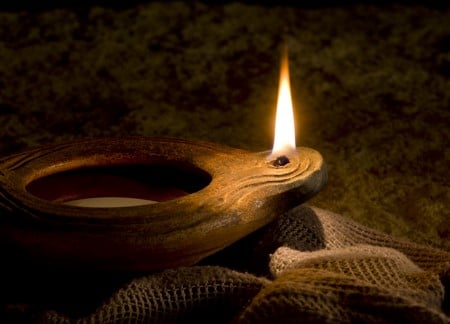
In some villages, to this day, it is required that anyone who joins a wedding procession after sunset must carry a small, lighted lamp. In Jesus’ time those lamps were clay vessels that could fit into the palm of one’s hand, like the one pictured above. Oil was poured into a hole in the center. The wick would protrude from an opening on the side.
Sufficient oil to keep the lamp burning was carried in a small flask. When the party began, you had better have your lamp ready. Otherwise, you would be seriously breaching Middle Eastern etiquette by insulting the bride and groom.
In Matthew 25:1-13, Jesus tells a story about ten young women who, like everyone else in town, have been waiting for the fun to begin. Five of them are ready. Their lamps are at hand and their flasks of oil are full. Jesus calls them wise.
But the other five young women, for one reason or another, are caught off guard. The groom suddenly shows up – surprise – but they’ve run out of oil.
Without burning lamps, they’re going to miss the parade. They’re going to miss the feast. They’re going to miss the chance to experience the splashy coverage of the biggest social event of the season.
Jesus calls them foolish.
On the pages of the Bible, a “fool” isn’t someone who lacks IQ, physical grace, or common sense. A foolish person is someone who misses the chance of a lifetime because something else – something comparatively trivial – seems more important than being ready for the moment when God suddenly shows up.
The five unprepared young women were certainly intending to join the party. But when it comes to walking with God, good intentions are not good enough.
There’s a world of difference between hearing Jesus’ words and obeying them.
The Apostles’ Creed declares, “From there [from heaven] he will come.” Come to earth, that is, a second time. We do not know when this will happen. We do not know precisely what that day will look like or feel like.
The one thing Scripture makes perfectly clear is that we had better be ready.
In Jesus’ parable, there’s little doubt who the groom is. It’s Jesus himself. And how does the Bible describe what it will be like when God’s Son brings together all of God’s people at the end of history? It will be a party like no other in the next world – the Wedding Feast of the Lamb (Revelation 19:6-9).
The groom in the parable takes longer than expected to start his walk through the streets. The young women all fall asleep. Then in verse five they hear the cry, “Here’s the bridegroom! Come out to meet him!” This is the moment at which spiritual wisdom is fully contrasted with spiritual foolishness.
Only when it’s too late do the five unprepared women discover that they cannot hitchhike on somebody else’s faith.
“Give us some of your oil; our lamps are going out!” (Matthew 25:8). But we cannot borrow the faith of our parents or grandparents. Nor can we make a withdrawal from the commitment of our spouse or the resiliency of our small group and pass it off as our own.
We have to own our own trust in Jesus.
Perhaps we’ve been led to believe that if we just have a lamp – an invitation to God’s big party – all is well. We don’t really need a reservoir of oil. Bible study is nice and all that, but we can always fall back on a good internet search engine to dig up promises and commands if the need ever arises. Nor do we need to go all-out to learn how to pray, serve, or even comprehend what we say we believe.
Bible scholar Dale Bruner is surely spot on when he points out that all too many people are content with the lamp of experiential Christianity but refuse to take up the flask of discipled Christianity.
That truth begins to dawn on the five foolish virgins. “While they were on their way to buy oil, the bridegroom arrived. The virgins who were ready went in with him to the wedding banquet. And the door was shut. Later the others also came. ‘Sir! Sir!’ they said. ‘Open the door for us!’”
But it’s too late. They’ve missed the party.
Did you used to cram for tests – you know, stay up all night before a final exam, trying to pour into your head all the learning you should have been doing over the course of an entire semester? Jesus is telling us that we cannot “cram” our relationship with him.
We cannot pretend to know someone whom we have not actually taken the time to know.
In the age of electricity, what does it mean to keep our lamps burning?
Read. Pray. Ask questions. Pay attention. Don’t fall asleep in the middle of your life.
The Creed is a great reminder that one of these days, the Groom of all grooms is going to show up.
And he’ll be walking right down the middle of your street.