
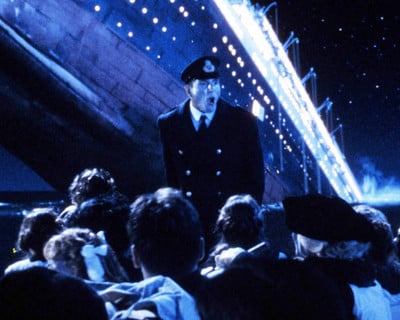
To listen to today’s reflection as a podcast, click here
On April 14, 1912 – 114 years ago today – the RMS Titanic struck an iceberg just before midnight.
Two hours and 40 minutes later, the “unsinkable” British luxury liner plunged more than two miles into the depths of the North Atlantic Ocean.
Historians estimate that more than 3 million ships are lying somewhere on the floors of the world’s oceans. But no maritime disaster has stirred deeper feelings and generated greater fascination than the loss of Titanic.
Trivia buffs have uncovered an astonishing number of details – things that would probably have gone unnoticed if the ship had arrived safely in New York City.
First class passengers, for instance, were served a novel delicacy during the first four days of the voyage: peanut butter. They were regaled with 20,000 bottles of champagne. Having each paid approximately $112,000 (in today’s money) to join Titanic’s maiden voyage, the richest passengers enjoyed private bathrooms.
The approximately 700 third-class passengers, meanwhile, had to share two bathtubs.
On the day of the disaster, Titanic’s wireless operators received and ignored six warnings of icebergs. A nearby ship, the Californian, sent the message, “We are stopped and surrounded by ice.” The Marconi operator aboard Titanic, who was overwhelmed on April 14 by the task of sending out passengers’ messages to family members and friends, responded, “Shut up, shut up, I am busy.”
John Jacob Astor IV, one of the world’s richest men, was among the victims. Milton Hershey, who was in the midst of establishing his empire of chocolate, had reserved a first-class stateroom. But business commitments had compelled him to sail to America the week before.
The survival rate for first-class women was 97%, while only 16% for third-class men. Three dogs made it safely to the lifeboats, along with a mother cat and her litter of kittens.
James Cameron’s dramatization of the fateful voyage (which took home 11 Academy Awards in 1998) is exceptional in that it focuses on a part of the Titanic story that every previous film had ignored: the reality of the hundreds of passengers who were still alive and screaming for help in the freezing waters of the Atlantic long after the ship had disappeared.
The raw numbers of the disaster were as chilling as the 28-degree water.
There were 2,223 souls on board when the boat hit the iceberg. The ship was equipped with twenty lifeboats, having a total capacity of 1,178. Even though there was room for more than half the passengers to be saved, a mere 705 were rescued.
The difference between the lifeboat capacity of 1,178 and 705 is 473. At least that many people were still alive and thrashing about in the water for many minutes after Titanic sank.
Why didn’t the lifeboats, which were only partially filled, go back to rescue them?
We know the answer to that question. In sworn testimony presented in the hearings that followed the disaster, conversations in the lifeboats were reconstructed.
In lifeboat 8, several passengers strenuously pressed for going back. One said aloud that he would rather die with those in the water than row off and be safe. But the majority overruled him, arguing that desperate, drowning people would surely capsize them. “It’s no use going back for a lot of stiffs,” said Quartermaster Hichens.
In lifeboat 1, Charles Hendricksen proposed going back to pick up some of those in the water. But Lady Duff Gordon, the renowned fashion designer, muttered something about the danger of being swamped. Her husband, Sir Cosmo Gordon, offered five pounds to each of the crewmen aboard not to row them back. The other male passengers agreed that a rescue would be dangerous.
Lifeboat 1 held only 12 people. It could have carried 40.
One of the lifeboats, which was filling with water, needed to be bailed out. A crew member asked to borrow the hat of one of the men who was there so he could start bailing, but the man refused. Even though he was soaked to the skin with freezing water, the man said, “If I give you my hat, I might catch cold in the night air.”
In the end, only lifeboat 14 went back. By the time it responded it was able to save just three people.
What is most disturbing is how similar those lifeboat conversations are to discussions that are regularly heard today in our own family rooms, board rooms, and church council meetings – debates as to whether we should extend care to those in the inner city, or reach out to the rural poor, or target the needs of people pleading for financial help, or serve as advocates for those who are too small or too silent to have a voice of their own.
“We can’t go help those people. We don’t have a budget for that. They’ll pull us under. Isn’t there some agency that’s supposed to help? It’s probably too late, anyway. They’re just a bunch of stiffs. We have to take care of us.”
But our lifelong job assignment is not to take care of us. It is to lay down our agendas to take up the agenda of the God who cares for those in deepest need.
“Blessed are the poor in spirit,” Jesus says in Matthew 5:3, “for theirs is the kingdom of heaven.” The word he uses for “poor” is ptochoi – the ancient world’s poor who were so helpless that even the most compassionate philosophers and rabbis declared that righteous people had no obligation to such creatures beyond an occasional handout.
Yet Jesus announced that such hopeless men and women would populate the kingdom of his heavenly Father.
To put it another way, Jesus would have been in lifeboat 14.
And our place is with him.
On our way back.