
To listen to today’s reflection as a podcast, click here
Revive and Restore sounds like a spiritual retreat ministry.
In truth, it’s a consortium of biologists and geneticists who have been working for years to clone a number of creatures that used to walk and fly amongst us.
Their flagship project is the passenger pigeon, billions of which lived in North America until they were hunted to extinction early in the 20th century. Other candidates for “de-extinction” are the Mastodon, Woolly Mammoth, Ivory-Billed Woodpecker, and Saber-Toothed Tiger.
I am personally hoping that if the Saber-Toothed Tiger is actually brought back to life, its reintroduction will happen at least 500 miles from the northwest side of Indianapolis.
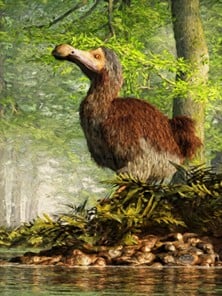
Dr. Beth Shapiro, an evolutionary biologist at the University of California, Santa Cruz, announced in 2016 that scientists have sequenced the entire genome of the dodo.
The dodo was a large, flightless bird – adults stood about three feet tall and weighed around 25 pounds – that used to live in abundance in just one place on Earth. That was Mauritius, an island off the east coast of Africa.
The word “dodo” became synonymous with “brainless” because these creatures were magnificently trusting. Far from being dumb, they simply had no natural predators. The dodos trusted the European sailors who began to arrive on their island about 400 years ago – protein-starved men who mostly saw them as entree items at KFC.
In less than a century, every last dodo was gone.
Re-introduction may happen as soon as 2028. What used to be a Jurassic Park-type fantasy has shifted into the realm of possibility. We may once again share the planet with a long-extinct creature.
From one perspective, the extinction of living things on Earth is no big deal. Paleontologists estimate that something like 99.99% of all the plant and animal species that have ever lived (not just living things, but entire species) have already come and gone.
Many of these disappearances are part of what biologists call the “background” ebb and flow of living systems. Certain species, for one reason or another, are simply crowded out of the picture.
At least five times, however, it seems there have been cataclysmic extinction events – extreme volcanic activity (such as the Yellowstone hot spot we noted earlier this week) or the collision of a comet or asteroid with our planet. Such dramatic events have eliminated up to 80% of the Earth’s existing flora and fauna in one fell swoop.
Even though our planet is no stranger to the phenomenon of extinction, the current disappearance of numerous plant and animal species has gradually become a very big deal, indeed.
That’s because human beings appear to be primary actors in this particular drama.
This is where many of us begin to tune out. “Here we go again – environmental extremists blaming us for everything that’s wrong with the planet. Isn’t it way past time for us to throw off this blanket of guilt?”
Some people don’t even want to talk about this subject. “It’s a Democratic issue,” the say. Others regard it as a Republican issue.
What I think we can say for sure is that this is a spiritual issue – one that deserves the attention of those who cherish a deep love for their Creator and all that he has made, and look forward to God’s new creation at the end of history.
We can also agree that the current extraordinary decline in biodiversity is not something that human beings ever intended.
But as we are reminded every year on Earth Day, there are a great many of us. We eat a lot. We rearrange the landscape. We release an incredible number of chemical compounds into the air and into the oceans. There is currently a mass of plastic refuse floating in the Pacific Ocean that is twice the size of Texas.
Human activity has radically reduced the world’s rain forests and coral reefs, two of the most bio-diverse ecologies. Scientists have become convinced that myriad species of insects, birds, fish, amphibians, trees, flowers, and microorganisms are vanishing even before they are documented.
By and large, we don’t notice the disappearance of what we never noticed before.
But we do begin to pay attention when we note the loss of larger creatures that seem to be vanishing right before our eyes.
Would the return of the dodo really make any kind of difference? Sadly, it would only be a symbolic gesture.
But it might become a way of remembering our ongoing responsibility as stewards of God’s creation – to bring to mind, more than just one day each year, the deep wisdom of God’s creation mandate in Genesis 2:15: “The Lord God took Adam and placed him in the Garden of Eden to tend and watch over it.”
Human life is not just about using whatever we think might make us look good or feel good.
God created an incredible world that we are called to care for on God’s behalf.