
To listen to today’s reflection as a podcast, click here
What if you’re offered a gift that seems too good to be true?
In 1835, an eccentric British chemist died and left his entire inheritance to America.
By all accounts, James Smithson was a bit odd.
He was the illegitimate child of the Duke of Northumberland. He never learned his true birthday. His mother brought him into the world in an abbey in Paris, apparently to stay out of public view.
Going against the flow of a culture that had little regard for children of dubious origin, Smithson became a renowned mineralogist. He never married or fathered children.
His left his fortune to his nephew on the condition that he produce heirs. When his nephew died, also fatherless, Smithson’s will stipulated that his legacy (approximately half a million dollars, the equivalent of $12 million today) be gifted to the government of the United States.
This was something of a surprise, since Smithson had never visited America.
The gift was accompanied by a single guiding sentence. It should be used to “increase the diffusion of knowledge among men.”
The movers and shakers in Washington were immediately suspicious. Why in the world would a British citizen send his fortune across the Atlantic?
No one in Washington could fail to recall that the British had burned down America’s capital just 20 years earlier during the War of 1812. President Andrew Jackson recommended declining the gift. He could hardly forget fighting the British in the Battle of New Orleans.
It was also widely known that Smithson’s half-brother, Hugh Percy, the legitimate son of the Duke of Northumberland, had led British troops against the American colonies during the earliest days of the Revolution. He had tried to prevent our country’s independence. And now his brother was offering us a gift? Was this some kind of Trojan Horse?
South Carolina Senator John C. Calhoun declared that it was “beneath the dignity of the United States to receive presents of this kind,” and many Americans agreed with him.
But one American leader offered a different response.
Former president John Quincy Adams, now a congressman from Massachusetts, had always believed in governmental support of the arts and sciences. He said the country had “an imperious and indispensable obligation” to take the money and put it to good use.
What do you do if you’re offered a gift that seems too good to be true?
First, you say thank-you. Then you do everything you can to turn that gift into a gift for others.
That’s not to say it was easy for Adams. After Congress decided to receive Smithson’s money, its leaders bickered for 10 years trying to figure out what to do with it. Some suggested the founding of a national university. Others wanted a botanical garden or celestial observatory.
While the debate wore on, several shady elected officials grabbed most of the money and invested it in what turned out to be a fraudulent real estate deal in Arkansas. Adams was furious. He demanded that the Treasury pay back every penny, with interest. It did.
And you thought Congressional misbehavior was a recent development.
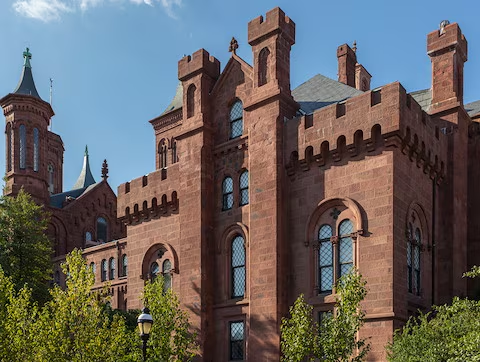
Finally, in 1846, James Smithson’s gift was put to use. It funded what became known as the Smithsonian Institution.
No one doubts that the Smithsonian has become one of America’s enduring treasures. “The Nation’s Attic,” as it’s known, now includes 19 museums that hold 154 million items, nine research centers, and a zoo. They’re spread across Washington D.C., seven states, and the nation of Panama.
Every year, 30 million people walk through the doors of the Smithsonian. Three weeks ago in Washington D.C., my grandson Marco and I were two of them. There is no admission fee, all because a curious chemist gave a gift that has grown almost miraculously.
But first that gift had to be received. And then turned into a gift for the rest of the world.
What do you do if God offers you a gift that seems too good to be true?
First, you say thank-you.
There is no gift like God’s grace. It is his lavish, unconditional, absolutely undeserved posture of love and kindness toward you and me. It cannot be earned. It cannot be deserved. It cannot be reasoned away, because, quite frankly, God relentlessly offers it.
All we can do with the gift of God’s grace is receive it. And then, with God’s help, we do everything we can to transform that gift into a blessing for others.
On our 250th birthday this weekend, Americans have a lot to think about. We have received from God extraordinary provisions of freedom and natural resources – gifts that surpass anything known in human history. What shall we do with this unprecedented liberty and opportunity?
First, we say thank-you. We thank the Giver who has “shed his grace” on America, even if, far too often, we have taken his grace for granted.
Then we resolve that God’s gifts are not, in the end, about us. They’ve come to us because they’re on their way to the next generation, and on their way to the rest of the world.
The very best gifts are not too good to be true.
It’s truer to say they’re too good not to be shared.