
To listen to today’s reflection as a podcast, click here
Each day this month of August we’ll be looking at one of the extraordinary metaphors that the Bible uses to illustrate the nature of our relationship with God.
During most of the 20th century, Malcom Muggeridge was regarded as Britain’s most gifted journalist, satirist, and social commentator.
By his own admission, he threw much of his life away.
He pursued toys. He craved honors. He drank, smoked, and womanized without boundaries. During World War II he served Britain as a spy, even while contemplating the merits of communism. He attempted to take his own life.
Something kept eating at Muggeridge. He yearned for life to mean something.
After personally encountering Mother Teresa’s ministry to the poor of Calcutta, he wrote a book about her life called Something Beautiful for God. It clearly signaled a change in his sense of what mattered. Toward the end of his life, Muggeridge reflected:
“I may, I suppose, regard myself or pass for being a relatively successful man. People occasionally stare at me in the streets. That’s fame.
“I can fairly easily earn enough to qualify for admission to the higher slopes of the Internal Revenue. That’s success.
“Furnished with money and a little fame even the elderly, if they care to, may partake of trendy diversions. That’s pleasure.
“It might happen once in a while that something I said or wrote was sufficiently heeded for me to persuade myself that it represented a serious impact on our time. That’s fulfillment.
“Yet, I say to you – and I beg you to believe me – multiply these tiny triumphs by a million, add them all together, and they are nothing – less than nothing, a positive impediment – measured against one draft of that living water Christ offers to the spiritually thirsty, irrespective of who or what they are.”
That’s transformation.
Malcom Muggeridge got a do-over. He traded his old life, with its fleeting happiness, for the hope of something infinitely more durable.
It is really possible to start life over?
From a certain perspective, the ancient Romans thought so.
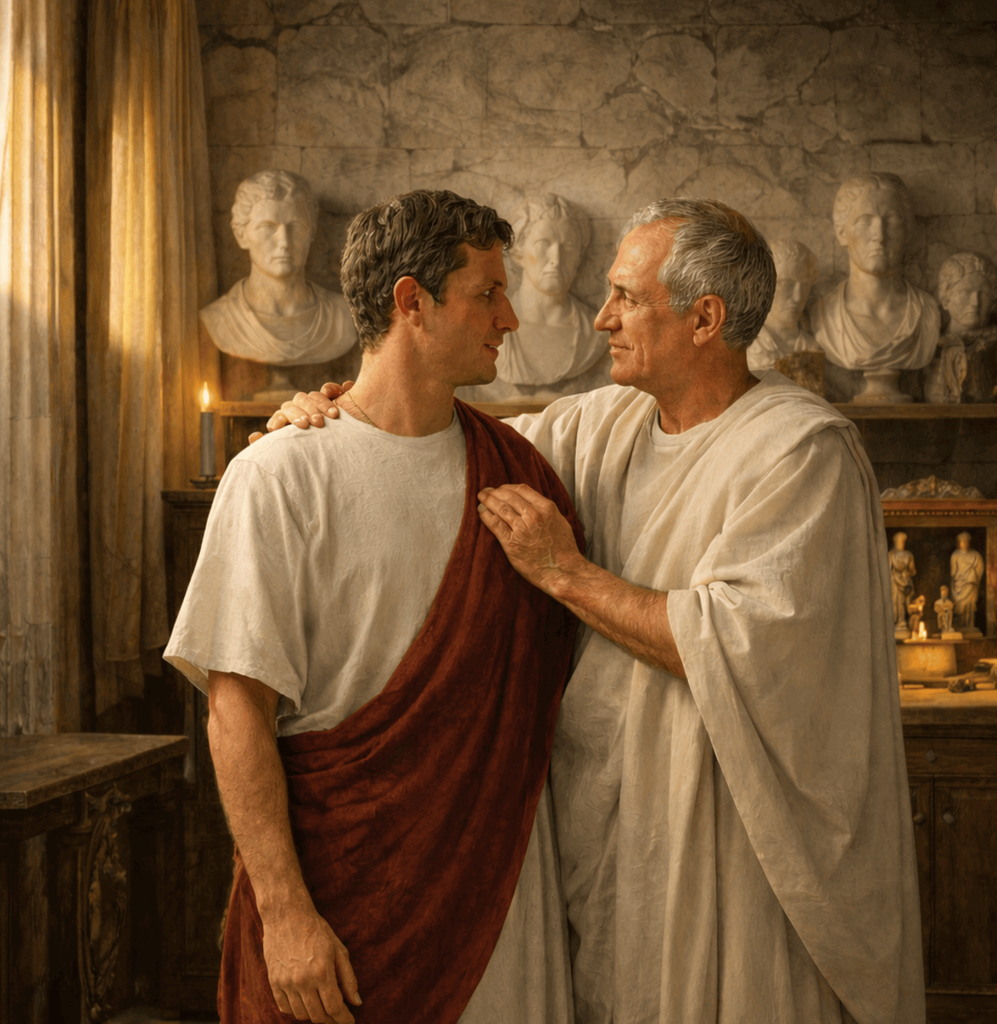
That notion was lived out in the practice of adoption. Bringing another human being into one’s own family – assuming the sum total of their emotional, relational, and financial burdens – is a wonderful reality at any time and any place. But adoption at the height of the Roman Empire – the very time the apostle Paul was writing almost half the books of the New Testament – was something uniquely special.
The chief historian at UNRV.com, a website devoted to exploring ancient Roman practices, asserts that “adoption was at the heart of Roman ideas about continuity, authority and identity.”
When the male head of a Roman household adopted someone as a son (this would typically be a teenager or a young adult), at least three things happened to that young man.
First, he got anew father.
Even though he lost all the rights pertaining to his family of origin, he gained all the rights of his new household. In most cases, that meant stepping into a world of greater prestige and enhanced security regarding resources and opportunities.
Second, he became heir to his newfather’s estate.
Even if his adopted dad gained a dozen additional children by one means or another, nothing would ever affect the certainty of his new inheritance.
Third, his old life was completelywiped out. All of his debts were erased. It was as if he had never had that former life. He was now regarded as a completely new person – blessed with a new name, new identity, and new destiny. It was the ultimate social and relational do-over.
What in the world might prompt such a radical move?
The head of a Roman household may have feared that the family line was about to go extinct. A successor and heir was desperately needed – and there was no time to wait for a child to grow up. There also may have been a desire to redirect inheritance away from “undesirable relatives” (not that such an idea has ever occurred to any of us).
Sometimes Roman adoption was a way of cementing an alliance between prominent families. It could also have served as a means of giving a talented young man “a leg up” in his vocational aspirations. A tradesman or shopkeeper could choose to adopt the next owner of his business.
Did emotion ever come into play?
It did indeed. Personal letters and funerary inscriptions reveal that adopted sons frequently became beloved members of the household.
This is the point at which we begin to grasp one of the most compelling biblical metaphors of our relationship with God:
We are the adopted kids of our Father in heaven.
Paul expresses this powerfully in Romans 8:14-17:
“For those who are led by the Spirit of God are the children of God. The Spirit you received does not make you slaves, so that you live in fear again; rather, the Spirit you received brought about your adoption to sonship. And by him we cry, “Abba, Father.” The Spirit himself testifies with our spirit that we are God’s children. Now if we are children, then we are heirs—heirs of God and co-heirs with Christ…”
Notice that Paul “trades up” one metaphor for something more intimate.
Is it legitimate to say that we are the slaves of God? It is. God is our Master, and we are his servants. But God is also our Father – the one who has adopted us in love, welcomed us into his family, and granted us co-inheritance with Jesus. That metaphor overwhelms the metaphor of mere servanthood.
As God’s adopted children, we have begun an entirely new existence.
You don’t have to be a Malcom Muggeridge – someone who tried everything and discovered it to be dust – to realize that stepping into God’s kingdom is the ultimate spiritual do-over.