
To listen to today’s reflection as a podcast, click here
What’s the last thing a great hotel housekeeper does before stepping out of a room?
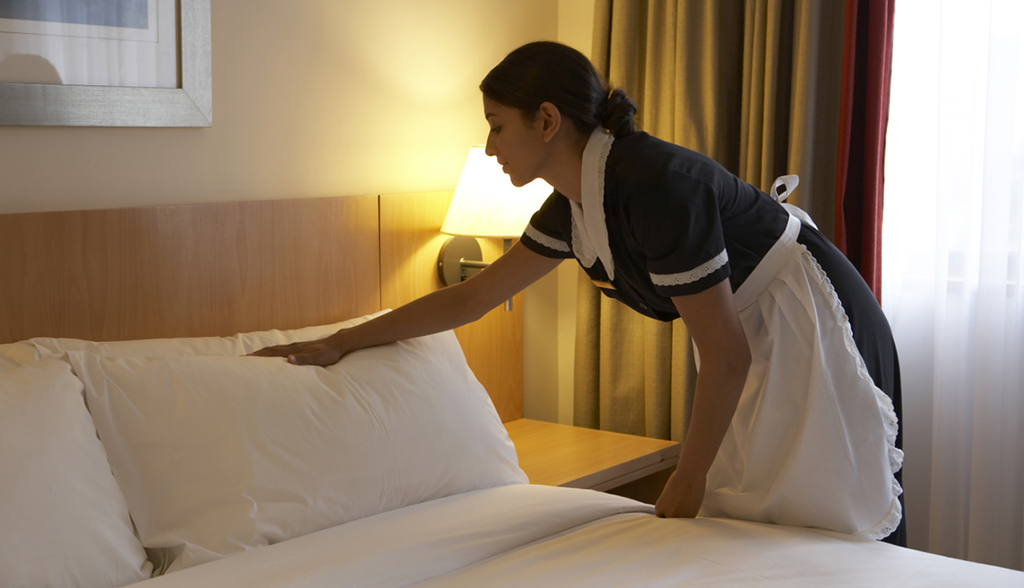
She turns on the ceiling fan and lies down on the bed she has just finished making.
Why in the world does she do this?
“That’s the first thing the guest is going to do after a long, hard day. They’re going to turn on the fan and flop onto the bed. If they look up and see dust fly off the fan, they’ll think the room isn’t clean. That’s why I make sure I get there first.”
That’s one of the fascinating discoveries the Gallup Organization made a few years back when they hosted a focus group of eight exceptional hotel housekeepers. One had been on the job for just 18 months, while another had cleaned the same section of the same hotel for 23 years.
What they all had in common was an observable talent for cleaning rooms.
This is the point at which many of us need a reality check. We’re pretty sure that hotel housekeeping doesn’t require any actual talent, and that no one in their right mind would want to do this soul-crushing job a minute longer than absolutely necessary.
But we’re wrong on both counts.
The researchers in workplace motivation at Gallup discovered that great hotel housekeepers experience enduring satisfaction in their work.
The job is not easy. Every morning they start from scratch. Who knows what kind of human hurricane has blown through each of those rooms the night before, leaving behind a debris field of towels, toiletries, and half-eaten omelets? What rock groups or college rugby teams are on the schedule for tonight?
Gallup asked the great housekeepers if they yearned to get promoted out of such drudgery.
They replied that they loved their work and couldn’t imagine leaving it behind. They knew they would be starting at the bottom of the same mountain every morning, like Sisyphus in the ancient Greek myth. They were well aware they would have to do the same thing 24 hours later. But that very challenge energized them.
Did they see themselves as “front of house” or “back of house”? That’s the classic distinction between hotel staff members who interact directly with the guests and those who are typically out of sight.
“Oh, we’re totally front of house!” they said. Why did they think that? “We are always on stage,” came the answer.
The women went on to describe their opportunities to display creativity, be accountable, and to achieve something tangible every day. “We make a show for our guests.” Unless the families object, they will take the toys the children have left behind for the day and create fanciful scenes to greet them when they return. One of the stuffed animals might have his paw on the remote control, while the others will be sharing a bag of Sour Patch Gummies.
The housekeepers didn’t see their work as a chore to complete. The fact that they got to make a difference in the lives of their guests brought them “strength and satisfaction.”
No one had told them to behave like this. This was simply the way they wanted to live.
Where do you find such superstars? How does a hotel luck out by employing the Shohei Otani of housekeepers?
The Gallup researchers concluded that promoting someone out of a role – a role that most people assume should be left behind at the earliest possible opportunity – can be precisely the wrong move. Instead, managers have the chance to endow every job, big or small, with greater nobility. That might happen through pay raises. Or perhaps by elevating the amount of honor and affirmation each worker receives.
If hotel housekeeping is publicly revered, more talented people will see it as a career choice. Wouldn’t it be great to have a manager with that kind of sensitivity?
Actually, you already have such a boss.
“Whatever you do, work at it with all your heart, as working for the Lord, not for human masters” (Colossians 3:23).
On this Labor Day, as we contemplate the work that God has given to each of us – whether or not it has anything to do with a paycheck or a career or public visibility – we are called to excellence.
What are you facing these days? Is it piles of laundry and dirty dishes, an inbox full of unprocessed accounts, a garden full of weeds, or high-level meetings with opinionated leaders?
Your work matters. Your work is not just a task, but an opportunity to honor the God who himself worked to fashion the heavens and the earth, then assigned humanity’s first couple the opportunity to tend and care for his creation.
Work is worship – that is, a way to say that God is “worth” more than anything and anyone else.
By pursuing excellence in even the smallest tasks, what we do (and how we do it) expresses our conviction that God is our true Boss – the One who deserves the best we can bring to every endeavor.
The next time you flop down on a hotel bed and look up at the ceiling fan, offer a prayer of thanks that someone has worked hard to make your day a little nicer.
Then add a request that both you and that worker might experience the deep joy of serving a Boss who always calls out our very best.