
To listen to today’s reflection as a podcast, click here
Each day this month of August we’ll be looking at one of the extraordinary metaphors that the Bible uses to illustrate the nature of our relationship with God.
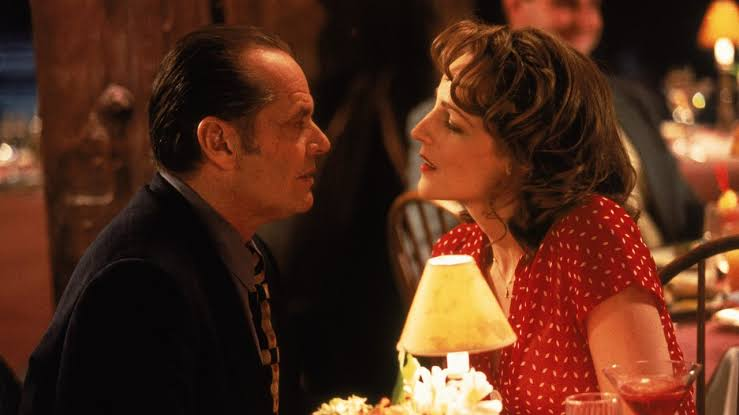
In the 1997 feature film As Good As It Gets, Helen Hunt plays Carol, a single mom with a chronically sick child who stays afloat by working as a Manhattan waitress.
All she wants is someone who will love her. Someone normal.
“Why can’t I have a normal boyfriend?” she complains to her mother. “Just a regular boyfriend, one that doesn’t go nuts on me!”
Her mother answers calmly, “Everybody wants that, dear. It doesn’t exist. There’s no such thing as normal.” As if to prove her mother right, Carol gradually finds herself drawn to an embittered writer named Melvin, played by Jack Nicholson.
Melvin is a mess. Even though he desperately yearns for love, he doesn’t enjoy the company of other people. Afflicted by obsessive-compulsive tendencies, he is afraid to step on sidewalk cracks.
Melvin has almost given up on the hope that his life will ever get better. He sighs to a support group of depressed psychiatric patients, “What if this is as good as it gets?”
No one can stand to serve Melvin at the Manhattan restaurant where he always eats – always at the same table and always with disposable plastic utensils so he won’t risk contamination from previous patrons.
No one except Carol, who begins to see someone worth loving behind his off-putting exterior.
But it’s not easy. In conversation, Melvin doesn’t have much of a filter. Carol, exasperated, asks him, “Do you have any control over how creepy you allow yourself to get?”
In the film’s signature scene they sit down together at an upscale restaurant. Melvin immediately observes how interesting it is that he was required to wear a jacket and tie, while Carol could be served (as he points to her) “in a house dress.”
That’s it. Carol has had enough. She stands up to leave.
As it dawns on him that he has just insulted her, he begs her to stay. “Pay me a compliment, Melvin,” she replies. “I need one.” She then explains, as if to someone who flunked Empathy 101, “A compliment is something nice about someone else.”
Melvin pulls himself together. “I’ve got a really great compliment for you, and it’s true.”
Carol sits down. “I’m so afraid you’re about to say something awful,” she admits.
Melvin launches into some of his personal medical history, and how much he hates pills. “I’m using the word ‘hate’ here… Hate.” This is not going well at all. He meanders. He seems to lose his way. Then he announces that after a conversation with Carol a few weeks earlier, he finally started taking the hated pills the next morning.
Carol is confused. “I don’t quite get how that’s a compliment for me.”
Melvin waits a moment and then clarifies, “You make me want to be a better man.”
After a long pause, Carol says, “That’s maybe the best compliment of my life.”
It’s amazing to watch Helen Hunt’s face as she processes Melvin’s compliment. There’s a reason why she won Best Actress from both the Golden Globes and Academy Awards for this role, and why both groups honored Jack Nicholson as Best Actor as well.
These two performers are pulling back the curtain on our greatest hopes and greatest fears.
What does it mean to love? Will anyone ever love me, really love me, when they find out who I really am? If all of us are living messed-up lives, how can we ever draw close enough to each other to survive without hurting each other in the process?
Love is what makes us want to be better people – even to do what we would rather not do – so that we might experience greater joy and intimacy with those we love.
And now the scariest question: Who goes first?
John the apostle replies, “And this is the kind of love we’re talking about: not that once upon a time we loved God, but that he loved us…” (I John 4:10, The Message).
God goes first. God is one the one who declares that he really loves us, even though he knows who we really are. And he pours his love into our hearts so we can bravely choose to love him and love each other, even at great risk.
And the miracle of such love?
It makes us want to be better human beings.